
Homeowners: 3 Weekend Fixes for Ranch Curb Appeal With No Added Height
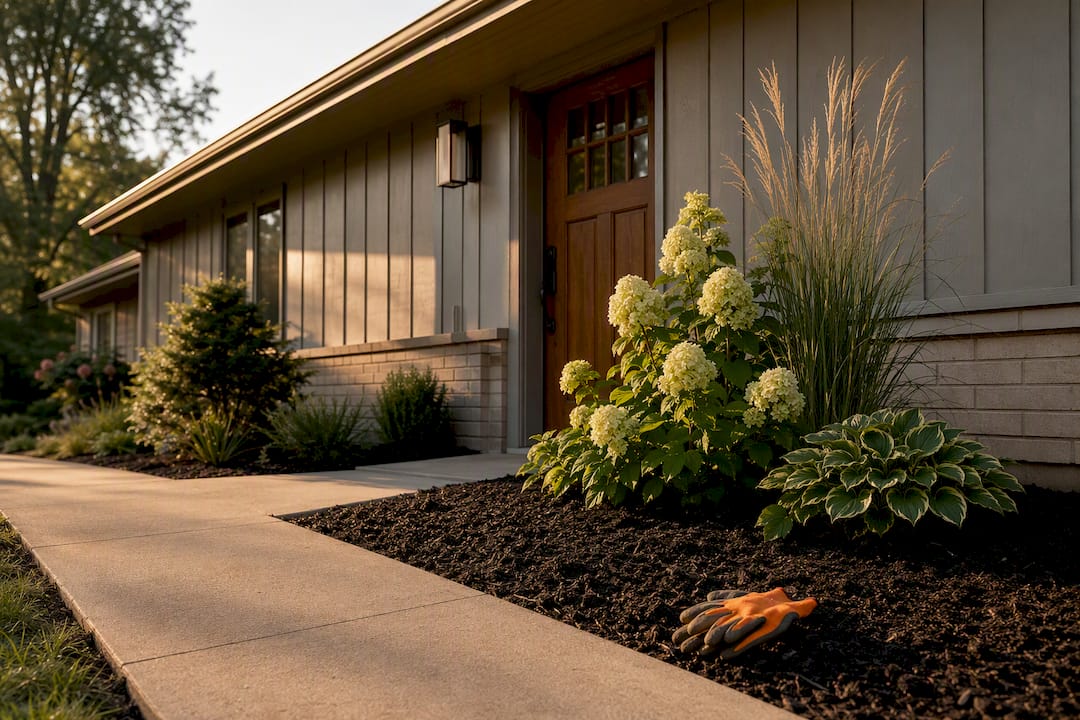
Homeowners: 3 Weekend Fixes for Ranch Curb Appeal With No Added Height
Start by clarifying the entry, layering low-to-tall planting, and calming the garage — those three moves deliver the biggest visual change for ranch proportions. Ranch homes read best when their horizontal lines stay intact, so the fix isn’t adding height. It’s directing the eye toward the front door and away from the driveway, using plants, color, and a few smart placement decisions.
TL;DR:
- Recessing the garage door at least four feet behind the front wall line visually reduces its dominance on the ranch facade.
- Layering plants from low shrubs to taller trees creates vertical interest and breaks the house’s long, flat horizontal lines.
- Fixing the front entry with contrasting paint, a canopy, and well-chosen furnishings draws attention away from the garage and enhances curb appeal.
- Keeping plant heights below window sills and using drought-tolerant native species minimizes maintenance and prevents a neglected appearance.
- Hiring professionals for structural hardscape work, such as grading or walls, ensures proper execution, while DIY-friendly tasks like planting and painting remain accessible.
Table of Contents
- What’s the Fastest Way to Boost Curb Appeal on a Ranch Home?
- How Should You Layer Landscaping on a Long, Low House?
- How Do You Make the Front Door the Focal Point?
- How Do You Keep the Garage From Overpowering the House?
- What Colors and Materials Work Best on a Ranch Facade?
- What Makes a Walkway Feel Welcoming on a Ranch Lot?
- Where Should You Add Lighting and House Numbers?
- What Curb Appeal Mistakes Hurt Ranch Homes Most?
- How Do Landscaping Professionals Approach a Ranch Makeover?
- How GC Signature Outdoors LLC Can Help With Your Ranch Home Project
- Where to Learn More About Ranch Curb Appeal
- Sources
- FAQ
What’s the Fastest Way to Boost Curb Appeal on a Ranch Home?
Ranch houses reward small, well-placed changes over big vertical statements. A Zillow guide on ranch curb appeal points to five moves that consistently work: breaking up horizontal lines, using symmetry, softening corners with curves, adding color and texture, and putting real design attention on the porch. None of that requires a contractor crew or a torn-up yard.
Here’s a weekend-and-small-budget priority order:
- Trim and edit first. Cut back overgrown shrubs, remove dead plants, and refresh mulch beds. This alone changes how “finished” the house looks.
- Group plantings instead of scattering them. Three shrubs clustered near the porch read better than three spread evenly along the foundation.
- Paint the front door a contrasting color. It’s the cheapest way to create a focal point.
- Add a lighting fixture or two. A porch light upgrade and a path light near the walkway change how the house reads after dark.
- Tackle one bigger project this season. Pick either defining the entry, balancing the garage, or fixing the planting bed. One done well beats three done halfway.
Keep plant heights below window sills wherever they sit near glass. Overgrown foundation shrubs are one of the fastest ways to make a ranch look neglected, even when the house itself is in good shape.
Pro Tip: If you only have a Saturday, spend it on mulch and one clean planting cluster by the front door. That single change photographs better than almost anything else you could do in a day.
How Should You Layer Landscaping on a Long, Low House?
A ranch facade is a long horizontal line, and unbroken horizontal lines look flat from the street. The fix is layering plants by height, front to back, so the eye has something to travel across instead of skimming past.
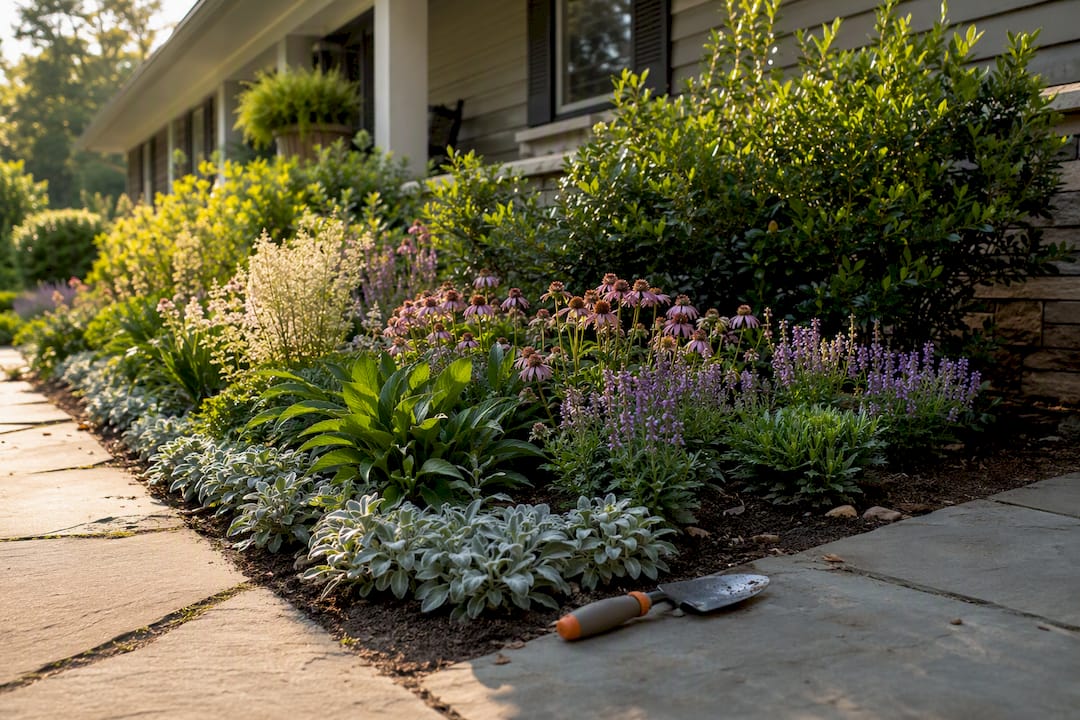
Put low shrubs directly under windows, keeping them well below the sill. Add medium shrubs or ornamental grasses a few feet out, then anchor the corners of the house with a small tree or tall upright shrub. That corner planting does double duty: it frames the facade and breaks the roofline’s straight edge without competing with it. A foundation planting guide from This Old House recommends this exact short-to-tall progression because it creates a vertical counterpoint without overwhelming a low eave line.
Curved bed edges and a gently winding front walkway soften the boxiness that comes standard with most ranch layouts. Straight lines everywhere make the house feel rigid; one curved bed near the entry changes the whole read.
- Keep symmetry loose but intentional: matching planters or shrub pairs on either side of the door work better than mirror-image precision.
- Choose drought-tolerant natives where your climate allows. They cut maintenance and often look better in year three than water-hungry annuals ever did.
- Never plant anything that will reach window height within a few seasons. Check mature size, not nursery size.
Pro Tip: If you’re not sure how tall a shrub gets, look up its mature spread before you buy. A “cute” 18-inch shrub at the garden center can hit 6 feet in five years and block half your window.
For more layout ideas that stay low-maintenance long term, our front yard landscaping guide walks through combinations that hold up season after season.
How Do You Make the Front Door the Focal Point?
On most ranch homes, the garage door is bigger and closer to the street than the front door, which means the eye lands there first unless you redirect it. A small entry canopy, a contrasting door color, and a clearly defined path do that work without adding height that fights the roofline.
- Add a canopy or extended porch roof over the door. Even a modest overhang gives the entry visual weight.
- Paint the door a color that contrasts with the siding. Deep blue, black, or a warm red against neutral siding reads as intentional, not accidental.
- Install porch furnishings that suggest use: a bench, a pair of planters, a doormat that isn’t an afterthought.
- Make sure the house numbers are visible from the street and match your door hardware finish.
- Keep the path from the driveway to the door visually distinct, not just a slab of concrete blending into the drive.
A before-and-after ranch remodel featured by Better Homes & Gardens shows this pattern clearly: a deep porch treatment, one consistent color palette, and coordinated plantings did more for the home’s presence than any structural change.
How Do You Keep the Garage From Overpowering the House?
On a lot of ranch homes, the garage is the single largest visual block on the front elevation, and it often sits closer to the street than the rest of the house. Where the lot allows it, designers recommend recessing the garage door at least 4 feet behind the primary front wall line, which pulls it visually backward even without moving a single wall.
- Paint the garage door the same color as the siding, not a bright contrast, so it recedes instead of announcing itself.
- Choose a simple panel style over heavy glazing or ornate hardware; a busy door pattern draws more attention, not less.
- Add trim only if it matches the rest of the house’s trim scheme, never as a standalone accent.
- Plant a tall shrub or small tree between the garage and the front walkway to break the sightline from the street.
- Align your walkway lighting and planting beds to pull the eye toward the entry, away from the driveway approach.
What Colors and Materials Work Best on a Ranch Facade?
Ranch homes look their best with one consistent siding material and a single restrained accent, not three competing textures fighting for attention. A checklist for updating ranch exteriors backs this up: successful updates reinforce the horizontal profile through aligned lines and consistent materials rather than piling on vertical accents.
- Pick one accent move, whether that’s a stone-clad porch base, a bold trim color, or a wood-clad entry beam, and commit to it fully instead of adding two or three half-measures.
- Use contrasting trim on windows and the roofline to add definition without adding bulk.
- If you have brick, think twice before painting it. Painting brick is close to permanent, and sound brick often looks better updated with new trim, door color, and lighting than covered in paint.
- For door hardware and finish coordination, a makeover guide from One Day Doors & Closets covers how door choices tie the whole facade together.
What Makes a Walkway Feel Welcoming on a Ranch Lot?
The path from driveway to door does more visual work than most homeowners realize. Paths connecting the driveway to the front entry should measure at least 4 feet wide, enough for two people to walk side by side comfortably. Anything narrower feels like an afterthought, even on a small lot.
- Use a material that contrasts with the driveway, such as pavers, brick, or stamped concrete, so the path reads as its own design element.
- A gentle curve toward the entry, rather than a straight shot, slows the eye and makes the approach feel considered.
- Keep steps low-profile with a small landing at the door. Steep or narrow steps look out of place against a low-eave house.
Our walkway width guide breaks down sizing for different lot shapes if you’re planning a full path replacement.
Where Should You Add Lighting and House Numbers?
Layered lighting does more for nighttime curb appeal than a single bright fixture ever will. Combine a porch light, low path lights along the walkway, and uplighting on a corner tree or the facade itself.
- Mount house numbers where they’re visible from the street, ideally lit or reflective, and match the finish to your door hardware.
- Keep garage lighting softer than entry lighting so attention still lands on the door after dark.
- A dimmer accent light on a corner planting draws the eye exactly where you want it.
Our lighting placement guide covers spacing and fixture types in more detail.
What Curb Appeal Mistakes Hurt Ranch Homes Most?
The most common mistake is fighting the ranch’s horizontal form with vertical additions, like fake gables or a tall wainscot band that reads as bolted on rather than original. Ranch design works because the lines are calm and continuous; stacking height onto it usually backfires.
- Don’t replace a single front window without matching head and sill lines across the rest of the facade. Mismatched windows are one of the fastest ways to make a ranch look patched together.
- Avoid piling on materials, like adding stone, then shutters, then new trim, then a new door color all at once with no coordinating plan.
- Skip oversized planters or statuary that compete with the entry instead of supporting it.
Pro Tip: When in doubt, remove one element instead of adding another. Ranch exteriors almost always improve more from editing than from adding.
How Do Landscaping Professionals Approach a Ranch Makeover?
When a professional landscaping company walks a ranch property, the priority order is almost always the same: clarify the entry, build out a planting plan that respects window lines, address the garage’s visual weight, and finish with lighting. That sequence matches what shows up in professional before-and-after work: a deep porch treatment, consistent plantings, and a garage that recedes rather than dominates.
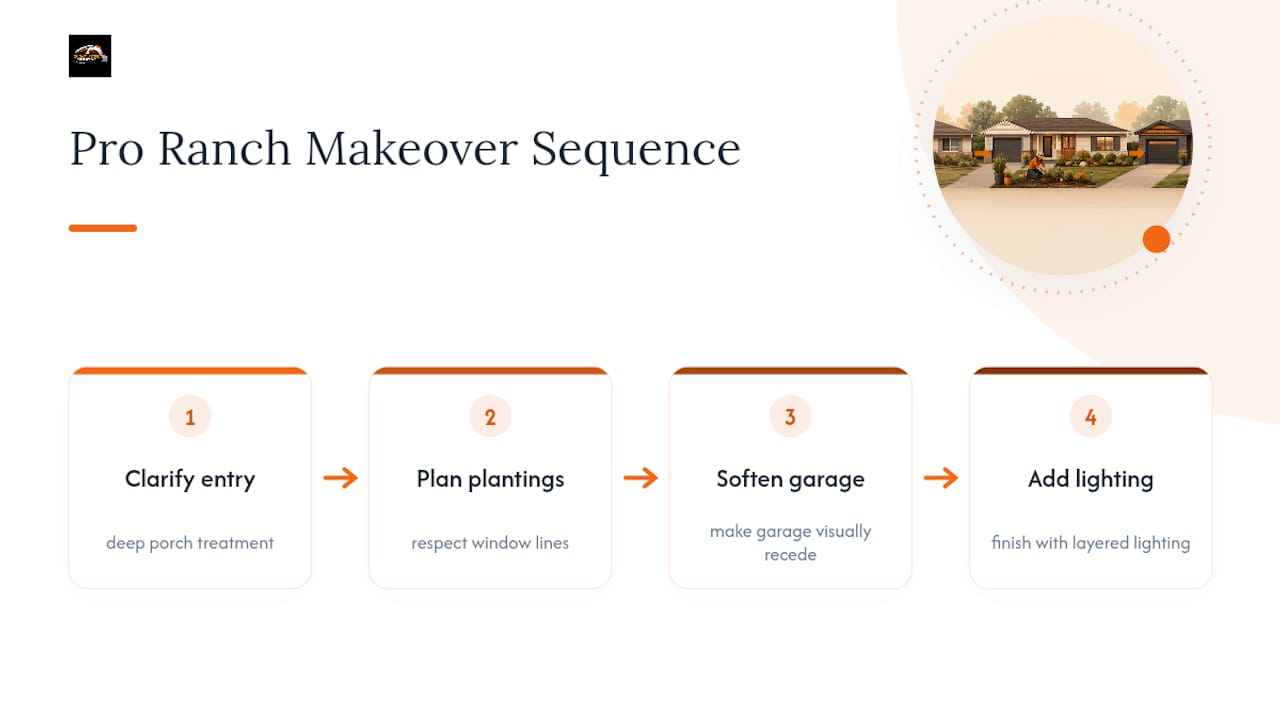
Design-and-build work, like retaining walls, paver walkways, or regrading a bed with drainage issues, is where hiring a pro makes the most sense. Planting and paint are DIY-friendly; structural moves involving grading, walls, or hardscape usually aren’t.
How GC Signature Outdoors LLC Can Help With Your Ranch Home Project
Some landscaping companies give homeowners a single point of contact for the kind of ranch makeover this article covers, instead of juggling a mulch crew, a paver contractor, and a lighting installer separately.

Some teams handle weekly mowing, seasonal cleanups, and mulch installation for the maintenance side of curb appeal, plus landscape design and build work for bigger moves like garage-adjacent planting beds, retaining walls, and paver walkways that widen a tight entry path. If your ranch home needs a coordinated planting plan or a walkway rebuilt to a comfortable width, the design and build team can map that out during a walkthrough. Homeowners further along in a project, like adding a paver patio or fire pit near a newly opened-up entry, can look at the outdoor living design options for what’s possible on a similar lot.
Browse the project gallery for examples of front-yard and hardscape work completed around Smithville, Platte City, and Kearney, then reach out to schedule a walkthrough and get a plan specific to your property.
— GC Signature Outdoors LLC
Where to Learn More About Ranch Curb Appeal
- Ranch house curb appeal (HomeLight) — agent survey data on curb appeal’s selling power.
- 5 ways to boost curb appeal (Zillow) — core technique list.
- Foundation planting basics (This Old House) — layering technique.
- Before-and-after ranch makeover (BHG) — visual gallery reference.
Sources
- Designing paths for your landscaping (HGTV)
- 5 Ways to boost a ranch-style home’s curb appeal (Zillow)
FAQ
Does curb appeal actually sell a house faster?
Real estate professionals widely agree it does. Nearly half of surveyed agents named curb appeal the strongest selling point in their current markets, ahead of many interior upgrades.
How much value does curb appeal add to a ranch home?
There’s no single universal figure since it depends on the market and scope of work, but agents consistently rank exterior presentation among the top factors buyers notice first, which is why entry and landscaping projects tend to have strong returns relative to their cost.
What are the biggest curb appeal mistakes on a ranch home?
The most damaging mistakes are fighting the horizontal roofline with vertical add-ons like fake gables, replacing windows inconsistently so head and sill lines no longer match, and layering too many competing materials onto one facade at once.
Is it cheaper to build a new ranch-style home than to renovate curb appeal on an existing one?
New construction costs vary too widely by region and lot to state a single figure, but most of the curb appeal fixes in this article, like planting, paint, lighting, and path work, cost far less than any new build and can be done in phases.
Should I hire a professional or DIY my ranch home’s curb appeal?
Painting, planting, and lighting are reasonable DIY projects for most homeowners, but grading, retaining walls, and paver walkways involve drainage and structural considerations that a professional crew, such as GC Signature Outdoors LLC’s design and build team, is better equipped to handle correctly.
Recommended
Ready to get started in Kansas City's Northland?
GC Signature Outdoors serves Smithville, Platte City, Kearney, Liberty, and surrounding areas.