
Front Yard Landscaping Ideas: 9 Low-Maintenance Wins
Front Yard Landscaping Ideas: 9 Low-Maintenance Wins
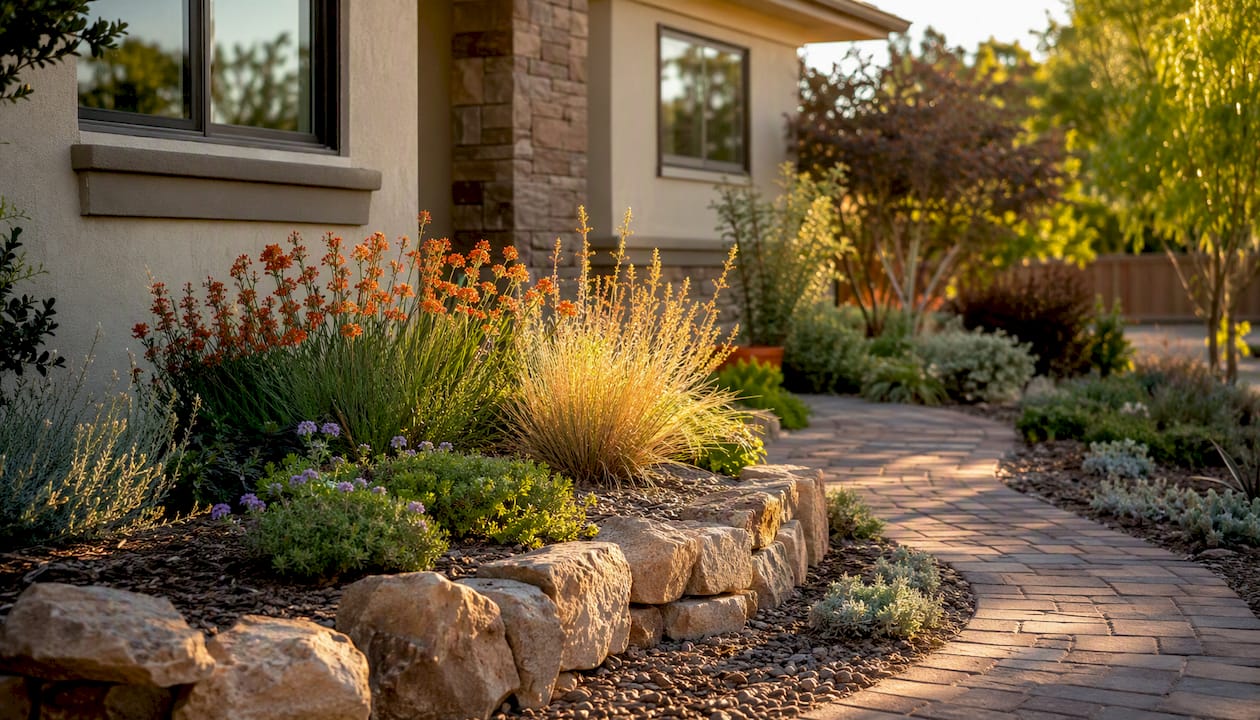
The fastest path to a front yard that actually looks finished: cut back turf, define a clear walk from curb to door, repeat 3 to 5 plants instead of collecting one of everything, add one simple hardscape feature, and mulch every bed 2 to 4 inches deep. That sequence covers curb appeal and long-term upkeep in one move, and it works whether you’re doing the labor yourself or handing a plan to a crew.
Here’s why each piece earns its spot:
- Less lawn means less mowing, less watering, and fewer bare patches to patch.
- A defined entry path (not a diagonal shortcut worn into the grass) makes the whole yard read as designed rather than accidental.
- Repeating the same handful of plants in blocks, instead of scattering singles, is what makes a small yard look intentional from the street.
- Mulch at the right depth suppresses weeds and holds moisture, cutting the two chores homeowners complain about most.
Pro Tip: Install hardscape first and plant second. Skid steers and delivery trucks will crush new perennials, and re-digging a bed to fix a walkway you should have built first wastes both time and plants.
Key Takeaways
A low-maintenance, high-curb-appeal front yard comes from reducing turf, sequencing hardscape before planting, and repeating a small palette of proven plants in mulched beds.
| Point | Details |
|---|---|
| Sequence hardscape first | Install walkways and edging before planting so equipment and materials don’t damage new beds. |
| Test soil and sun before buying plants | A county extension soil test plus a three-time-of-day sun check prevents most plant failures. |
| Mulch 2 to 4 inches deep | This depth suppresses weeds and retains moisture, cutting weekly watering and weeding time. |
| Repeat 5 to 8 backbone plants | Massed, repeated plantings read as intentional from the street, unlike scattered single specimens. |
| Hire out grading and hardscape | GC Signature Outdoors LLC offers turnkey design, hardscape, mulch installation, and mowing for KC Northland homeowners who want one crew handling the whole project. |
Table of Contents
- Front Yard Landscaping Ideas by Style and Yard Size
- How Do You Assess Your Front Yard Before Planting?
- What Design Rules Make a Front Yard Look Professional?
- What Is the Most Low-Maintenance Landscaping for a Front Yard?
- Which Plants Work Best for Front Yard Flower Beds?
- Choosing Hardscape Materials for Walkways and Edging
- What Order Should Front Yard Landscaping Projects Follow?
- Should You DIY Your Front Yard or Hire a Landscaper?
- A Publisher’s Note on Common Front Yard Mistakes
- How GC Signature Outdoors LLC Can Handle the Heavy Lifting
- Sources
- FAQ
Front Yard Landscaping Ideas by Style and Yard Size
Most homeowners get stuck not because they lack ideas, but because they have too many competing ones. Picking a style first narrows every decision after it, from plant choice to mulch color. Here’s a working idea bank organized by look and the yard size it actually suits.
Formal/symmetrical. Mirror-image plantings on either side of the front door, clipped hedges, and a straight center walk. Quick wins: matched boxwood pairs flanking the entry, a single ornamental tree on-center, gravel or brick in a herringbone pattern. Maintenance is medium (hedges need shaping twice a year). Works best on medium to large lots with a centered door; DIY-friendly for the planting, though a mason typically handles the walkway.
Cottage. Loose, layered perennial beds with self-seeding flowers and informal edges. Quick wins: mixed drifts of coneflower and black-eyed Susan, a curved (not straight) front bed line, a picket or low wire edge. Maintenance runs medium to high since cottage beds need some deadheading and thinning. Fits small to medium yards especially well, and it’s one of the more forgiving DIY styles because imperfect spacing reads as charm, not error.
Modern front garden ideas. Clean lines, massed single-species plantings, minimal color palette, architectural plants like agave or ornamental grasses. Quick wins: gravel bands instead of mulch, steel edging for crisp lines, one bold specimen plant near the entry instead of a mixed bed. Maintenance is low once established. Modern reads best on smaller lots where a busy mixed bed would look cluttered; hire out the steel edging and hardscape, DIY the planting.
Mediterranean/xeriscape. Gravel groundcover, drought-tolerant shrubs, and warm-toned hardscape. Quick wins: swap turf for decomposed granite, mass Russian sage or lavender along a sunny walkway, add a terra cotta or concrete container cluster at the entry. Maintenance is low to very low. Best for full-sun yards of any size; this is a strong DIY candidate for the planting if drainage is already decent.
Woodland/shade garden. For north-facing yards or lots with mature trees. Quick wins: liriope as a shade-tolerant edging plant, hosta and fern massed under canopy, stepping-stone paths instead of solid walkways. Maintenance is low to medium. Works on any size lot with real shade; DIY-friendly since shade plants tend to be forgiving.
Rock and mulch minimalist. Not just a fallback for renters. Rock gardens paired with mulch beds cut mowing and watering dramatically while still supporting drought-tolerant plantings that keep curb appeal intact. Quick wins: river rock border along the foundation, mulch islands around specimen shrubs, decorative boulders as focal points. Maintenance is low. Fits any size yard and is one of the easiest DIY weekend projects available.
Pollinator/native meadow-style. Mixed native perennials and grasses in loose masses. Quick wins: swap a turf strip along the sidewalk for yarrow and catmint, let ornamental grasses stand through winter for texture. Maintenance is low once roots establish, though the first year needs regular watering. Best on medium to large lots with room for the plants to spread; strongly DIY-friendly and often the cheapest style to install from seed or small plugs.
Good landscaping isn’t just about looks, either. Appraisal-adjacent research suggests strong landscape design can add roughly 5 to 15% to a home’s perceived value, which is a meaningful return for a weekend of digging and a truckload of mulch.
How Do You Assess Your Front Yard Before Planting?
Skip this step and you’ll be replacing dead plants by August. A proper site read takes maybe 20 minutes spread across a day, plus one soil test.
Start with light. Check the yard three times: mid-morning, noon, and late afternoon, over two or three days if your schedule allows. Note which beds get full sun (6+ hours), partial shade (3 to 6 hours), and full shade. Most plant failures trace back to guessing this wrong rather than watching it.
Next, test your soil. A basic pH and nutrient panel (N, P, K) tells you whether you’re working with the acidic, sandy, or clay-heavy conditions that determine what will actually thrive. County extension offices run these tests for roughly $15 to $25, and most turn results around in a week or two.
Check drainage by digging a hole about a foot deep, filling it with water, and timing how long it takes to drain. Standing water after several hours signals compacted or clay soil that will drown anything but the most water-tolerant species.
Finally, map your view lines and zones from the street, the driveway, and the front door itself, and measure your main walkway. A path narrower than 3 feet feels cramped; most designers recommend 3 to 5 feet for comfortable two-person passage.
- Sun/shade log across three times of day
- Soil test (pH, N, P, K) through your county extension office
- Drainage test with a simple dug hole
- View-line map and walkway width measurement
Pro Tip: Match whatever you plant to your climate before falling in love with it. The USDA Plant Hardiness Zone Map takes thirty seconds to check and prevents the single most common (and expensive) landscaping mistake: buying a plant that can’t survive your winter.
What Design Rules Make a Front Yard Look Professional?
The gap between a yard that looks “done” and one that looks like a collection of individually purchased plants almost always comes down to three principles.
The rule of 3 says group plants in odd numbers: 3, 5, or 7. Odd groupings read as more natural to the eye than even ones, and it’s a genuinely useful shortcut for foundation beds and entry plantings. That said, experienced designers point out it’s a guideline, not a law: formal entries with a centered door often look better with matched symmetrical pairs flanking the walk than with an odd cluster. Once you’re grouping more than 12 or 13 plants, the odd/even distinction stops mattering anyway.
Layer by height and distance from the house: groundcover in front, perennials next, shrubs behind those, and any trees furthest back or as anchor points. This creates depth even in a bed that’s only a few feet deep. Always plant for mature size, not the size the nursery pot suggests, or you’ll be ripping out overcrowded shrubs in three years.
Repetition ties a design together. Designers commonly recommend repeating 5 to 8 backbone plants in blocks across the yard rather than using a dozen different one-off specimens. A yard with three different plants repeated five times each reads as far more intentional from the street than one with fifteen different single plants.
- Odd groupings (3, 5, 7) for informal beds; symmetry for formal, centered entries
- Groundcover → perennials → shrubs → trees, layered by mature height
- 5 to 8 repeating backbone plants instead of one-off specimens
Pro Tip: Stand at the curb and squint. If your eye jumps around without landing anywhere, you likely have too many different plants competing for attention rather than too few.
What Is the Most Low-Maintenance Landscaping for a Front Yard?
Reducing turf and grouping plants by water need, a practice called hydrozoning, does more to cut weekly upkeep than any single product or gadget. Plants with similar water requirements go together, so you’re not overwatering drought-tolerant shrubs to keep a thirsty perennial alive three feet away.
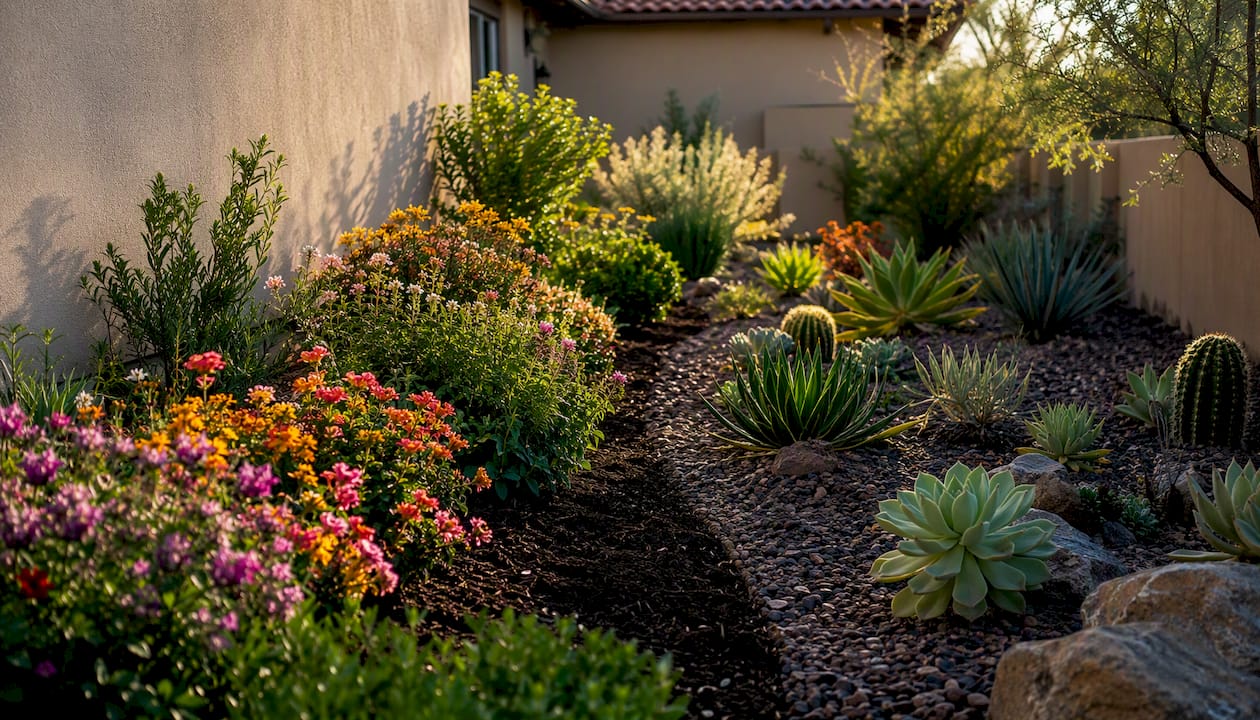
Mulch is the other half of the equation. Extension research recommends 2 to 4 inches of mulch for effective weed suppression and moisture retention, applied to bare soil around plants rather than piled against stems. Pair it with clean metal or stone edging and weeding drops sharply because there’s no loose soil line for seeds to colonize.
Beyond mulch and hydrozoning, a few tactics compound the savings. Swapping a strip of turf along the sidewalk or driveway for gravel or native groundcover eliminates trimming in the awkward spots string trimmers struggle with. No-mow groundcovers like creeping phlox fill space where grass would otherwise need weekly attention. Drip irrigation on a timer, rather than an overhead sprinkler, cuts both water waste and the fungal issues that come with wet foliage.
Homeowners who replace turf sections with mulched perennial beds and mass drought-tolerant plantings typically report a noticeable drop in weekly maintenance time, largely because xeriscaping and native palettes reduce irrigation needs once plants establish.
- Group plants by water need (hydrozones) instead of mixing thirsty and drought-tolerant species
- Apply 2 to 4 inches of mulch and pair it with clean edging
- Replace hard-to-mow turf strips with gravel or groundcover
- Use drip irrigation over overhead sprinklers where possible
Pro Tip: New plantings still need consistent water the first season regardless of how drought-tolerant the species is at maturity. Budget for regular watering through the first summer, then taper off as roots establish.
Which Plants Work Best for Front Yard Flower Beds?
The right plant list depends on the job each plant is doing, not just how it looks in a nursery pot. Think in roles: anchor, structure, mass planting, groundcover, and containers.
Anchor shrubs and small trees carry the yard’s shape year-round. Boxwood is the standard choice for formal structure, holding a clipped shape in sun or partial shade and tolerating a wide range of soils. The Knock Out rose works as a flowering anchor in full sun, blooming from late spring through frost with minimal spraying required compared to older rose varieties.
Structural evergreens and grasses give winter interest when perennials die back. Karl Foerster feather reed grass stands upright through snow and adds vertical movement other plants can’t match; it tolerates full sun to light shade and average soil.
Massed perennials are where most of the color and pollinator activity happens. Coneflower (Echinacea) and black-eyed Susan (Rudbeckia) both thrive in full sun, tolerate drought once established, and self-seed enough to fill in gaps over a couple of seasons. Salvia and yarrow bring long bloom windows and genuine drought tolerance, both preferring full sun and well-drained soil. Russian sage (Perovskia) adds silvery, airy texture and handles poor soil better than almost anything else on this list. Lavender wants full sun and sharp drainage above all else; wet feet in winter kill it faster than cold does. Catmint (Nepeta) is one of the most forgiving mass plantings available, blooming for months in full sun to part shade with almost no pest issues.
Groundcovers and edges finish the front line of a bed. Creeping phlox spreads into a low mat covered in spring blooms and handles full sun to part shade. Liriope works as a grass-like edging plant that tolerates shade better than most groundcovers, making it valuable for north-facing beds. Agave brings architectural drama to hot, dry, full-sun spots, particularly in Mediterranean and modern schemes, though it needs winter protection or container placement outside warmer zones.
Three palettes to start from:
- Sun/dry: Russian sage, salvia, yarrow, and agave massed in odd groupings, mulched with gravel.
- Part shade: Liriope edging, catmint drifts, and a boxwood anchor at the entry corner.
- Formal/evergreen: Matched boxwood pairs, Knock Out rose along a sunny wall, Karl Foerster grass at the corners.
Pro Tip: Buy in odd-numbered groups of the same variety rather than one of each plant on this list. Three coneflowers massed together outperform one coneflower, one salvia, and one yarrow scattered separately, every time.
Choosing Hardscape Materials for Walkways and Edging
Hardscape is the skeleton the planting hangs on, and material choice affects how much upkeep you’re signing up for.
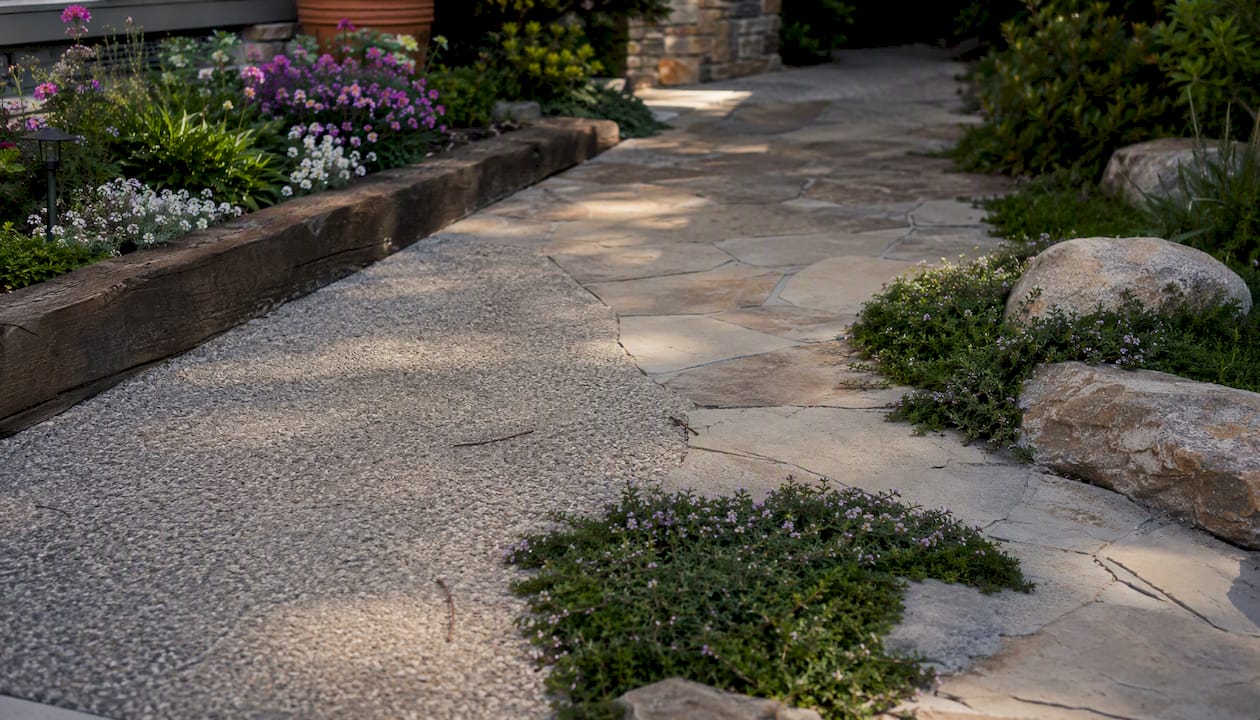
Concrete is durable, low-maintenance, and the most budget-conscious poured option, though a plain slab can look flat without some detailing like a broom finish or exposed aggregate. Brick pavers offer more design flexibility (herringbone, basket weave, running bond) and individual units can be replaced if one cracks, but joints need occasional refreshing to stop weed growth. Natural stone brings the most upscale look and holds up well long-term, though irregular stone requires more careful installation to avoid trip hazards. Gravel is the lowest-maintenance surface to install and the easiest for a DIY weekend, but it migrates over time and needs periodic topping off, plus edging to keep it contained.
Whatever surface you choose, install it before you plant. Heavy equipment, compacted staging areas, and material delivery all threaten young plants, and design professionals routinely sequence hardscape ahead of softscape for exactly this reason.
Edging deserves its own decision. Steel edging gives the cleanest, most modern line and holds up for decades. Aluminum is a lighter-duty, easier-to-DIY alternative with a similar look. Natural stone edging fits cottage and Mediterranean styles better than metal does. Whichever you pick, a defined edge is what keeps mulch, gravel, or grass from creeping into beds and generating the kind of weekly touch-up work that makes yards feel high-maintenance even when the plants themselves aren’t.
- Concrete: durable and affordable, best with a decorative finish
- Brick pavers: flexible patterns, individual units replaceable
- Natural stone: highest-end look, careful installation required
- Gravel: lowest-maintenance surface, needs edging to stay contained
- Steel or aluminum edging for clean, low-upkeep bed lines
What Order Should Front Yard Landscaping Projects Follow?
Sequencing wrong is the single most common reason front yard projects run over budget and take longer than expected.
- Site assessment. Sun mapping, soil test, and drainage check, typically a day or two of observation plus a one to two week wait on soil test results.
- Hardscape installation. Walkways, edging, retaining walls, and any structural elements go in first, while equipment access is still unrestricted.
- Soil preparation. Amend beds based on your soil test results; this is also when you regrade for drainage if needed.
- Planting, largest to smallest. Trees first, then shrubs, then perennials, then groundcover, so bigger equipment and root balls don’t disturb smaller, already-placed plants.
- Mulch and irrigation. Apply mulch immediately after planting to protect new roots, and set up drip lines or soaker hoses before the first heat wave hits.
- Final cleanup and lighting. Install fixtures, sweep hardscape, and do a final walk-through.
DIY homeowners working weekends should expect a small front yard refresh to stretch across 3 to 6 weekends depending on hardscape complexity, while a hired crew can often complete the same scope in 3 to 7 working days. Spring and fall are the best planting windows in most climates; midsummer heat stresses new roots, and planting into frozen or waterlogged soil in winter wastes both time and plants.
Pro Tip: Let new beds settle for a few days after grading before planting. Freshly disturbed soil compacts and shifts, and planting into it too early can leave roots sitting in air pockets once the ground settles.
Should You DIY Your Front Yard or Hire a Landscaper?
Scale and equipment are the real dividing line, not confidence. Planting perennials, spreading mulch, and installing simple edging are reasonable DIY projects for most homeowners. Retaining walls, major grading, drainage correction, and anything requiring a permit belong with a professional, both for safety and because mistakes in these areas are expensive to undo.
If you’re interviewing a landscaper, a short list of questions saves headaches later:
- What’s the realistic timeline for each phase of the project?
- Who handles the hardscape versus the planting, and are they in-house or subcontracted?
- Is there a warranty on plants or hardscape installation?
- Can you see examples of completed local projects?
- How do you sequence hardscape and planting on this specific site?
A landscaper who can answer the sequencing question clearly, without vague hand-waving, is usually a good sign they’ve run this process enough times to avoid the common rework mistakes.
A Publisher’s Note on Common Front Yard Mistakes
The same handful of mistakes show up on front yard after front yard. Overplanting is the biggest one: cramming too many species into a small bed creates visual noise instead of the layered look homeowners are after. The fix is fewer varieties, more repetition.
Wrong plant, wrong exposure is a close second, usually a shade-loving plant baking in full sun or vice versa. Check your sun mapping before you buy, not after.
Poor grading causes water to pool against the foundation instead of away from it, a problem no amount of pretty planting will disguise. And skipping the hardscape-first sequence remains the most avoidable form of expensive rework we see. For anything involving grading, retaining walls, or drainage correction, it’s worth getting a professional opinion before you break ground.
How GC Signature Outdoors LLC Can Handle the Heavy Lifting
Reading a list of ideas is one thing. Getting hardscape sequenced correctly, soil amended to the right specs, and plants installed so they survive their first summer is another. GC Signature Outdoors LLC is the local, turnkey option for KC Northland homeowners who want the plan in this article executed without managing three separate contractors.

Our team handles landscape design and planting, hardscape installation like walkways and paver work, mulch installation with proper bed edging, and the weekly mowing and seasonal cleanups that keep a new front yard looking as good in year two as it did on installation day. Because we’re a family-run crew working with professional-grade equipment, you get one point of contact for the whole project instead of coordinating a designer, a paver installer, and a mowing service separately.
If you’re ready to move past the idea stage, browse our landscape design and planting services or view completed front yard transformations in our project portfolio for inspiration specific to KC Northland homes. Reach out for an estimate and we’ll walk your site with you before anything gets planted.
Sources
- Using mulch in the garden — Iowa State University Extension
- County extension testing services — University of Georgia Extension
- USDA Plant Hardiness Zone Map — USDA (ARS)
- Low-maintenance front yard landscaping ideas with rocks and mulch — HGTV
FAQ
What Is the Rule of 3 in Landscaping?
The rule of 3 groups plants in odd numbers (3, 5, or 7) because odd groupings read as more visually balanced than even ones. It works best for informal foundation beds and entry plantings; formal, symmetrical entries often look better with matched pairs instead.
What Is the Most Low-Maintenance Landscaping for a Front Yard?
Reducing turf, grouping plants by water need, and applying 2 to 4 inches of mulch with clean edging cuts weekly watering and weeding more than any single product change. Massed drought-tolerant perennials and evergreen structure add curb appeal without extra upkeep.
How Do You Properly Landscape a Front Yard?
Start with a site assessment (sun, soil, drainage), then install hardscape, prep soil, plant largest to smallest, and finish with mulch and irrigation. Following that order, rather than planting first, prevents the rework that comes from equipment or grading damaging new beds.
Do I Need a Soil Test Before Planting?
A basic pH and nutrient test from your county extension office, typically $15 to $25, tells you what amendments your beds actually need. Skipping it often means guessing at fertilizer and lime, which can do more harm than good.
Should I Hire a Professional for Front Yard Landscaping?
Simple planting, mulching, and edging are reasonable DIY projects, but grading, drainage correction, and retaining walls generally call for a professional. GC Signature Outdoors LLC handles design, hardscape, and planting as a single turnkey service for homeowners who’d rather not manage multiple contractors.
Recommended
Ready to get started in Kansas City's Northland?
GC Signature Outdoors serves Smithville, Platte City, Kearney, Liberty, and surrounding areas.