
Low Maintenance Landscaping for Homeowners: A Starter Plan
Low Maintenance Landscaping for Homeowners: A Starter Plan
TL;DR:
- Implementing native plants, durable hardscape, and smart irrigation significantly reduces yard maintenance over time.
- The initial one to three years require active care to establish the landscape, after which it largely takes care of itself.
The five moves that cut yard upkeep the most are reducing lawn area, choosing climate-adapted native plants, adding durable hardscape, installing smart irrigation, and grouping plants into hydrozones with a mulch layer. Do those five things and you have addressed the root cause of most weekend yard work.
Do this first: Walk your yard and mark every patch of turf you never actually use. That’s your starting point.
Here’s the short version of what the playbook looks like:
- Replace unused turf with groundcovers, gravel, or hardscape
- Choose native plants matched to your soil and light conditions
- Install permeable pavers or natural stone for patios and paths
- Add drip irrigation with a smart controller
- Mulch all beds to 2–3 inches and group plants by water need; most native beds become low-maintenance after one to three years, with prairie plantings typically taking 2–3 years to fill in and suppress weeds.
Low maintenance landscaping is not a style choice. It’s a design and plant-selection approach that replaces high-upkeep turf and mismatched plants with climate-adapted species, purposeful hardscape, and smarter irrigation. The term you’ll also see used is “sustainable landscaping” or “low-input landscaping,” and those mean roughly the same thing: less chemical input, less water, less weekly effort.
Pro Tip: Buffalo grass, a Missouri native, needs much less water per week compared to conventional turf, and it matures to a height that means mowing becomes optional rather than weekly.
The catch? Low maintenance is front-loaded. The first one to two years require real attention. After that, a well-designed yard mostly takes care of itself.
Table of Contents
- How the right design strategy actually cuts your weekly workload
- Which plants actually stay low maintenance in your yard?
- Hardscape and surface choices that reduce long-term upkeep
- Irrigation systems and automation that save time and water
- What ‘low maintenance’ actually costs you up front: the establishment timeline
- How to adapt this playbook to your U.S. climate region
- A 6-step plan to convert part of your yard this season
- Key Takeaways
- GC Signature Outdoors LLC can build your low-maintenance yard for you
- FAQ
How the right design strategy actually cuts your weekly workload
The biggest maintenance savings don’t come from any single plant or product. They come from design decisions made before anything goes in the ground. Get these right and you’re solving the problem at the source.
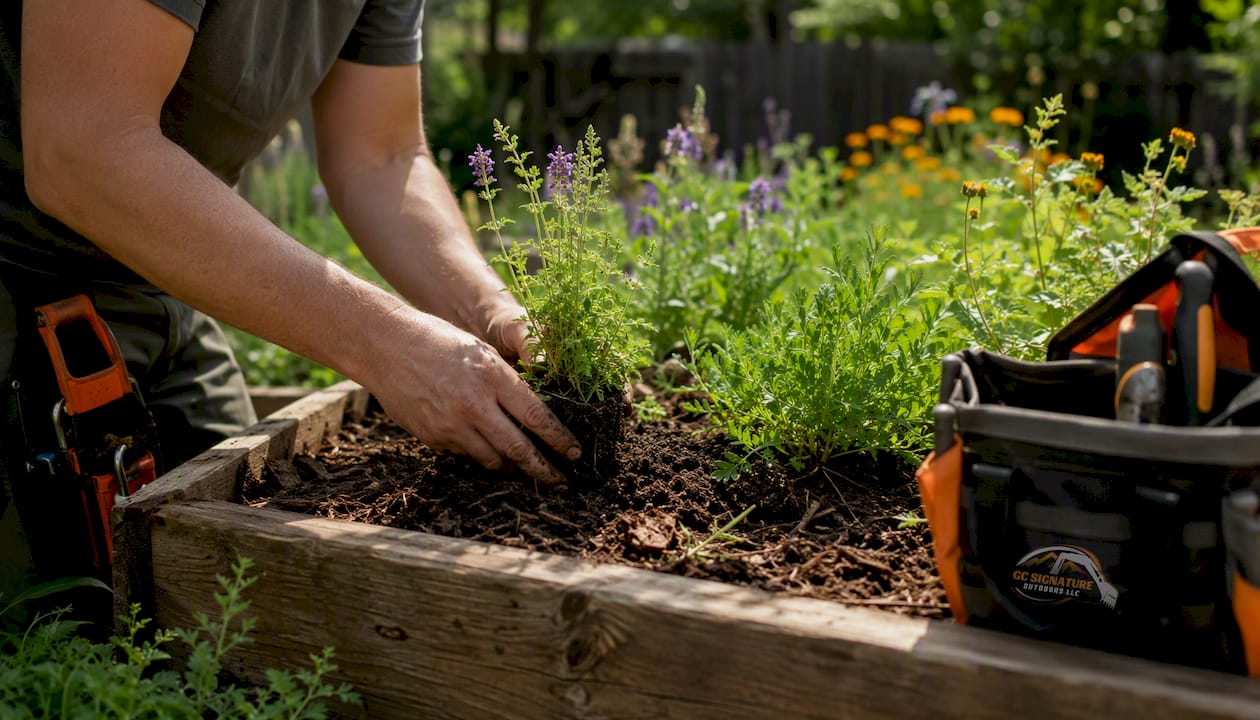
Right plant, right place is the single most effective principle in easy care gardens. A plant adapted to your existing light, soil, and moisture conditions doesn’t need coaxing. It doesn’t need extra water, extra fertilizer, or rescue pruning after a bad winter. The University of Minnesota Extension frames it plainly: matching plant needs to site conditions reduces maintenance and improves longevity. That’s not a platitude. A shade-loving shrub planted in full sun will struggle every single season, and you’ll spend years trying to compensate for a five-minute decision.
Reduce turf wherever you can. Lawn is the most labor-intensive surface in any yard. It needs mowing, edging, fertilizing, aerating, and watering on a schedule that doesn’t stop. Replacing even a third of your turf with native groundcovers, mulched beds, or hardscape removes a proportional share of that recurring work.
Mass plantings and living mulch do double duty. Dense plantings of a single species crowd out weeds by shading the soil and competing for resources. A block of prairie dropseed or Pennsylvania sedge along a fence line is far easier to maintain than a mixed border with a dozen different species, each needing different timing and technique.
Front-load your site prep. Grading, drainage fixes, weed eradication, and soil amendment done before planting prevent the problems that generate the most maintenance later. Standing water kills plants. Persistent weeds outcompete new plantings. Skipping this step is the most common reason a “low maintenance” yard turns into a high-maintenance one.
Pro Tip: The most common rookie mistake is overplanting at installation to get that “full” look immediately. Plants need room to mature. Crowded plants compete, require more pruning, and are more disease-prone. Plant at mature spacing and mulch the gaps.
Which plants actually stay low maintenance in your yard?
Plant selection is where most homeowners either win or lose the maintenance battle. The goal is to match plant function to site conditions, then choose species that handle your regional climate without intervention.
Native plants are the foundation of any genuinely low upkeep garden design. In Missouri and the broader Midwest, natives evolved with local clay soils, summer heat, and variable rainfall. After establishment, they typically need no supplemental irrigation and no fertilizer. The Missouri Department of Conservation is direct about this: native plants handle local conditions with minimal supplemental care after they’re established.
Here’s how to think about plant roles and which types fill them:
- Structure and year-round form: Evergreen shrubs (native viburnums, inkberry holly) and ornamental grasses (switchgrass, little bluestem) give the yard bones in every season without demanding much back.
- Season-long interest: Long-lived perennials like coneflower (Echinacea), black-eyed Susan, and prairie blazing star bloom in succession and return reliably for years.
- Groundcover and weed suppression: Pennsylvania sedge, wild ginger, and creeping phlox form a dense mat that outperforms repeated mulch applications for long-term weed control.
- Dry or sunny spots: Buffalo grass for turf areas, sedum varieties, and native prairie dropseed handle drought without complaint.
- Shade and moist areas: Wild ginger and native ferns thrive where other plants fail, eliminating the need to fight the site.
Pro Tip: Mass a single species in groups of 5–9 plants rather than scattering individuals. You prune by block instead of plant-by-plant, weed control is simpler, and the design reads as intentional rather than accidental.
Hardscape and surface choices that reduce long-term upkeep
Hardscape is where you trade recurring maintenance for a one-time installation. Done right, a paver patio or gravel path requires almost nothing from you for years. Done wrong, it heaves, sinks, and becomes a project.
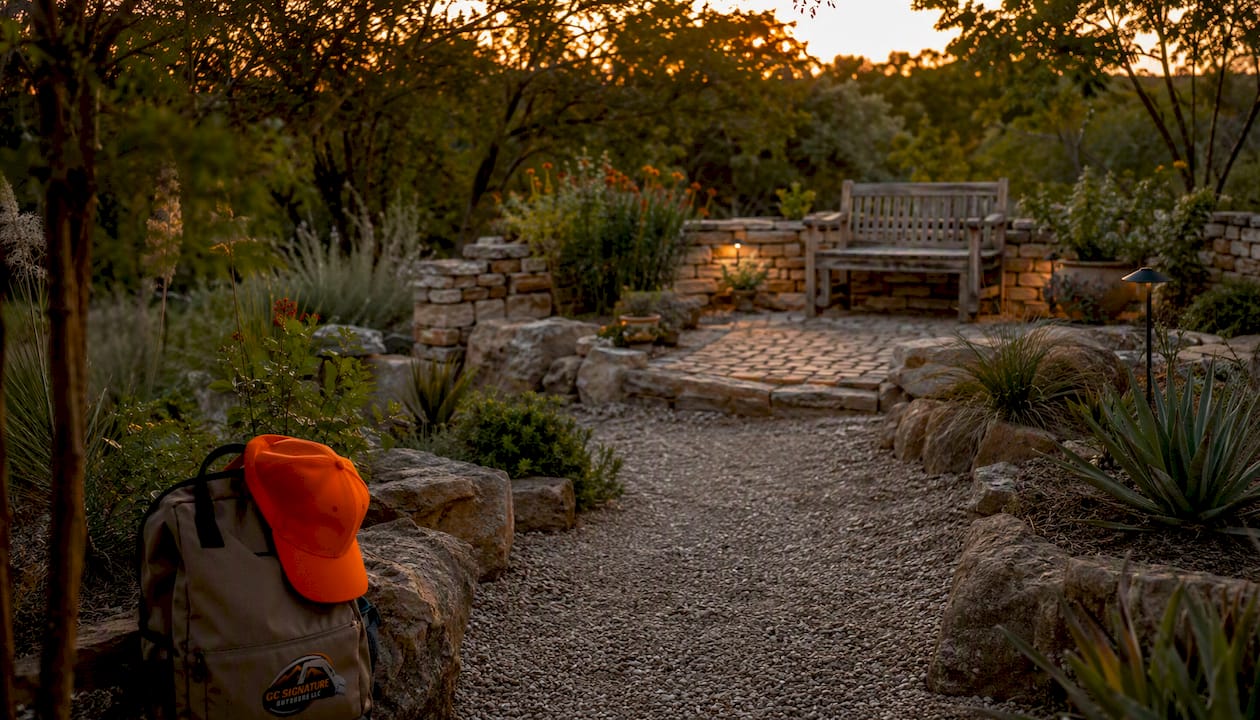
In freeze-thaw climates like the KC Northland, permeable pavers and natural stone installed on a proper compacted base consistently outperform wood decks over time. Wood absorbs moisture, expands and contracts with temperature swings, and needs staining or sealing every few years. A well-set paver patio on a gravel and sand base handles freeze-thaw cycles without heaving and needs little more than occasional joint sand replenishment.
Surface options and their maintenance realities:
- Permeable pavers: Excellent for patios, paths, and driveways. Allow water infiltration, resist heaving, and are repairable without replacing the whole surface. See how they compare to poured concrete in this pavers vs. concrete guide.
- Natural stone (flagstone, limestone): Durable and low-maintenance once set. Irregular shapes require more installation skill but last decades.
- Decomposed granite or gravel: Low cost, good drainage, and works well in dry garden beds or informal paths. Needs occasional top-dressing and edging to stay contained.
- River rock and mulch alternatives: Useful around trees and in beds where you want to eliminate mowing. River rock doesn’t break down like wood mulch, so it’s a longer-term solution.
- Wood decks: Still a good choice for elevated spaces or specific aesthetic goals, but budget for maintenance. Composite decking reduces that burden significantly compared to pressure-treated lumber.
Drainage deserves its own mention. Resolving standing water in the design phase prevents erosion, soggy lawn patches, and plant failure. A French drain or regraded slope added during installation costs far less than fixing a failed planting bed two years later.
Pro Tip: Before any hardscape goes in, check that your grading directs water away from the foundation and toward a drainage point. Proper base work and grading is often the difference between a low-maintenance installation and one that needs repairs every spring.
Irrigation systems and automation that save time and water
Watering is the task that most homeowners either overdo or underdo. Automation solves both problems, and hydrozoning makes automation actually work.
Quick comparison of irrigation options:
- Drip irrigation: Delivers water directly to the root zone. Minimal evaporation, low pressure, and ideal for shrub beds, perennial borders, and vegetable gardens. Reduces water use significantly compared to overhead spray.
- Efficient spray heads (rotary nozzles): Better than older fixed spray heads for lawn areas. Apply water slowly enough for the soil to absorb it, reducing runoff.
- Smart controllers: Connect to local weather data and adjust run times automatically. Skip watering after rain, run longer during heat waves. Worth the upfront cost for anyone with an in-ground system.
- Rain barrels: Low-tech supplement for hand-watering containers and new plantings. Not a substitute for a full irrigation system but useful for reducing tap water use.
Hydrozones are the organizing principle behind efficient irrigation. Group plants with similar water needs in the same zone, and your controller can water each zone on its own schedule. A drought-tolerant native bed and a newly seeded lawn patch have completely different needs. Running them on the same timer means one is always over- or under-watered. Grouping plants by shared water needs makes irrigation predictable and cuts the time you spend troubleshooting.
Installation checklist for a new irrigation system:
- Site assessment: map sun/shade zones, soil type, and existing drainage
- Hydrozone layout: group plants by water need before drawing valve zones
- Controller selection: choose a Wi-Fi smart controller compatible with local weather data
- Valve and head placement: minimize overlap, avoid spraying hardscape
- Rain sensor or soil moisture sensor: required in most municipalities and prevents overwatering
- Pressure regulation: install a pressure regulator to protect drip emitters
Pro Tip: Winterize your irrigation system every fall before the first hard freeze. Blow out the lines with compressed air to prevent cracked pipes and emitters. In the KC Northland, that means getting it done before mid-October.
What ‘low maintenance’ actually costs you up front: the establishment timeline
The phrase “low maintenance” misleads a lot of homeowners into thinking the yard will take care of itself from day one. It won’t. The first one to three years are the most demanding, and skipping that work is exactly how a low-maintenance design turns into a weed-filled disappointment.
Year one is about survival and suppression. New plantings need consistent watering (typically once or twice a week, depending on rainfall and temperature) until roots are established. Mulch applied at 2–3 inches at planting time does the most work here: it holds soil moisture, moderates temperature swings, and smothers weed seeds. The Missouri Botanical Garden identifies mulch as the single most cost-effective maintenance tool for new beds.
“Low maintenance does not mean no maintenance. Real low-maintenance comes after years of correct initial work.” — Missouri Botanical Garden
Typical establishment timeline:
| Plant Type | Time to Low-Maintenance Maturity |
|---|---|
| Annual groundcovers | 1 season to suppress weeds |
| Perennials (coneflower, black-eyed Susan) | 1–2 years to fill in and self-sustain |
| Native shrubs and evergreens | 2–3 years to establish deep roots |
| Prairie grass and native grass mixes | 2–3 years to suppress weeds effectively |
Prairie plantings typically need 2–3 years to reach the density that crowds out weeds and reduces intervention. That’s not a flaw in the design. It’s how perennial root systems work.
Seasonal checklist for years 0–3:
- Spring: Pull any winter annual weeds before they set seed; refresh mulch to 2–3 inches; check irrigation heads and drip emitters
- Summer: Water new plantings during dry spells; spot-treat any aggressive weeds; avoid heavy pruning on first-year shrubs
- Fall: Cut back spent perennials (or leave seed heads for birds); add a thin layer of compost to beds; mark any drainage issues to fix in spring
- Year 2–3: Reduce supplemental watering as plants establish; begin light pruning to shape shrubs; assess which plants are thriving and which need replacement
Pro Tip: Before you plant anything, kill existing weeds thoroughly. Smother with cardboard and mulch for a full season, or use a targeted pre-emergent. Planting into a weedy bed guarantees years of hand-pulling.
How to adapt this playbook to your U.S. climate region
The same principles apply everywhere, but the plant palette and material choices shift significantly by region. Here’s how to adjust.
Midwest (KC Northland / Missouri): Clay soils and freeze-thaw winters are the defining constraints. Native plants adapted to Missouri’s clay outperform imported species without amendment. Choose permeable pavers over wood decks for any hardscape exposed to winter. Use hydrozones to manage the feast-or-famine rainfall pattern: wet springs, dry Augusts. Little bluestem, prairie dropseed, and native viburnums are workhorses here.
Pro Tip for Midwest: Check your USDA Plant Hardiness Zone at planthardiness.ars.usda.gov before buying any plant. The KC Northland sits in Zone 6a–6b, which rules out many plants marketed nationally as “cold-hardy.”
South and Florida: Heat, humidity, and occasional hurricanes shape every choice. Prioritize salt-tolerant and drought-tolerant natives once established. High mulch rates (3–4 inches) reduce evaporation in summer heat. Choose low-profile, flexible plant forms that don’t become projectiles in high winds.
West and California: Drought is the primary constraint. Native California plants (manzanita, California fescue, ceanothus) combined with gravel mulch and drip irrigation form the backbone of any waterwise design. Wildfire-aware planting means keeping highly flammable plants away from structures and maintaining defensible space with low-fuel groundcovers.
Northeast: Cold hardiness and freeze-thaw cycles drive material choices. Select perennials rated to Zone 4 or 5 for reliability. Evergreen structure (arborvitae, inkberry, native hollies) carries the yard through long winters. Use natural stone or quality concrete pavers on a deep gravel base to handle frost heave.
A 6-step plan to convert part of your yard this season
You don’t have to redo everything at once. Start with one section and build from there. Here’s the sequence that makes the most sense.
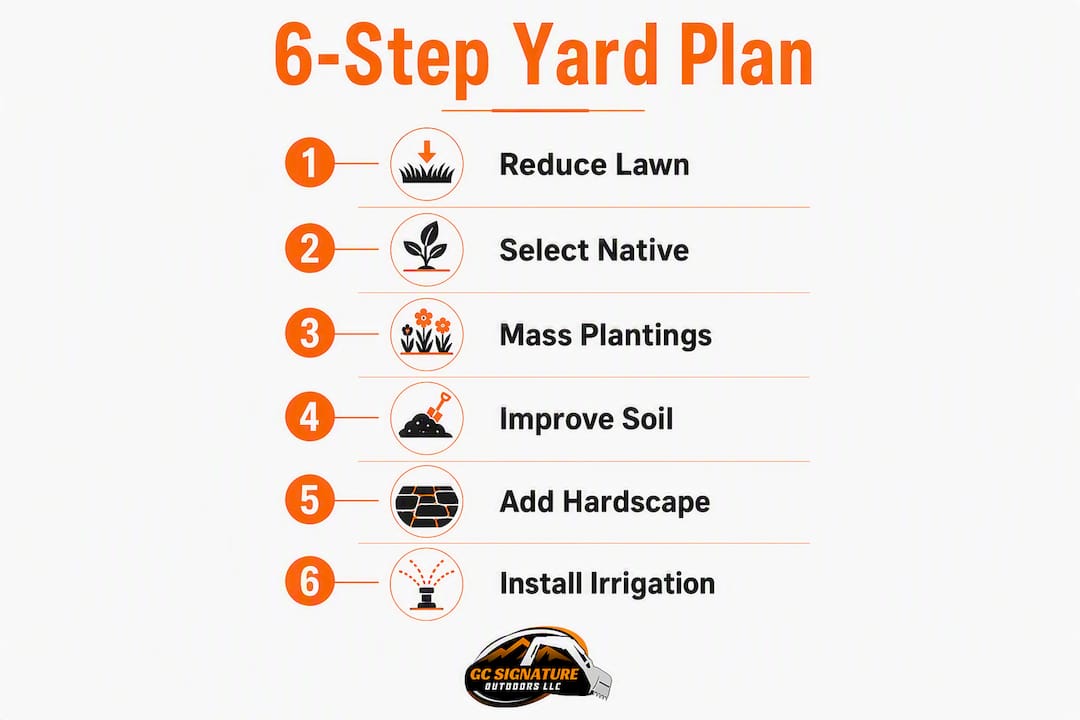
- Site assessment: Walk the yard and note sun exposure, drainage patterns, soil type, and which areas you actually use. Mark problem spots (standing water, bare patches, overgrown shrubs).
- Reduce turf: Identify lawn areas that serve no functional purpose. Target those first for conversion to groundcovers, mulched beds, or hardscape. Aim to keep turf only where it’s actively used for recreation or foot traffic.
- Plan your hardscape: Decide on paths, patios, and edging before planting. Hardscape defines the structure that plants grow around. Getting this right first prevents replanting later.
- Choose your plant palette: Select 3–5 species per zone based on your site conditions and USDA hardiness zone. Prioritize natives and long-lived perennials. Mass each species in groups of 5–9.
- Install irrigation and mulch: Set up drip zones for new beds before planting. Lay cardboard and mulch in areas you’re not planting yet to suppress weeds while you work in phases.
- Monitor the first two years: Water new plantings through dry spells, pull weeds before they set seed, and note what’s thriving. Adjust the plant palette based on what you observe.
**Do this first this weekend: ** Pick one 10-foot section of lawn edge you never use and smother it with cardboard topped with 4 inches of wood chip mulch. That’s the first step toward a no-mow zone, and it costs almost nothing.
Cost factors to plan for (no dollar figures here):
- Materials: pavers, gravel, mulch, plants, and irrigation components
- Labor: excavation, grading, and base preparation for hardscape
- Drainage fixes: French drains or regrading if standing water is present
- Irrigation installation: controller, valves, and emitters
For design help and drainage assessment, GC Signature Outdoors LLC’s landscape design team works with homeowners in Smithville, Platte City, Kearney, and surrounding KC Northland communities.
Key Takeaways
Low maintenance landscaping works because it replaces recurring labor with smart upfront design: native plants, durable hardscape, and automated irrigation matched to your regional climate.
| Point | Details |
|---|---|
| Start with turf reduction | Replace unused lawn with groundcovers or hardscape to cut the biggest source of recurring work. |
| Native plants are the foundation | Climate-adapted natives need minimal water and no fertilizer after establishment. Most native perennials and shrubs fill in within 1–2 years, while prairie grass mixes typically require 2–3 years to reach a self-sustaining, low-maintenance state. |
| Establishment is front-loaded | Consistent watering, mulching, and weed control in years 0–3 determine long-term success. |
| Hydrozones cut irrigation time | Group plants by water need so each zone runs on its own schedule without overwatering. |
| GC Signature Outdoors LLC | Serves KC Northland homeowners with design, paver patios, mulch installation, and native planting. |
What homeowners should realistically expect
Most homeowners underestimate how much the first season matters. The yards that end up genuinely low maintenance are the ones where someone invested real attention in year one: proper grading, thorough weed removal, correct plant spacing, and consistent watering until roots took hold. The yards that don’t make it are usually the ones where those steps got skipped in the rush to “get it done.”
At GC Signature Outdoors LLC, the projects that hold up best over time share a common thread: the invisible work was done right. Proper base preparation under pavers, drainage addressed before planting, and plants selected for the actual site conditions rather than what looked good at the nursery. A paver patio and native bed installation in Smithville, for example, typically reduces the mowing footprint significantly while adding a usable outdoor space that requires almost no seasonal upkeep beyond a mulch refresh each spring.
The expectation to set: your yard will look better and require less work by year three. Getting there takes a real first year.
GC Signature Outdoors LLC can build your low-maintenance yard for you
Designing a low-maintenance yard is straightforward on paper. The hard part is the execution: grading the site correctly, sourcing the right plants for KC Northland clay soils, setting pavers on a base that won’t heave after the first hard freeze, and installing irrigation that actually runs on a smart schedule.

GC Signature Outdoors LLC handles all of it for homeowners in Smithville, Platte City, Kearney, and the surrounding KC Northland area. The services map directly to this guide: landscape design and native planting, paver patios and outdoor living spaces, mulch installation and bed edging, and ongoing lawn care for homeowners who want a maintained yard without managing it themselves. Every project uses professional-grade materials and equipment, and the team handles design through installation so you’re not coordinating multiple contractors.
Ready to see what’s possible? Browse the project gallery or reach out to schedule a consultation.
Useful sources for further research
These resources are worth bookmarking if you want to go deeper on plant selection, hardiness zones, or regional guidance:
- Native Plants for Your Landscape — | Missouri Department of Conservation: Missouri-specific native plant guidance, including species suited to clay soils and low-water conditions.
- USDA Plant Hardiness Zone Map — Enter your zip code to find your exact hardiness zone before purchasing any perennial or shrub.
- Lawns and Landscapes — | University of Minnesota Extension: Research-backed guidance on sustainable landscape design and plant-to-site matching for northern climates.
For local plant lists and site-specific design help in the KC Northland, the GC Signature Outdoors LLC design page is a good starting point.
FAQ
What is the lowest maintenance landscaping?
The lowest maintenance approach combines native plants matched to your site conditions, a reduced lawn area, durable hardscape (pavers or natural stone), and drip irrigation with a smart controller. After a 1–3 year establishment period, this type of yard requires minimal weekly intervention.
What is no-maintenance landscaping called?
It’s commonly called xeriscaping when the focus is on drought tolerance and water conservation, or sustainable landscaping when the emphasis is on native plants and reduced inputs. True zero-maintenance doesn’t exist, but well-designed native and hardscape yards come close after establishment.
What is the least expensive way to landscape a yard?
Replacing turf with native groundcovers and wood chip mulch is typically the lowest-cost starting point. Native groundcovers establish quickly and suppress weeds without the ongoing cost of mowing, fertilizing, and watering that conventional lawn requires.
What is the rule of 3 in landscaping?
The rule of 3 is a design principle suggesting plants look most natural when grouped in odd numbers, with three being the minimum. It applies to color, texture, and plant mass: repeating a combination of three elements (a tall grass, a mid-height perennial, a low groundcover) throughout a bed creates visual rhythm without looking cluttered.
How long does it take for a low-maintenance yard to actually become low maintenance?
Most perennials and native shrubs become low maintenance in 1–2 years, while prairie grass mixes typically require 2–3 years to reach maturity and suppress weeds effectively. The establishment phase demands consistent watering and weed control, but the workload drops sharply once plants fill in.
Recommended
Ready to get started in Kansas City's Northland?
GC Signature Outdoors serves Smithville, Platte City, Kearney, Liberty, and surrounding areas.