
KC Northland: 8 Slope Landscaping Ideas That Work With Your Grade
KC Northland: 8 Slope Landscaping Ideas That Work With Your Grade
Before you plant anything on a slope, stabilize the soil and manage water. That comes first, always. Once erosion is under control, pick an approach that matches your grade: terraced beds and low walls for a gentle slope, layered native groundcovers and ornamental grasses for moderate ground, examples of sustainable landscaping for your yard like rock features and dry streambeds where water moves fast, or a raised deck when you need flat space but don’t want to fight the hill for it.
TL;DR:
- Proper drainage and soil stabilization are essential before installing plants or hardscape on a slope, especially for steeper grades exceeding 30 percent.
- Combining biodegradable netting, mulch, and native deep-rooted plants creates layered resistance against erosion during initial establishment.
- Structural solutions like retaining walls or terraces should be built only after assessing site conditions and are best handled by professionals for anything over four feet tall.
- Use drip irrigation and redirect surface water through swales or dry creek beds to minimize runoff and soil loss, particularly during heavy rains.
- Planting should be tailored to microclimates along the slope, with drought-tolerant species on hot, dry peaks and moisture-loving plants at the bottom where water collects.
Table of Contents
- Slope Landscaping Ideas for Every Grade and Style
- Stabilize First: Matching Erosion Control to Your Slope
- Drainage and Irrigation Fixes That Keep Slopes From Washing Out
- Where to Plant What: Matching Species to the Slope
- Hardscape and Access: Building Features That Hold Up
- What to Expect: Timeline and Ongoing Maintenance
- How a Local Pro Phases a Slope Project
- Why Erosion-First Beats Design-First on a Slope
- Ready to Fix Your Slope the Right Way
- Sources
- FAQ
Slope Landscaping Ideas for Every Grade and Style
A slope isn’t one problem. It’s several, depending on how steep it is, what the soil does when it rains, and how much sun hits which section. These eight approaches cover most of what homeowners actually deal with, from a gentle backyard rise to a genuinely steep hillside lot.
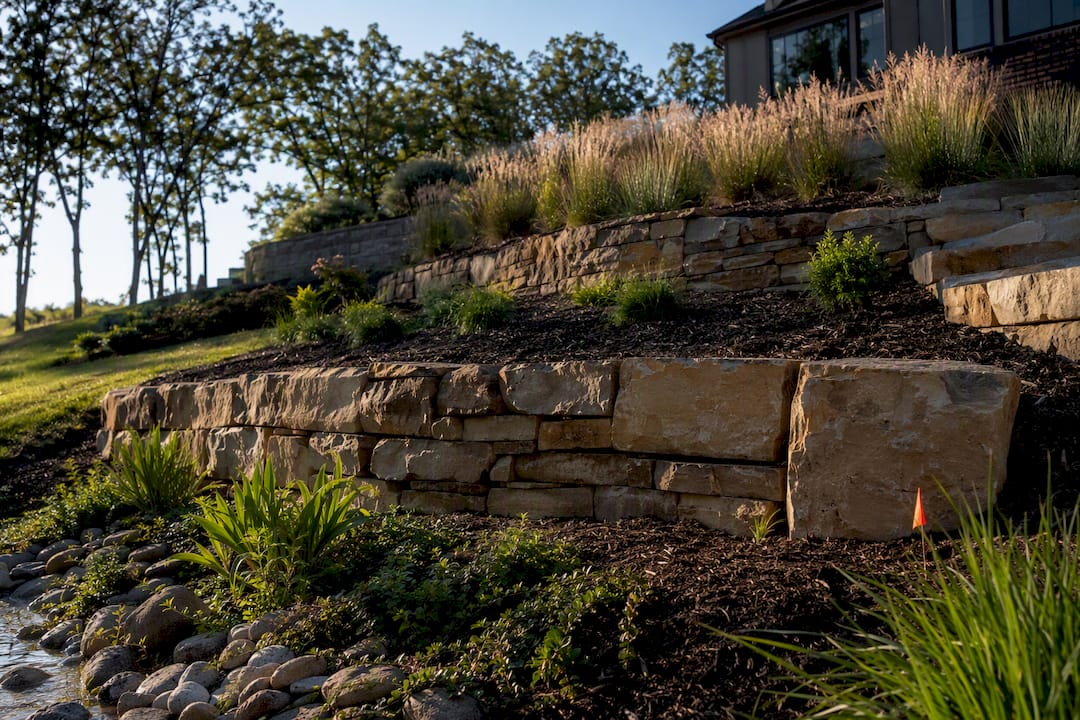
- Terraced beds and low retaining walls turn unusable grade into flat planting or seating space, and each level slows water instead of letting it sheet straight downhill.
- Layered groundcovers and shrubs knit the soil together with overlapping root systems, cutting long-term mowing and weeding once established.
- Rock gardens, riprap, and boulder anchors slow runoff physically and give you a low-maintenance option on slopes too steep or dry for thick planting.
- Ornamental grasses and meadow-style plantings add movement and dense fibrous roots that hold soil far better than turf.
- Raised decks or cantilevered patios make sense when a ground-level patio would need heavy excavation or a tall wall just to sit flat.
- Switchback stairs and access paths protect plantings from foot traffic shortcuts, which are one of the fastest ways bare-soil erosion channels form.
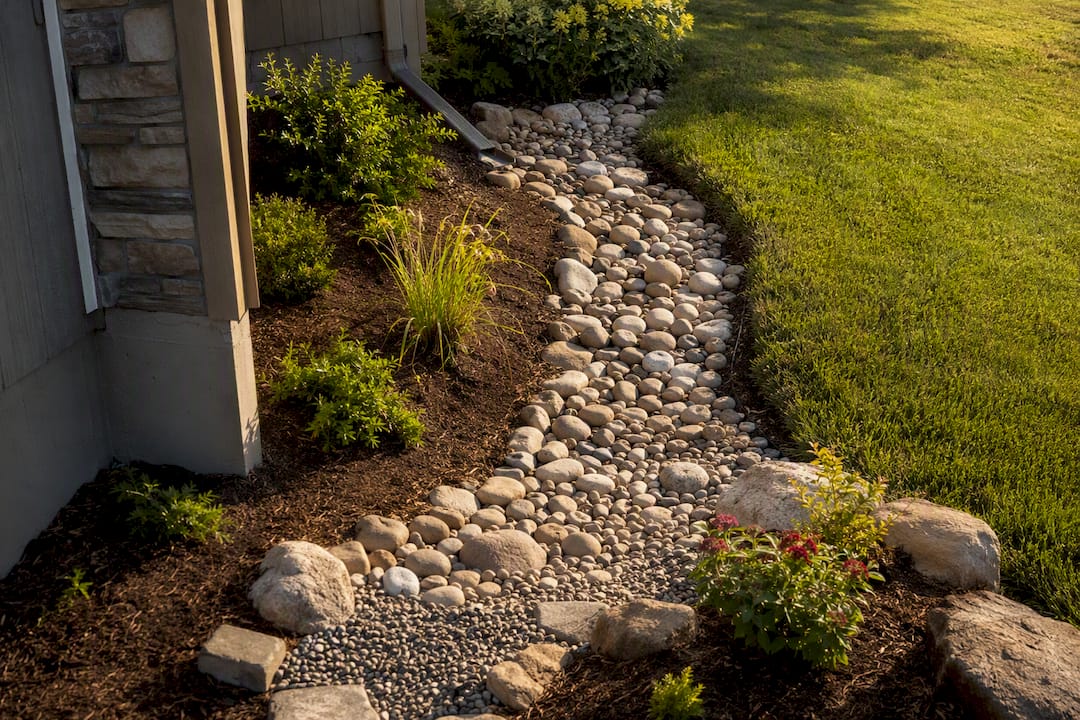
- Rain gardens and dry creek beds capture and redirect concentrated runoff instead of letting it carve a gully where downspouts or driveways dump water.
- No-mow alternatives like native sedges replace turf on grades where mowing is unsafe, with far less input once roots take hold.
Stabilize First: Matching Erosion Control to Your Slope
Grade determines your options more than style preference ever will. A gentle slope, generally under 15%, usually holds with the right plants alone. A moderate slope in the 15 to 30% range needs plants plus some structure, mulch, or netting to get through establishment. Anything approaching or exceeding 30% often crosses into territory where mowing becomes unsafe and plants alone aren’t enough, which usually means terracing or an engineered retaining wall.
Temporary surface protection and permanent structural fixes solve different problems. Mulch, jute or coir netting, and straw wattles hold soil in place while roots establish over weeks or months. Retaining walls, terraces, and riprap are permanent and handle water forces that netting never will. Skip synthetic landscape fabric on slopes; it tends to increase runoff and harm soil health over time, so stick with biodegradable netting during establishment instead.
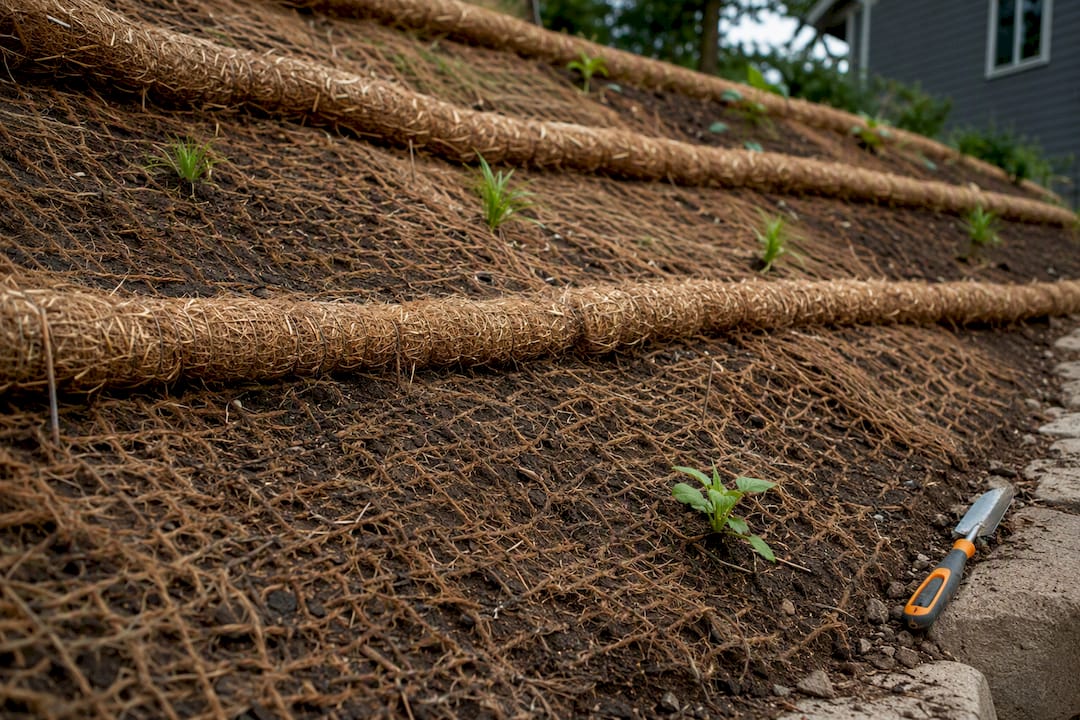
Biological anchors matter just as much as hardscape. Deep-rooted natives create a subsurface web that resists slippage, while fast-spreading stoloniferous groundcovers cover bare soil quickly. Combining both root types builds a layered matrix that resists surface washout and deeper slumping at the same time.
Here’s the order that actually works:
- Assess grade, soil type, and where water enters and exits the site.
- Install temporary erosion control (netting, wattles, mulch) before the first hard rain.
- Build any structural elements the slope requires (walls, terraces).
- Plant in the pattern the site calls for, following the contour.
- Water and monitor through the establishment window.
Pro Tip: Any retaining wall taller than roughly 4 feet, or any site with visible soil movement or standing cracks, needs an engineer or licensed contractor. That’s not a DIY judgment call anymore.
Drainage and Irrigation Fixes That Keep Slopes From Washing Out
Map the water before you touch a shovel. Walk the site during or right after a hard rain and note where water enters your property, where it concentrates into a channel, and where it pools. Those three points dictate everything downstream.
Surface fixes handle most residential slopes. Swales redirect sheet flow along a gentle channel, dry creek beds give concentrated runoff somewhere to go without carving a new gully, and simply extending downspouts away from the slope’s edge stops a huge share of erosion at the source. Sediment traps at the base catch soil before it reaches a storm drain or a neighbor’s yard.
Subsurface drainage comes into play behind any retaining wall. A perforated pipe wrapped in gravel, running behind the wall with a clear daylight outlet, relieves the hydrostatic pressure that causes most wall failures.
For irrigation, drip and soaker systems minimize runoff far better than overhead sprinklers, which tend to run off a slope before water ever soaks in. During establishment, pair irrigation with temporary measures:
- Jute or coir netting staked over bare soil until roots take hold
- Germination blankets on freshly seeded areas
- Staged watering: shorter, more frequent cycles rather than one long soak that just runs downhill
Where to Plant What: Matching Species to the Slope
Think of a slope in three bands, because each one behaves like a different microclimate. The top dries out fastest and takes the most sun, so drought-tolerant species and deep-rooted grasses belong there. Explore more drought-tolerant landscaping options if that top band gets full sun most of the day. The middle band holds more moisture and benefits from a mix of shrubs and perennials that fill in and shade the soil surface. The bottom, where water collects, is where moisture-loving plants and rain-garden species actually thrive instead of struggling.
Native groundcovers and grasses do the heaviest lifting here. Extension research points to river oats, little bluestem, muhly grass, Pennsylvania sedge, coral bells, creeping phlox, and common juniper as reliable, low-maintenance performers once they’re rooted in.
Planting pattern matters as much as species choice:
- Stagger plants across the contour rather than in straight vertical rows to break up channelized flow.
- Mass plants in drifts instead of scattering single specimens; density is what actually slows water.
- Water on a consistent schedule for the first 8 to 12 weeks, mulch 2 to 3 inches deep, and remove any biodegradable netting once you see new root growth pushing through it.
- Skip monocultures. Combining shallow spreaders with deep taproots gives you both quick surface cover and long-term anchoring.
Hardscape and Access: Building Features That Hold Up
A raised deck often beats a ground-level patio on steeper lots, mainly because it needs posts and footings instead of the heavy excavation and soil hauling a patio slab requires. Retaining wall material matters too: segmental block is forgiving for DIY, dry-stacked stone looks the most natural, and timber is cheapest but shortest-lived. Every wall type needs gravel backfill and drainage behind it, or it will eventually fail.
- Add step landings and switchback paths so foot traffic doesn’t cut its own erosion channel.
- Tuck planting pockets into wall faces for a softer, layered look.
- Handle simple terracing and small walls yourself; call in a contractor for anything load-bearing or over a few feet tall.
- Keep new construction well clear of established tree root zones to avoid destabilizing mature trees on the slope.
What to Expect: Timeline and Ongoing Maintenance
Establishment isn’t instant, and treating it that way is how erosion control fails. The first 8 to 12 weeks are the fragile window: roots are still shallow, and a heavy rain can undo weeks of work if netting or mulch isn’t holding. Months three through twelve are when root mass actually builds enough to hold the slope on its own.
- Water consistently through establishment, then taper as roots deepen and rainfall becomes sufficient.
- Keep mulch at 2 to 3 inches. More than that traps moisture against stems and invites rot on a slope that’s already prone to holding water unevenly.
- Inspect after every heavy rain and at each freeze-thaw cycle for the first year; check again as plants go dormant in fall.
- Call a professional if you see soil movement, a section of failed cover, or any settling along a retaining wall.
How a Local Pro Phases a Slope Project
Most successful slope projects follow a sequence: evaluate the site, control erosion immediately, handle structural work, plant, then monitor establishment. A local outdoor services company applies that same phasing on jobs across the KC Northland area, whether the work is a full landscape design or a standalone retaining wall.
Retaining walls, drainage correction, and planting all tie together on a slope, which is why piecemeal DIY fixes often underperform a coordinated plan. Professional-grade equipment is used for grading and wall construction, and portfolio work includes retaining walls, paver patios, and stone seating areas built specifically to handle grade changes. A site visit is the point where slope percentage, soil type, and drainage patterns get assessed before any structural decision gets made.
Why Erosion-First Beats Design-First on a Slope
Most slope advice starts with plant lists and Pinterest boards. That’s backwards. The homeowners who end up redoing a hillside project twice are almost always the ones who picked plants or pavers before they understood where their water actually goes. Fix drainage and soil movement first, and nearly every planting or hardscape choice downstream gets easier and cheaper.
The other place conventional advice falls short is monoculture thinking: one groundcover, one grass, done. A slope that survives ten years of Midwest weather usually has layered root types working together, not a single species carrying the whole load. Native groundcovers mixed with deep-rooted grasses consistently outperform single-species plantings because they resist erosion across seasons rather than just one.
If there’s one thing worth prioritizing above all the inspiration photos, it’s this: work with the grade you have. Fighting a hillside with heavy regrading almost always costs more and destabilizes more soil than terracing around the slope’s natural shape ever will.
— GC Signature Outdoors LLC
Ready to Fix Your Slope the Right Way
A DIY erosion fix can buy you a season or two, but a slope that’s actually engineered for drainage, wall integrity, and root depth holds up through Missouri’s freeze-thaw cycles and heavy spring rain without a redo. Such permanent fixes are built for homeowners across the KC Northland area, from retaining walls and drainage correction to full planting plans designed around your slope’s grade.

If your hillside needs structural work, the retaining wall builders team can walk the site with you and map out drainage before any construction starts. Prefer to see finished work first? Browse a landscaping portfolio for examples of terraced beds, paver patios, and stone seating built into residential yards. Either way, the next step is simple: request a site visit and get a plan built around the grade you actually have, not the one a generic guide assumes.
Sources
For deeper technical guidance, Iowa State University Extension covers grading and drainage basics, while Penn State Extension is the strongest source for native plant selection. This Old House and The Seattle Times offer practical, step-by-step framing, and The Old Farmer’s Almanac is useful for erosion-control plant lists.
- Gardening on slopes and hillsides — Iowa State University Extension
- Native groundcovers can solve tough challenges — Penn State Extension
FAQ
How can I make my sloped yard look good?
Layer plantings by height and root type across the contour, add a terrace or low wall to break up the grade, and use a rock feature or dry creek bed where water concentrates instead of fighting it.
How do I landscape a hillside cheaply?
Native groundcovers and grasses cost far less than retaining walls and hardscape, so prioritize plant-based stabilization on gentler slopes and save structural work for sections that genuinely need it.
What is the best low-maintenance hillside landscaping?
A mix of native groundcovers, deep-rooted ornamental grasses, and sedges typically needs the least ongoing care once established, since their root systems hold soil without regular mowing or watering.
What is the best landscape material for a slope?
There’s no single best material. Retaining walls suit steeper grades that need structural support, while riprap and boulders work well for high-flow water areas, and mulch or coir netting protects soil during plant establishment on gentler ground.
When should I hire a professional for slope work?
Bring in a contractor or engineer for any retaining wall over roughly 4 feet, any site showing soil movement, or any project involving drainage behind a structural wall.
Recommended
Ready to get started in Kansas City's Northland?
GC Signature Outdoors serves Smithville, Platte City, Kearney, Liberty, and surrounding areas.