
Homeowners: Contractor Tips to Protect Concrete From Deicing Salt
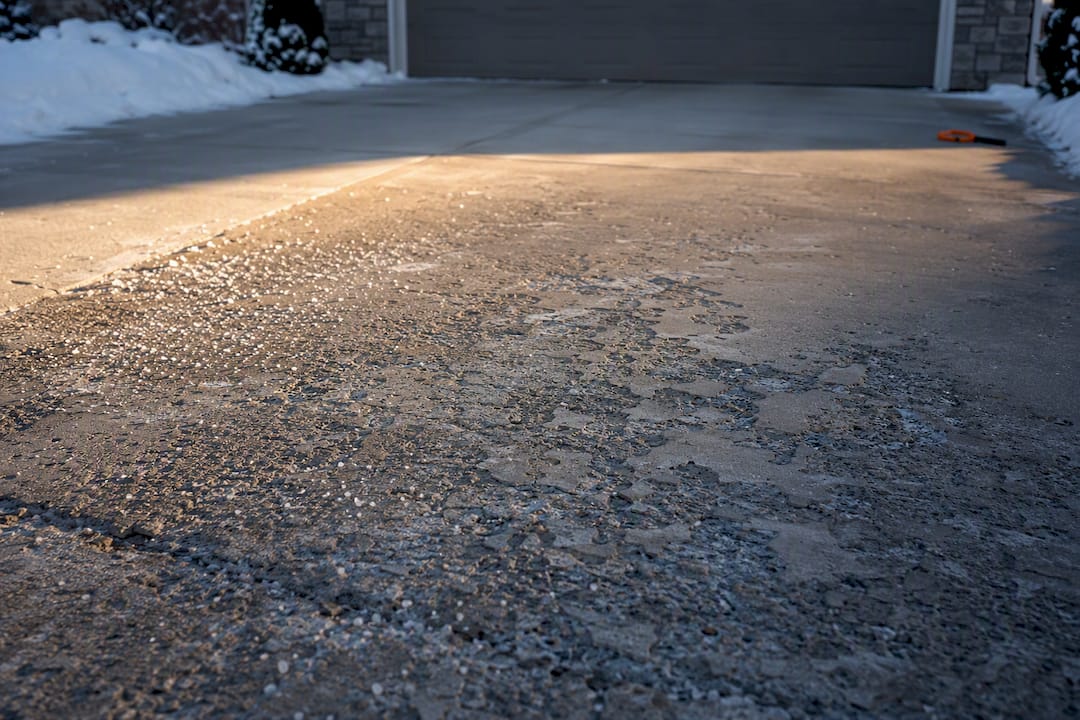
- Broom-finish flatwork per sq ft
- $8–$15
- Stamped / colored concrete per sq ft
- $15–$25
- Typical 2-car driveway replacement
- $6,000–$13,000
Homeowners: Contractor Tips to Protect Concrete From Deicing Salt
Yes, many common deicing salts damage concrete, both by pulling more water into the slab before freeze cycles and, with some chemicals, by attacking the cement paste directly. Skip salt entirely on concrete younger than a year, switch to sand for traction on any slab that looks weak or scaled, and sweep away residue every spring. If you see flaking, pitting, or rust stains along a driveway or patio, treat it as a signal to get the surface assessed before another winter passes.
TL;DR:
- Calcium and magnesium chloride deicers can cause chemical reactions that lead to cracking and strength loss even without freeze-thaw cycles.
- Salt increases concrete saturation, worsening freeze-thaw damage and accelerating the penetration of chemically aggressive chlorides.
- Newly poured concrete should wait at least 30 days before salt exposure, with a full year being safer for driveways poured in fall.
- Penetrating sealers, such as silane and siloxane, provide better long-term protection against salt ingress than surface coatings.
- Sand and abrasives are the safest traction options, as they add no chemical risk and are effective when used with shovels.
Table of Contents
- How Deicing Salt Damages Concrete
- Which Deicers Are Safer for Concrete?
- When You Should Not Use Deicing Salt at All
- Preventing Salt Damage to Concrete Before Winter Hits
- How to Apply Deicing Salt Without Wrecking Your Driveway
- Spotting Salt Damage and Deciding on Repairs
- What a Concrete Assessment Actually Checks
- Balancing Safety and Long-Term Concrete Health
- Get Your Concrete Ready for Winter With GC Signature Outdoors LLC
- Sources
- FAQ
How Deicing Salt Damages Concrete
Concrete looks solid, but it is riddled with microscopic pores that hold water. That’s the whole problem. When temperatures drop, water trapped in those pores freezes and expands roughly 9%, pushing outward against the surrounding paste. Ordinary freeze-thaw cycling already stresses a slab. Salt makes it worse in two separate ways, and homeowners rarely realize both are happening at once.
The first mechanism is physical. Salt lowers the freezing point of water on the surface, so instead of one clean freeze event, you get repeated partial thaw-refreeze cycles that draw more moisture into the slab through osmotic and hydraulic pressure. That extra saturation is what produces the flaking and pitting known as scaling. Deicing salts increase concrete saturation during winter cycling, and that added water content is a major driver of surface cracking, according to a materials science overview from ScienceDirect.
The second mechanism is chemical, and it’s specific to certain deicers. Calcium chloride and magnesium chloride don’t just sit on the surface. They react with the calcium hydroxide in hardened cement paste and can form expansive compounds, including calcium oxychloride and magnesium silicate hydrate. Calcium chloride deicing salt causes phase changes in cementitious materials that lead to cracking and measurable strength loss, independent of any freeze-thaw cycling at all. That’s worth sitting with: this damage can happen even when the temperature never drops below freezing.
Newer lab work backs this up. Recent research on magnesium chloride exposure documents progressive deterioration and expansive reaction products building up inside cement paste over repeated exposure cycles, confirming the chemical attack isn’t a one-time event but a cumulative one.
Pro Tip: If your driveway was poured with a sodium chloride resistant mix design but you’ve been using a calcium or magnesium chloride product for faster melting, you may be undoing that protection every winter without realizing it.
Here’s what makes this genuinely dangerous for a homeowner trying to make a smart choice: the two mechanisms compound each other rather than acting independently.
- Physical saturation from any chloride salt weakens the surface layer, making it more porous.
- That added porosity lets chemically aggressive salts like calcium and magnesium chloride penetrate deeper and faster.
- Deeper penetration means more contact with cement paste, which accelerates the expansive chemical reactions.
- The compounding effect explains why some driveways look fine for years, then scale rapidly in a single bad winter.
The interaction matters more than either factor alone. A slab exposed only to freeze-thaw without salt, or only to salt without deep saturation, tends to hold up far longer than one hit by both at once.
Which Deicers Are Safer for Concrete?
Not all deicing salt products carry the same risk, and the differences matter enough to change what you buy at the hardware store. Homeowners often assume “ice melt” is a single category. It isn’t.
Sodium chloride (rock salt) is the cheapest and most widely sold option. It causes relatively little direct chemical attack on cement paste compared to calcium and magnesium chloride, but it’s far from harmless. Sodium chloride shows less chemical reactivity with hardened concrete, but it drives chloride ions deep into the slab, where they corrode any embedded steel reinforcement or rebar. On a driveway with reinforcing mesh or a patio slab tied into a footing, that corrosion risk is the bigger long-term threat, even if the surface looks fine.
Calcium chloride and magnesium chloride melt ice at much lower temperatures, which is why they show up in “professional strength” and extreme cold formulas. That performance comes at a cost: both react chemically with cement paste and can trigger the oxychloride formation discussed above. Transportation agencies have taken this seriously enough to study it directly. A DOT literature review on deicer effects recommends keeping magnesium and calcium chloride solution concentrations below what’s called the “pessimum” range, generally around the low 20-percent range, since concentrations above and below that threshold behave differently and higher isn’t always more damaging in a linear way.
Organic deicers and urea based products are often marketed as gentler alternatives. They tend to be less chemically aggressive toward concrete, but they carry their own trade-offs: urea based products can burn nearby grass and shrubs, and some organic blends still contain chloride salts as a secondary ingredient, so reading the label matters more than trusting the packaging.
Sand and other abrasives don’t melt ice at all, but they add traction without any chemical exposure. For a homeowner trying to protect a driveway long term, sand paired with a shovel is the lowest risk option on the table, even though it takes more physical effort than tossing down pellets.
- Sodium chloride: cheap, low chemical reactivity, high corrosion risk near rebar
- Calcium and magnesium chloride: effective in extreme cold, higher chemical attack risk
- Organic and urea blends: gentler on concrete, harder on nearby plants
- Sand and abrasives: zero chemical risk, manual effort required
When You Should Not Use Deicing Salt at All
New concrete is the single biggest risk category, and it’s the one homeowners most often get wrong. Concrete needs time to develop its full compressive strength and internal pore structure before it can handle repeated saturation and chemical exposure without damage.
- Wait at least 30 days before any salt exposure, and treat a full year as the safer benchmark for a driveway or patio poured in fall. Concrete reaches most of its design strength within the first month, but the internal capillary structure that resists salt penetration keeps refining for months afterward, following guidance echoed across cold weather curing practices.
- Check for low air entrainment or a weak finish. Concrete without adequate air entrainment, or a slab that was overworked or trowel finished too aggressively, lacks the microscopic air pockets that relieve internal freeze pressure. That kind of slab is vulnerable at any age, not just when new.
- Watch for repeated heavy applications and poor drainage. A driveway that pools water at a low spot, or gets deiced multiple times a week during a rough winter, accumulates saturation faster than the concrete can dry between events. Surface defects like hairline cracks or exposed aggregate give salt water a faster path inward.
Preventing Salt Damage to Concrete Before Winter Hits
Prevention starts long before the first snowfall, and it starts with decisions made when the concrete is poured, not with what you buy at the store in December.
Mix design is the foundation. A slab built with a water to cement ratio at or below 0.45 and air entrainment in the 5% to 7% range resists freeze-thaw damage significantly better than a standard mix. Durable concrete depends primarily on proper mix design, not on sealers or surface treatments applied later. That’s an important distinction: a sealer can extend the life of good concrete, but it cannot rescue concrete that was poured wrong. Supplementary cementitious materials like fly ash, slag, and silica fume also help. Lab mixes with SCMs performed better against deicer exposure than plain Portland cement mixes in durability testing, largely by reducing the paste’s permeability.
Placement and curing habits matter just as much as the recipe. Overworking the surface while bleed water is still present creates a weak, water rich layer right where deicers will hit hardest. Poor finishing practices correlate strongly with surface scaling, and that correlation holds regardless of how good the underlying mix was. Proper curing, keeping the slab moist and protected for at least seven days after the pour, lets the cement hydrate fully and closes off much of the pore structure salt would otherwise exploit.
Sealers add a second layer of defense on top of good concrete, but the type matters. Cure and seal products form a thin film on the surface and offer modest, short term protection. Penetrating sealers, specifically silane and siloxane formulations, work differently: they soak into the pore structure and chemically bond, repelling water and chloride ions from within rather than just coating the top. Penetrating silane and siloxane sealers significantly reduce water and chloride absorption and are the recommended choice for long-term winter protection on driveways and patios, according to technical guidance from Euclid Chemical. Industry bulletins consistently favor penetrating sealers over film-forming ones for this exact reason: they don’t wear off the way a surface coating does.
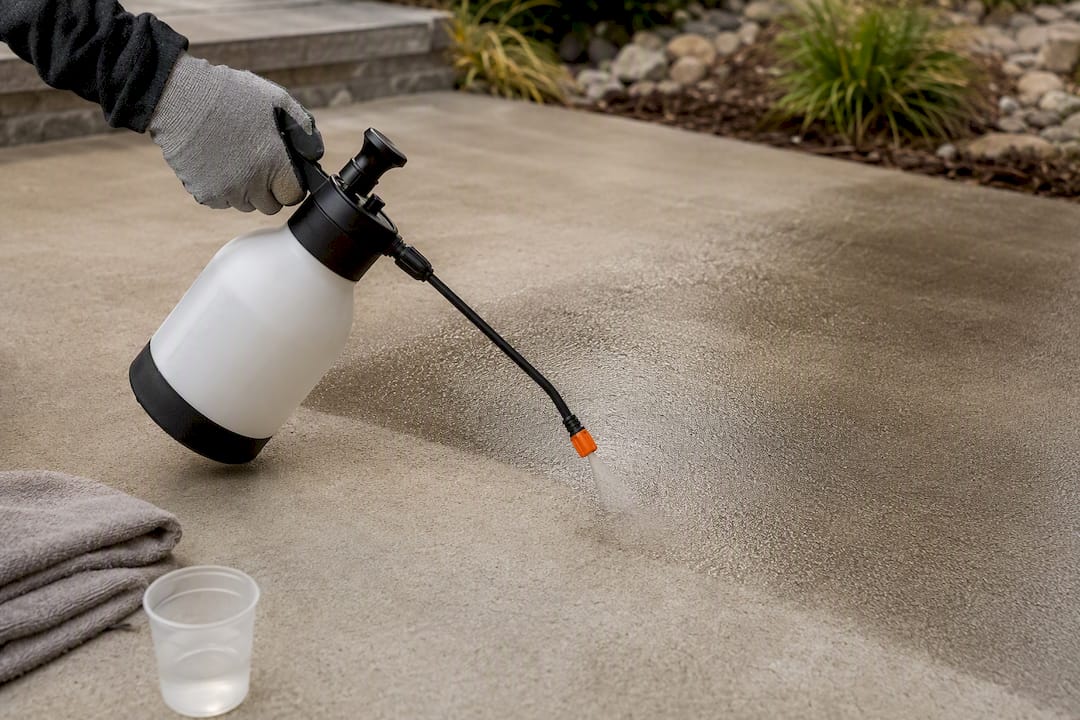
Timing the sealer application matters too. The concrete needs to be clean, fully dry, and above roughly 50°F for the product to absorb properly, a detail covered in more depth in common concrete sealing mistakes.
For ongoing maintenance, the simplest changes make the biggest difference:
- Shovel and use sand or another abrasive as your first line of defense before reaching for chemical deicers.
- If you do use a deicer, apply the lowest amount that clears the ice, not a heavy coating “just in case.”
- Sweep and rinse any leftover salt residue as soon as temperatures allow in spring, since lingering salt keeps drawing moisture even after the snow is gone.
- Reapply a penetrating sealer roughly every few years, checking absorption by splashing water on the surface. If it beads, the seal is still working; if it soaks in, it’s time to reapply.
How to Apply Deicing Salt Without Wrecking Your Driveway
If you’re going to use a chemical deicer at all, how you apply it matters almost as much as which product you choose.
- Read the bag before you buy it. Avoid products containing ammonium nitrate or ammonium sulfate. These are aggressive toward both concrete and metal and are increasingly flagged even in general consumer ice melt guidance.
- Check for concentration and temperature guidance on magnesium and calcium chloride products. Agencies recommend staying below roughly 20% to 22% solution strength for these chemicals where practical, since that pessimum range represents where damage potential tends to spike.
- Apply the minimum amount that works. More product doesn’t melt ice faster once you’ve covered the surface. It just adds unnecessary chloride load that sits on the slab longer.
- Reach for sand first on any surface where you’re worried about long-term wear, saving chemical deicers for genuinely icy conditions where traction alone isn’t safe.
- Never mix deicer products. Combining chemically different deicers can produce unpredictable reactions and doesn’t improve performance.
- Keep a rough log of what you used and when, especially on a newer driveway, so you know what to rinse away in spring and can track whether a particular product seems to be causing more surface wear than others.
Spring cleanup closes the loop: once temperatures stay reliably above freezing, sweep the surface, rinse thoroughly, and inspect for any new pitting or discoloration before deciding whether a section needs resealing or repair.
Spotting Salt Damage and Deciding on Repairs
Salt damage tends to announce itself gradually, then suddenly. Catching it early keeps a repair small.
- Look for scaling first. This shows up as a rough, flaking surface layer, usually starting at the edges of a driveway or around a garage apron. It’s the most common visible sign of chloride saturation combined with freeze-thaw cycling.
- Check for spalling and rust staining. Spalling looks like chunks or flakes popping off, sometimes down to the aggregate. Rust-colored streaks radiating from a crack usually mean chloride ions have reached embedded rebar and corrosion has started, which is a more serious structural signal than surface scaling alone.
- Test for delamination. Tap the surface with a hammer or the heel of a boot. A hollow, drumlike sound where the rest of the slab sounds solid indicates the top layer has separated from the concrete beneath it, a classic sign of advanced salt and freeze-thaw damage.
- Match the repair to the severity. Light scaling on an otherwise sound slab can often be addressed with surface patching and a penetrating sealer going forward. Spalling that’s more than surface deep usually calls for partial depth repair. Widespread delamination, structural cracking, or corroded reinforcement generally means replacement is the more cost-effective long-term answer rather than repeated patch jobs.
- Call a professional when you see rust staining, structural cracks wider than a hairline, or damage that’s spread across more than a small section. These conditions usually mean the reinforcement or the slab’s structural integrity is compromised, which goes beyond a homeowner-level fix.
What a Concrete Assessment Actually Checks
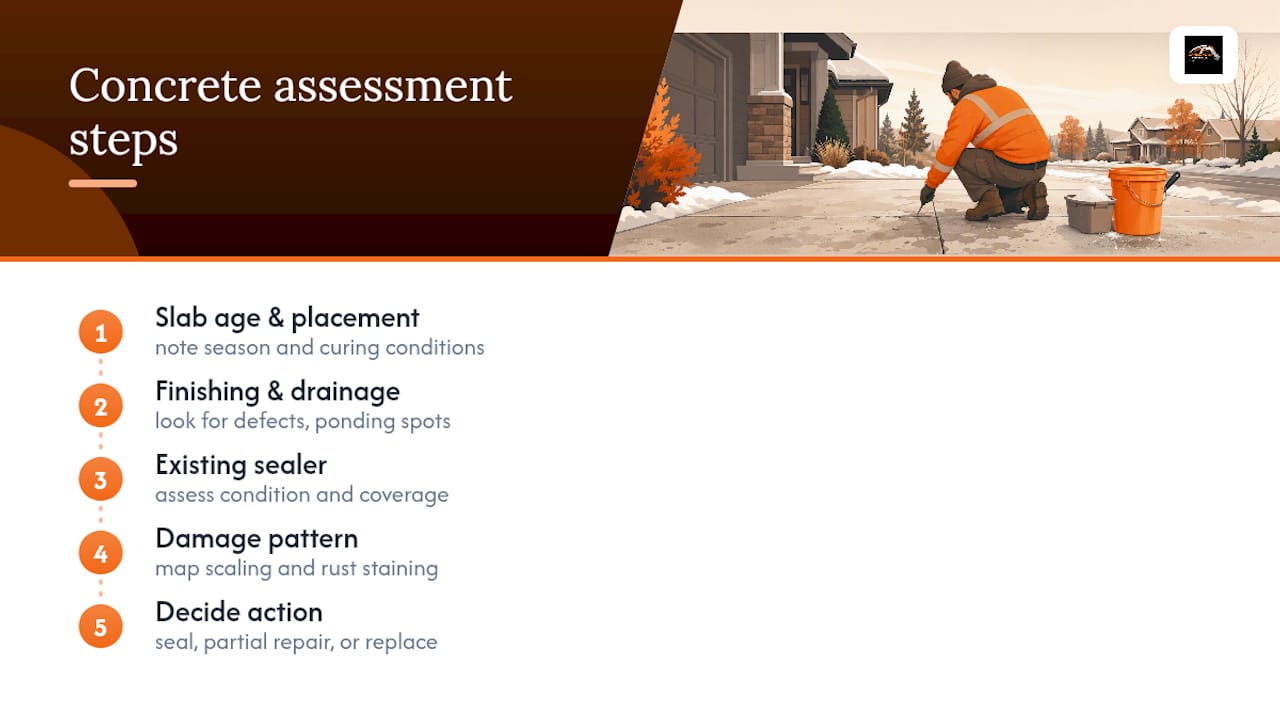
When GC Signature Outdoors LLC looks at a salt damaged driveway or patio, the evaluation follows a consistent sequence rather than a quick glance. A practical assessment checklist starts with the slab’s age and any known placement conditions, since concrete poured late in the season under rushed curing conditions behaves differently than a slab poured and cured properly in summer. From there, the check moves to visible finishing defects, drainage patterns and ponding spots, the condition of any existing sealer, and the location and pattern of scaling or rust staining.
That sequence determines whether sealing alone will extend the slab’s life, whether a section needs partial repair, or whether the damage has gone deep enough that replacement makes more financial sense than another round of patching. Concrete flatwork, sealing, and driveway or shed pad replacement are all part of the range of services covered during that kind of assessment.
Balancing Safety and Long-Term Concrete Health
Nobody should skip deicing entirely in the name of protecting a driveway. A fall on ice costs a lot more than a resealed patio. The smarter position is choosing the least damaging effective option for the conditions you’re actually facing, rather than defaulting to whatever bag of rock salt is cheapest at the hardware store.
Spending money upfront on a proper mix, correct curing, and a penetrating sealer is almost always cheaper than a decade of reactive patch repairs. That’s not a close call once you’ve seen both outcomes side by side. Keep a simple habit: walk your driveway and patio each spring, note any new scaling or staining, and address small problems while they’re still small. For slabs that matter, a stamped patio, a long driveway, a structural walkway, a professional look every few years catches issues before they become expensive.
— GC Signature Outdoors LLC
Get Your Concrete Ready for Winter With GC Signature Outdoors LLC
Concrete contractors often handle a full range of concrete work including flatwork, driveways, shed pads, and the sealing and maintenance that keep them standing up to winter. Professional concrete crews often bring consistent scheduling and use professional-grade materials on projects that homeowners might otherwise need multiple contractors for.

If your driveway is already showing scaling or rust staining, a repair now costs less than waiting for it to spread. If it’s sound but unsealed heading into another winter, that’s the cheaper problem to solve. GC Signature Outdoors LLC installs concrete driveways and concrete shed pads, and also handles broader seasonal cleanup and winter maintenance services for properties throughout Smithville, Platte City, and Kearney. Reach out for an assessment before the next freeze cycle sets in, and get a clear read on whether your slab needs sealing, repair, or nothing at all this year.
Sources
This guide draws on a DOT literature review of deicer effects on Portland cement concrete, peer-reviewed studies on calcium and magnesium chloride phase changes in cement paste, and manufacturer technical bulletins on penetrating silane and siloxane sealers, alongside general durability guidance on mix design and curing practices.
- Portland cement concrete: effects of deicers literature review (Sutter et al. / DOT literature review)
- The influence of calcium chloride deicing salt on phase changes and damage development in cementitious materials
- Deicing Salt - an overview
FAQ
What Is the Best Thing to Put on Concrete to Melt Ice?
Sand offers the lowest risk to concrete since it adds traction without any chemical reaction, but if you need a chemical deicer, choose one used at the lowest effective concentration and avoid ammonium-based products entirely.
What Is the Safest Deicing Salt for Concrete?
Sodium chloride causes less direct chemical attack on cement paste than calcium or magnesium chloride, though it still increases saturation and can corrode embedded steel reinforcement over time. No common deicing salt is entirely risk-free on concrete.
What Type of Deicer Is Safe to Use on Concrete?
Products applied at low concentrations, avoiding ammonium nitrate or ammonium sulfate, tend to be the least damaging chemical option; sand and other abrasives remain the safest choice overall since they involve no chemical exposure.
Why Can’t You Use Salt on Concrete?
Salt increases how much water the concrete absorbs, which worsens freeze-thaw cracking, and some salts, particularly calcium and magnesium chloride, react chemically with the cement paste itself and can weaken the slab even without freezing temperatures.
How Long Should You Wait Before Using Deicing Salt on New Concrete?
Wait at least 30 days before any salt exposure, and treat a full year as the safer benchmark for a driveway or patio poured heading into fall or winter.
Does GC Signature Outdoors LLC Offer Concrete Sealing or Repair?
Some lawn and landscape service providers offer concrete flatwork, driveway and shed pad installation, and winter maintenance services, with specific pricing for sealing and repair work available on request.
Recommended
Ready to get started in Kansas City's Northland?
GC Signature Outdoors serves Smithville, Platte City, Kearney, Liberty, and surrounding areas.