
Concrete Control Joints: Code Standards and Best Practices
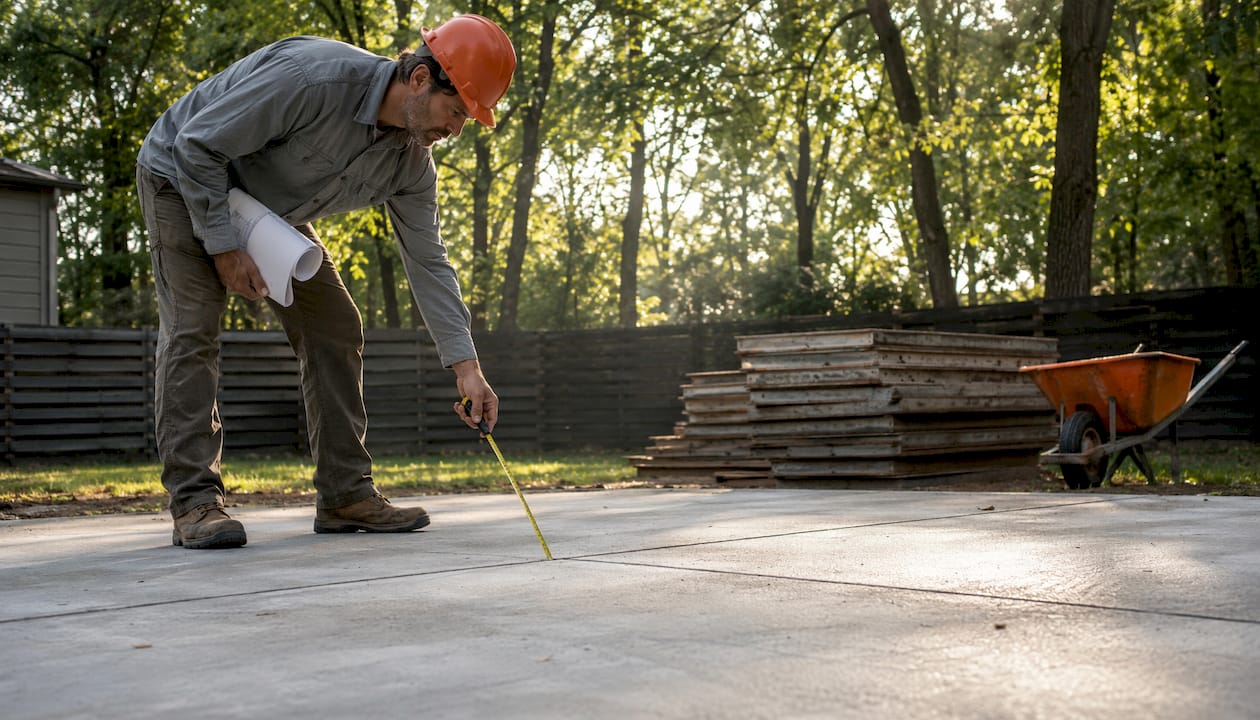
- Broom-finish flatwork per sq ft
- $8–$15
- Stamped / colored concrete per sq ft
- $15–$25
- Typical 2-car driveway replacement
- $6,000–$13,000
Concrete Control Joints: Code Standards and Best Practices
What are concrete control joints and why do they matter?
Concrete control joints are intentional weakened planes cut or formed into a slab to direct where shrinkage cracks will occur. Without them, concrete cracks wherever internal stress finds the path of least resistance, which is rarely where you want it. Per ACI 360R-10 and NRMCA guidelines, control joints must be sawed to at least 1/4 of slab thickness and spaced according to slab dimensions and environmental conditions.
The payoff is straightforward: a crack that forms beneath a control joint stays hidden and manageable. A random crack across an open slab face is a maintenance problem and, in load-bearing applications, a structural concern. Both IBC 2018 and ACI 318 reference contraction joint criteria as a baseline requirement for flatwork design, not an optional upgrade.
Key functions of control joints in concrete slabs:
-
Direct drying shrinkage cracks to predetermined locations
-
Reduce tensile stress buildup across slab panels
-
Preserve load transfer between adjacent panels when properly spaced
-
Allow independent slab movement without damaging adjacent structural elements
-
Extend service life by preventing uncontrolled crack propagation
For concrete driveways and patios in Kansas City, where freeze-thaw cycles add thermal stress as well as normal shrinkage, correct joint placement is the single most effective crack-prevention measure available.
The four types of concrete joints and how each one works
Concrete construction uses four primary joint types, and confusing them leads to real field problems.
-
Contraction (control) joints create a weakened plane so shrinkage cracks form in a controlled location. They are the most common joint in slabs on grade and are typically saw-cut or tooled into the surface.
-
Isolation joints fully separate a slab from adjacent fixed elements such as columns, walls, footings, or existing pavement. They allow independent vertical and horizontal movement in all three directions, and all bonded reinforcement is interrupted through the joint.
-
Expansion joints accommodate dimensional increases in concrete due to temperature rise. The Federal Highway Administration cautions that overusing expansion joints causes contraction joints to open wider, which leads to sealant failure and loss of load transfer across slabs. Use them where structures truly need thermal relief, not as a substitute for contraction joints.
-
Construction joints mark the interface between two successive concrete placements. They are placed at the end of a pour or when placement is interrupted long enough for the first lift to harden. In slab-on-grade work, construction joints are often located at planned contraction joint positions.
The distinction between expansion joints vs control joints trips up even experienced crews. Expansion joints are filled with compressible material and designed to close under heat; control joints are designed to open under shrinkage. They serve opposite mechanical purposes.
What do IBC 2018 and ACI 318 actually require?
The NRMCA’s CIP 6 guidance, which aligns with IBC 2018 and ACI 318 criteria, sets the following standards for contraction joint spacing:
For a standard 4-inch residential slab, joint spacing corresponds to 24–36 times slab thickness. A 6-inch commercial slab allows proportionally scaled spacing. Under high shrinkage conditions, including hot and dry Kansas City summers, spacing should move toward the tighter end of that range, closer to 24 times slab thickness.
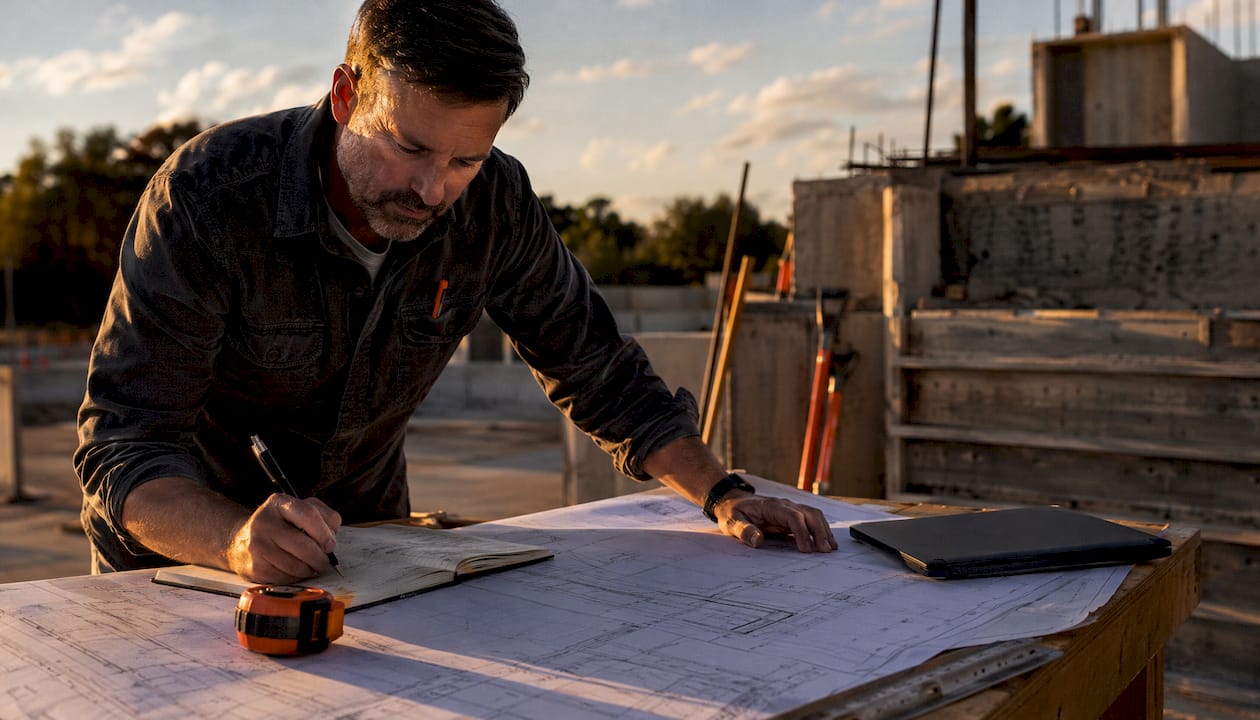
ACI 302.1R-15 adds a critical reinforcement constraint: steel crossing contraction joints must not exceed 0.10% of the slab cross-section. Exceed that threshold and the joint cannot open enough to relieve stress, forcing uncontrolled cracks to form elsewhere in the panel.
The FHWA’s Technical Advisory 5040.30 reinforces this by warning that expansion joints placed too frequently cause adjacent contraction joints to open beyond their design width, breaking down sealant and aggregate interlock.
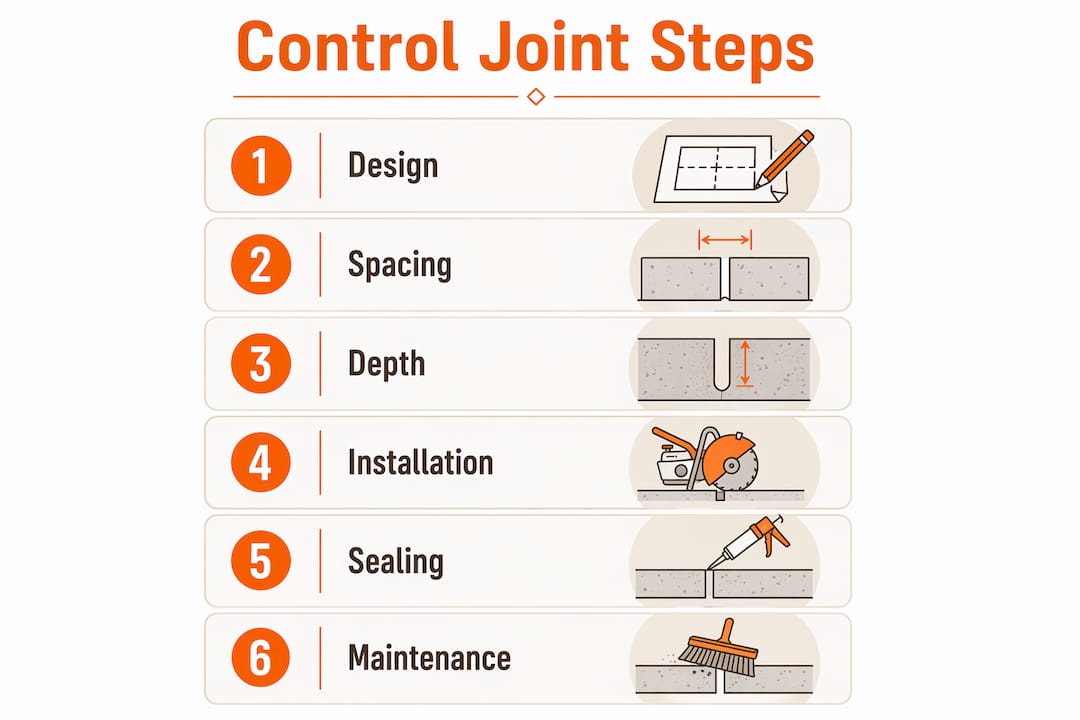
Panel aspect ratio is also a code-level concern. ACI 302.1R-15 sets the maximum long-to-short side ratio at 1.5:1, with 1:1 preferred. L-shaped and T-shaped panels should be avoided entirely.
How to install and maintain control joints correctly
Saw-cut timing
Timing is the variable contractors most often get wrong. The NRMCA guidance is explicit: start sawing when surface raveling no longer occurs, but before shrinkage cracks develop. That window is driven by concrete maturity, not clock hours. A hot, windy Kansas City afternoon can close that window in under two hours.
-
Conventional wet-cut saws: run within 4–12 hours after finishing
-
Early-entry dry-cut saws: run shortly after finishing, to a minimum depth sufficient to reach about 1/4 slab thickness for slabs up to 9 inches thick
Joint depth
Minimum saw-cut depth should be about 1/4 of slab thickness, with a minimum around one inch for typical residential slabs to ensure effective crack control. Going shallower than 1/4 thickness leaves the slab too stiff to crack at the joint, defeating the purpose entirely.
Layout rules
-
Place joints continuously across the full slab width. Staggered or offset joints create stress concentrations that generate diagonal cracks between the offset ends.
-
Keep panels as square as possible. The maximum aspect ratio is 1.5:1, long side to short side.
-
Avoid L-shaped panels. They crack at the interior corner almost every time.
Sealing and maintenance
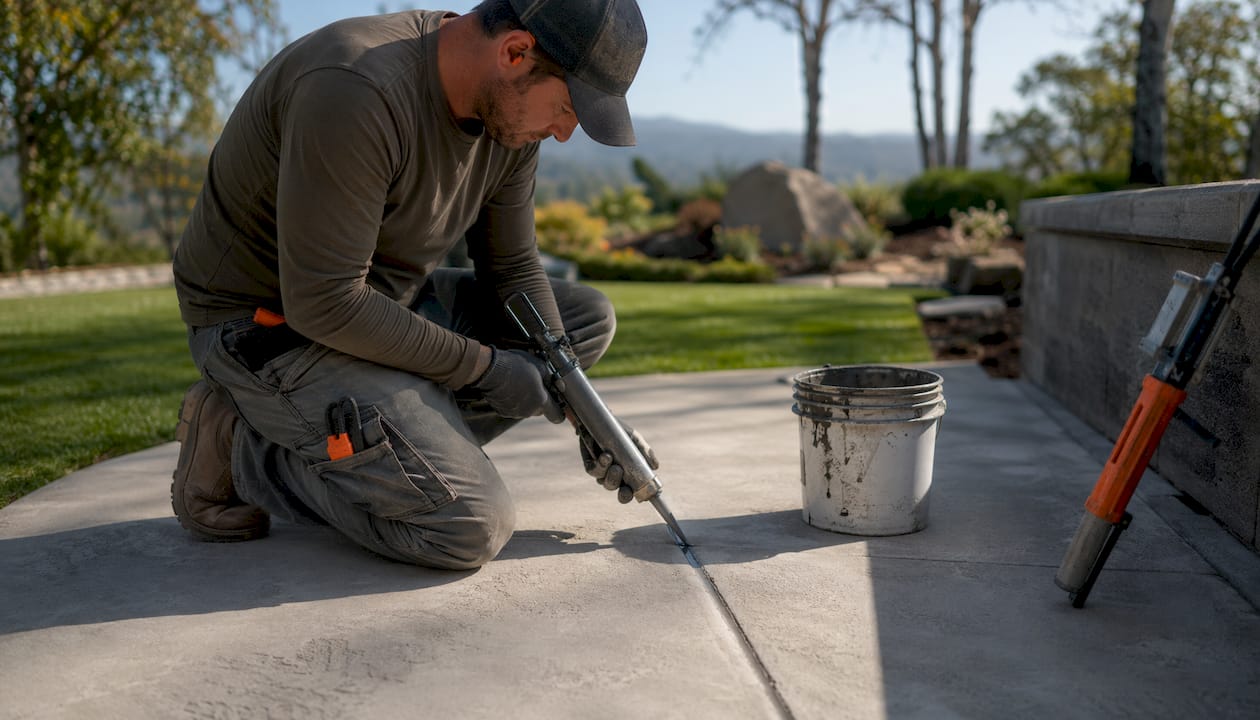
Joint sealants block moisture intrusion and debris infiltration, both of which accelerate joint deterioration. In freeze-thaw climates, water trapped in an open joint expands and spalls the joint edges within a few seasons. Inspect sealant annually and replace it when it shows signs of adhesion failure or compression set.
Pro Tip: At column or post locations, form the isolation opening as a square rotated 45 degrees so that contraction joints intersect at the corners of the diamond, not at the flat sides. This geometry distributes stress evenly and prevents the diagonal corner cracks that plague square-on-axis column blockouts.
Which Kansas City contractors handle control joint work?
Five contractors serve the Kansas City market with concrete joint services ranging from precision industrial sawing to full residential slab installation. One lead-in note: services, specializations, and estimate availability vary significantly across these providers.
| Contractor | Services Offered | Specialization | Certifications / Recognition | Best For | Rating |
|---|---|---|---|---|---|
| KC Waterproofing and Foundation Repair | Concrete leveling, foundation repair, basement waterproofing, drainage systems | Foundation and concrete repair, waterproofing | Home Advisor Elite Service Award, BBB Top Rated, Top KC Foundation Repair | Residential and commercial foundation and concrete repair | 4.9★ (888 reviews) |
| KC Coring & Cutting | Flat/slab sawing, core drilling, wall sawing, joint sealing, GPR, grinding | Precision concrete cutting, coring, industrial/commercial sawing | 47 years in operation | Industrial and commercial concrete sawing and joint sealing | 4.9★ (129 reviews) |
| Legacy Concrete Contractors Kansas City | General concrete contracting, flatwork | General concrete contracting | Local reputation for quality contracting | General concrete projects in the KC area | 4.9★ (34 reviews) |
| American Concrete Products of Kansas City, LLC. | Precast concrete products for commercial, utility, and transportation sectors | Precast concrete supply | Regional precast market reach | Commercial and infrastructure precast solutions | 4.9★ (15 reviews) |
| Superior Concrete KC | Slab installation, sealing, restoration, repair, free estimates | Residential and commercial concrete installation and maintenance | Licensed and insured, no hidden fees | Custom driveways, patios, and commercial slabs | 5★ (4 reviews) |
KC Coring & Cutting is the most specialized option for joint-specific work. With 47 years of flat/slab sawing and joint sealing experience and a safety-driven approach backed by an EMR Rating of .78, they are the go-to for industrial and commercial projects where precision sawing timing and depth are non-negotiable.
KC Waterproofing and Foundation Repair brings the broadest credentials for residential concrete repair, particularly where joint failures have allowed moisture intrusion into foundations. Their flexible financing makes larger repair scopes more accessible.
Superior Concrete KC suits homeowners and commercial clients who need a licensed, insured contractor for full slab installation with sealing included and free upfront estimates.
Legacy Concrete Contractors Kansas City handles general flatwork contracting for KC-area projects. American Concrete Products of Kansas City serves commercial and infrastructure clients needing precast supply rather than field installation.
Concrete flatwork done right in the KC Northland
If you’re a homeowner in Smithville, Platte City, or Kearney and you want concrete flatwork built with proper joint spacing from day one, Sgclandscape offers a different path than hiring a specialty concrete contractor. As a family-run outdoor construction company serving the KC Northland, Sgclandscape handles residential concrete driveways and patios as part of a complete outdoor build, meaning your slab, landscape design, and outdoor living space get planned together rather than pieced together by separate crews.

The practical advantage: joint layout, slab thickness, and surface finish get coordinated with the surrounding grade and drainage from the start, not retrofitted after the fact. Sgclandscape uses professional-grade materials and equipment on every pour, and their KC Northland project portfolio shows the finished results across driveways, patios, and outdoor living builds throughout the area. No hidden fees, no juggling multiple contractors.
FAQ
What are the four types of concrete joints?
The four primary types are contraction (control) joints, isolation joints, expansion joints, and construction joints. Each serves a distinct mechanical purpose: contraction joints control crack location, isolation joints allow free movement around fixed elements, expansion joints accommodate thermal growth, and construction joints mark the boundary between successive pours.
How deep should a control joint be on a concrete slab?
A control joint must be cut to a minimum depth of 1/4 of the slab thickness. For a standard 4-inch driveway slab, that means a 1-inch saw cut at minimum.
Are control joints necessary in concrete?
Yes. Concrete shrinks as it cures, and without planned weak points, tensile stress causes random cracking wherever the slab is weakest. Control joints direct that cracking to predetermined locations that are easier to seal and maintain.
What is the rule of thumb for control joint spacing?
Space control joints at 24–36 times the slab thickness, with a maximum of 15 feet for unreinforced slabs on grade. For a 4-inch slab, that means joints roughly every 8–15 feet. Tighten spacing toward the 24x end under high-shrinkage conditions such as hot, dry weather.
Key Takeaways
Properly designed and timed concrete control joints are the most effective single measure for preventing uncontrolled slab cracking in both residential and commercial flatwork.
| Point | Details |
|---|---|
| Minimum joint depth | Cut to at least 1/4 of slab thickness. |
| Spacing standard | Space joints at 24–36 times slab thickness, capped at 15 feet for unreinforced slabs. |
| Aspect ratio limit | Keep slab panels at a maximum 1.5:1 long-to-short ratio; square panels are preferred. |
| Reinforcement limit | Steel crossing contraction joints must not exceed 0.10% of slab cross-section or joints will not activate. |
| Sgclandscape option | Sgclandscape builds residential concrete driveways and patios in the KC Northland with joint layout integrated into the full outdoor design from the start. |
Recommended
Ready to get started in Kansas City's Northland?
GC Signature Outdoors serves Smithville, Platte City, Kearney, Liberty, and surrounding areas.