
Yard Drainage Solutions: Fixes by Symptom and When to Call a Pro
Yard Drainage Solutions: Fixes by Symptom and When to Call a Pro
The right fix depends entirely on what your yard is telling you. Standing puddles in the lawn usually mean poor grading or compacted soil. Water pooling near the foundation almost always traces back to downspouts or a negative slope toward the house. A soggy lawn that never fully dries points to drainage that never got an outlet in the first place, and basement seepage after storms signals a grading or hydrostatic pressure problem that needs more than a shovel and a Saturday afternoon.
Most of these problems respond to simple, low-cost interventions. The International Residential Code calls for a minimum slope away from the foundation, and the USDA Natural Resources Conservation Service has long documented how quickly healthy soil should shed water after rain. When a yard falls short of those benchmarks, the fix is usually one of a handful of proven options. GC Signature Outdoors LLC sees the same patterns across the KC Northland area: most callers need a downspout fix or a regrade, not a full drainage system.
- Standing puddles in the lawn: regrade the low spot or aerate compacted soil.
- Water pooling near the foundation: extend downspouts and correct negative slope.
- Soggy lawn that never dries or basement seepage: install a French drain, dry well, or sump pump, and get a professional site evaluation.
Pro Tip: Before you dig anything, watch your yard during and right after a hard rain. Most homeowners guess wrong about where water actually comes from, and a $40 downspout extension often does more than a $4,000 French drain aimed at the wrong problem.
Key Takeaways
Most yard drainage problems trace back to gutters, downspouts, or grade, and get solved with a targeted fix rather than a full system overhaul.
| Point | Details |
|---|---|
| Diagnose before you dig | Watch the yard 24 to 48 hours after rain and trace where water actually goes. |
| Try low-cost fixes first | Downspout extensions, splash blocks, and aeration solve most minor pooling issues. |
| Match the system to the cause | French drains, dry wells, and regrading each target a different root problem. |
| Call 811 before any trenching | It’s free and prevents utility damage before you break ground. |
| Verify the fix worked | Check that standing water clears within 12 to 18 hours after the next rain. |
| Get a pro assessment when DIY stalls | GC Signature Outdoors LLC offers site assessments and permanent drainage installs across the KC Northland area. |
Table of Contents
- How Do You Diagnose a Yard Drainage Problem?
- What Quick Fixes Can You Try First?
- Which Permanent Drainage System Fits Your Yard?
- How Do You Install a French Drain Yourself?
- When Should You Hire a Drainage Contractor?
- Do You Need a Permit to Fix Yard Drainage?
- What Do Real Drainage Projects Actually Look Like?
- How Does Aerating and Loosening Compacted Soil Help Drainage?
- What Do Drainage Fixes Typically Cost?
- Does Yard Drainage Work Affect the Environment or Local Regulations?
- How Should You Maintain Drainage Through the Seasons?
- A Local Pro’s Take on Drainage Priorities
- How Can GC Signature Outdoors LLC Help With Your Drainage Project?
- Sources
- FAQ
How Do You Diagnose a Yard Drainage Problem?
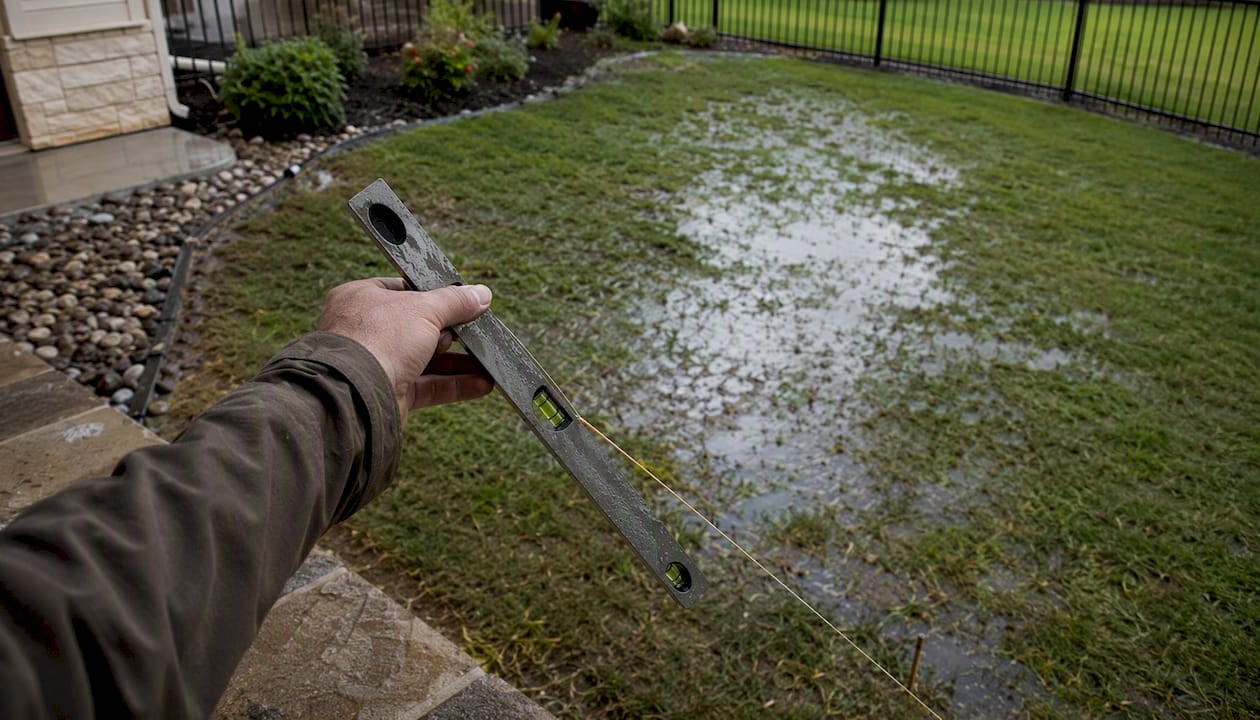
Grab a notebook and go outside 24 to 48 hours after a soaking rain. That window matters because healthy, well draining soil should clear standing water within 12 to 18 hours, according to inspection guidance built on USDA and ASCE drainage benchmarks. If puddles are still sitting there two days later, you’re dealing with either compacted soil, a low spot with no outlet, or a grade that’s working against you.
Start by tracing the water. Walk the property and follow the path it takes, or would take, from your roofline to wherever it eventually settles. Note where it pools, whether it reaches a storm drain, ditch, or just disappears into the lawn. A shockingly common culprit that gets skipped in this step: irrigation. A cracked sprinkler head or a stuck valve can mimic a grading problem for months before anyone thinks to check the controller schedule. Run each zone manually and watch for water surfacing somewhere it shouldn’t.
Two quick measurements tell you almost everything else. First, check slope with a level and a string line, or just eyeball a straight board: you want roughly 2 to 3 inches of drop over the first 10 feet away from the house. Second, run a percolation test. Dig a hole about 12 inches deep and 6 inches wide, fill it with water, let it drain, then fill it again and time how fast it disappears.
| Test | What to check | Healthy result | Problem sign |
|---|---|---|---|
| Post-rain visual | Puddles 24-48 hrs after rain | Water gone within 12-18 hrs | Standing water past 24 hrs |
| Slope check | Grade for first 10 ft from foundation | 2-3 inches of drop | Flat or sloped toward house |
| Percolation test | Drain rate in a 12-inch test hole | Drains within a few hours | Standing water after several hours |
| Irrigation check | Each zone run manually | No surfacing or leaks | Water pooling near heads |
What Quick Fixes Can You Try First?
Most yard drainage complaints get solved without a single excavator on site. The 15 DIY methods that consistently show up in drainage guides start with the cheapest, least invasive options, and for good reason: they work more often than homeowners expect.
- Extend downspouts with solid PVC pipe to carry water at least 5 to 10 feet from the foundation, further if the ground is flat.
- Clean gutters twice a year and check that they’re sized for your roof’s pitch and square footage.
- Add splash blocks under any downspout that still dumps water in a tight radius.
- Aerate and topdress compacted lawn areas, especially clay-heavy spots that hold water like a bowl.
- Rent a small surface pump for an isolated pooling area while you plan a permanent fix.
Most of these are an afternoon project with a shovel, a hacksaw, and maybe a rented core aerator. Downspout work costs the least and solves the most, according to guidance that consistently ranks it as the first move for foundation-adjacent puddling. Aeration runs a bit longer, usually a weekend including cleanup, and pays off best on lawns with heavy clay content.
Pro Tip: A surface pump buys you time, not a solution. If you’re still renting one after the third rainstorm, that’s your sign the problem needs a permanent outlet, not another extension cord.
Which Permanent Drainage System Fits Your Yard?
Quick fixes handle surface symptoms. Chronic saturation, a yard with nowhere for water to go, or a basement that takes on water every spring calls for something built to last. Each permanent option treats a different root cause, and picking the wrong one is the single most expensive mistake homeowners make.
Regrading reshapes the yard so gravity does the work, moving soil to create that 2 to 3 percent slope away from the house. It’s the right call when the yard’s problem is a negative grade, meaning water runs toward the foundation instead of away from it. French drains solve subsurface saturation and low spots by intercepting water underground and channeling it to an outlet. Dry wells step in when there’s no lower point on the property to drain toward at all, storing water underground until it percolates into surrounding soil. Catch basins and channel drains collect surface water at a specific point, like a patio corner or driveway dip, and move it through buried pipe. Swales and rain gardens disperse moderate runoff across a broader area while adding a planted feature to the yard. Sump pumps are the last resort for basements already taking on water, mechanically ejecting it when gravity alone can’t.
| Solution | Best for | Typical install time | Maintenance |
|---|---|---|---|
| Regrading | Negative slope toward house | 1-3 days | Minimal; recheck grade yearly |
| French drain | Subsurface saturation, low spots | 1-2 days | Annual inspection, flush if slow |
| Dry well | No lower outlet available | 1 day | Check for sediment buildup |
| Catch basin / channel drain | Concentrated surface pooling | Half day to 1 day | Clean debris annually |
| Swale / rain garden | Moderate runoff dispersal | 2-4 days | Seasonal plant and mulch upkeep |
| Sump pump | Active basement seepage | 1 day | Test pump each spring |
- Regrading has a broad footprint and reshapes visible landscape, so it’s not subtle, but it’s also the most permanent fix when the grade itself is the problem.
- French drains have a smaller footprint but need periodic flushing, since sediment eventually works its way in even with fabric wrap.
- Dry wells work quietly underground with almost no visible impact, but they’re only as good as the soil’s ability to absorb what they hold.
How Do You Install a French Drain Yourself?
If your yard has decent access, no major tree roots in the way, and a clear path to an outlet, this is a realistic weekend DIY project. If the trench route crosses near a foundation footing, a septic line, or a retaining wall, hire a pro. The margin for error underground is smaller than it looks from the surface.
- Plan the route. Map the path from the wet area to a safe discharge point, ideally daylighting into a lower part of the yard, a dry well, or a storm drain where permitted.
- Confirm slope. Aim for roughly 1 inch of drop per 10 feet of trench so water flows by gravity instead of sitting in the pipe.
- Dig the trench. A standard residential French drain runs about 6 to 8 inches wide and 18 to 24 inches deep, deeper if you’re routing under a walkway.
- Line the trench. Lay non-woven landscape fabric along the bottom and sides, leaving enough overhang to wrap over the top later.
- Add a gravel base. Pour 2 to 3 inches of washed gravel before setting the pipe.
- Place the pipe. Use perforated pipe with the holes facing down, which lets water seep in from below while resisting silt intrusion.
- Wrap it like a burrito. Fold the fabric over the pipe and gravel completely, then add more gravel on top to within a few inches of grade.
- Backfill and restore turf. Cap with soil and reseed or lay sod over the trench line.
Pro Tip: Skipping the fabric wrap is the number one reason DIY French drains clog within a year or two. A properly wrapped drain, holes down and gravel bedded, is what separates a system that lasts a decade from one you’re redigging by next spring.
Before any of this: call 811. It’s free, it’s fast, and it’s the only way to know for certain where gas, electric, and water lines run through your yard.
When Should You Hire a Drainage Contractor?
Some jobs cross a line where DIY stops making financial or practical sense. If standing water affects more than a quarter of your yard, or if it collects within 10 feet of the foundation no matter what you try, that’s a call-a-pro situation. Basement seepage after storms, a failed percolation test, or visible foundation movement and erosion deeper than 3 inches are not weekend projects. Those symptoms usually mean water is doing structural damage, not just landscape damage.
A proper professional diagnosis looks different from a quick estimate. It should include a full site inspection, a percolation or soil test, a written comparison of fix options with trade offs explained, and a clear plan for where the water ultimately goes, whether that’s a dry well, a daylight outlet, or a connection point that requires permit review.
Watch for red flags in a quote: vague scope language, no mention of who pulls permits, or no answer when you ask exactly where the water discharges. A solid written quote spells out the scope of work, who’s responsible for permitting, and the destination of the outlet in plain language.
Ask any contractor bidding a drainage job three questions before signing anything: Where does this water end up? Who’s responsible for permits if we need one? And what’s the maintenance schedule once this is installed? A contractor who can’t answer all three clearly probably hasn’t fully diagnosed your yard yet.
Pro Tip: Get at least two site visits before committing to permanent excavation work. A yard’s drainage problem can look identical on the surface but have completely different root causes underground, and a rushed diagnosis is how homeowners end up paying for the wrong fix twice.
Do You Need a Permit to Fix Yard Drainage?
Call 811 before you put a shovel in the ground, no exceptions. It’s a free service that marks buried gas, electric, water, and cable lines within a few days of your request, and it’s the one step that prevents a routine drainage project from turning into an expensive utility repair.
Permits are a separate question and depend on what you’re doing. Most small projects that keep water contained on your own property, like a French drain, a dry well, or basic regrading, typically don’t require a permit. The moment you connect to a public storm sewer, alter grade near a property line or easement, or direct runoff onto a neighbor’s lot, you’re in territory that usually needs local approval.
- Call 811 at least a few business days before any trenching begins.
- Check with your city or county if your plan involves a storm sewer connection or work near an easement.
- Locate irrigation lines and any low-voltage landscape wiring in addition to utility marks.
- Keep excavation at least a few feet from large tree trunks to avoid cutting major structural roots.
- Wear gloves and eye protection when cutting pipe or handling gravel, and use a spotter if operating a trencher.
What Do Real Drainage Projects Actually Look Like?
Drainage problems rarely fit textbook categories cleanly, and the most useful lessons come from jobs where two fixes had to work together. A yard with a slight negative slope toward the house and undersized downspouts, for example, almost never gets solved by fixing just one of those things. Regrading corrects the slope, but if the downspouts are still dumping water at the foundation, the problem creeps back within a season. Pairing a downspout reroute with a modest regrade tends to hold up far better than either fix alone.
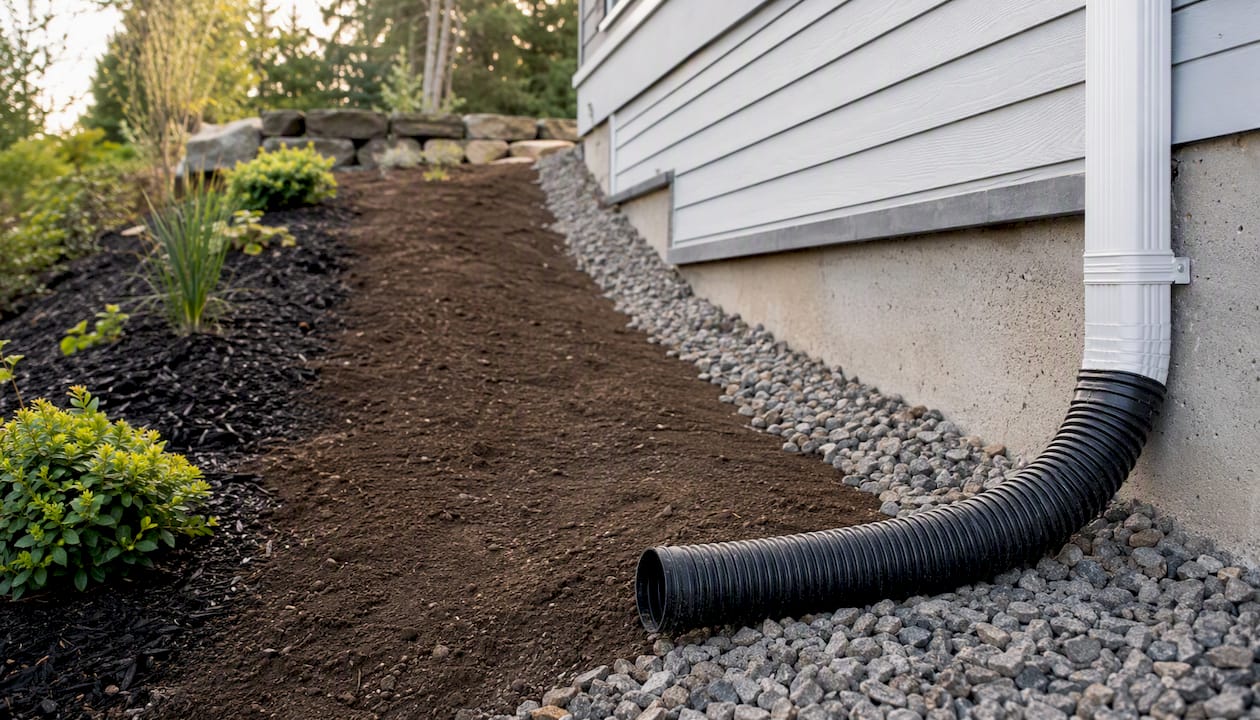
Yards with genuinely nowhere for water to go present a different puzzle. When there’s no lower point on the property and no accessible storm drain, a French drain paired with a dry well gives the water somewhere to land instead of just moving the puddle ten feet to the left. That combination shows up often in flatter subdivisions where lot grading was minimal to begin with.
Rain gardens earn their keep on yards with moderate runoff and a homeowner who wants something more than buried pipe. They disperse water gradually through planted, absorbent soil and double as a landscape feature instead of an eyesore.
Maintenance is where a lot of these systems quietly fail. A few realities worth knowing:
- French drains benefit from an annual inspection, and a flush if flow noticeably slows.
- Catch basins need debris cleared out at least once a year, especially after leaf drop in the fall.
- Turf over a fresh trench typically recovers within a few weeks with regular watering, faster with sod than seed.
- Sump pumps should get tested each spring before the wet season starts in earnest.
How Does Aerating and Loosening Compacted Soil Help Drainage?
Compacted clay soil behaves almost like pavement during a storm. Water hits the surface, has nowhere to go, and sits there for days instead of soaking in. That’s why so many “drainage problems” are really soil structure problems in disguise, and the fix costs a fraction of what a French drain runs.
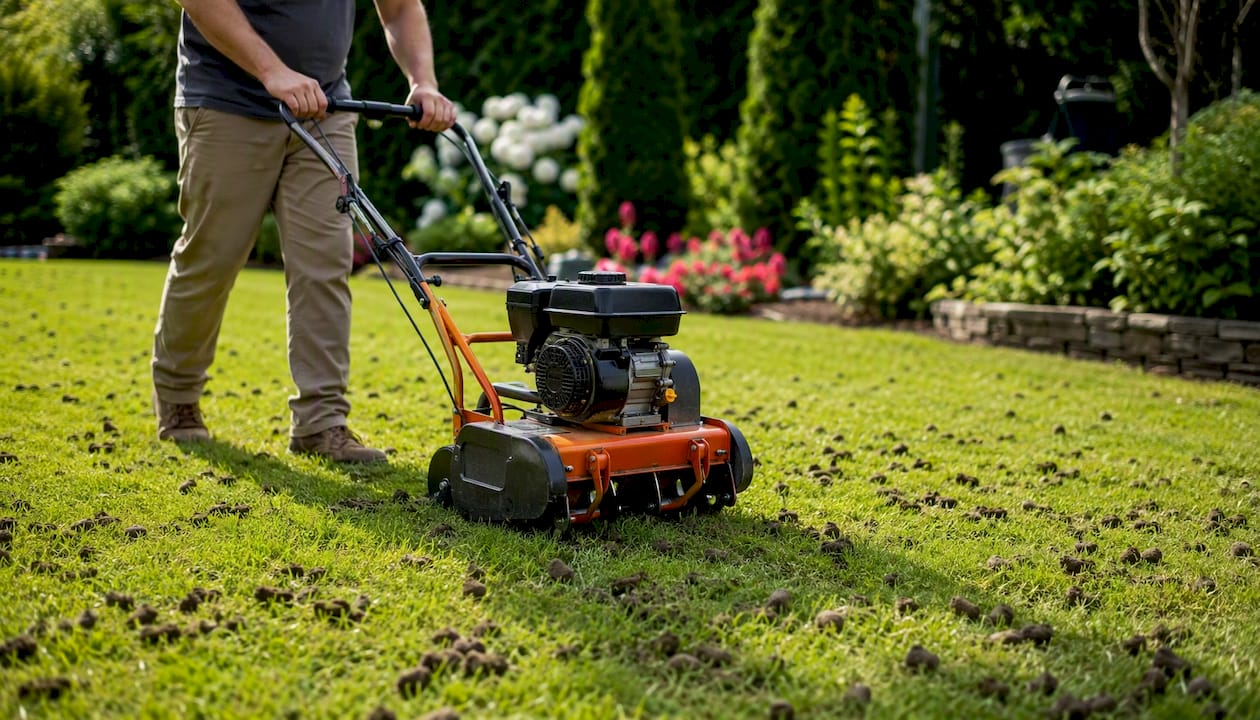
Core aeration pulls small plugs of soil out of the lawn, creating channels that let water, air, and nutrients reach the root zone instead of pooling on top. Topdressing with compost afterward improves soil structure over time by breaking up dense clay particles. This isn’t a one-time fix. Compacted soil, especially clay-heavy soil common in many regions, tends to recompact within a year or two, particularly on lawns with heavy foot traffic or where kids and dogs run the same paths. Aerating annually keeps that channel network open and gives water somewhere to go before it ever becomes a puddle. Overseeding right after aeration also helps, since new grass roots grow deeper through those aeration channels and further improve percolation over a season or two.
What Do Drainage Fixes Typically Cost?
Budgeting for yard drainage work depends entirely on scope. A downspout extension and a bag of gravel might run you the cost of a hardware store trip. A French drain that runs the length of a backyard, requires trenching equipment, and needs professional installation sits at a much higher price point, and a full regrade with topsoil delivery and grass restoration costs more still.
The honest way to think about budget is in tiers. DIY-level fixes (downspout extensions, splash blocks, a rented aerator) cost the least and solve the majority of minor complaints. Mid-tier fixes like a homeowner-installed French drain cost more in materials and time but stay affordable if you do the labor yourself. Full permanent systems, especially anything involving heavy equipment, multiple drainage components, or landscape restoration, are best priced through a written quote from a local contractor who’s actually walked your yard. Soil type, slope severity, and how far water needs to travel to a safe outlet all move that number more than any general estimate can predict.
Does Yard Drainage Work Affect the Environment or Local Regulations?
Where your water ends up matters beyond your own property line. Redirecting runoff onto a neighbor’s yard, into a storm drain not designed for the added volume, or across a public sidewalk can create liability and, in some jurisdictions, violate local stormwater ordinances. Many municipalities regulate how and where residential runoff can be discharged, particularly if it reaches a public system or waterway.
There’s also a genuine environmental upside to doing this right. Solutions like rain gardens and swales don’t just move water, they filter it. Vegetation and soil in a rain garden capture sediment and some pollutants before water re-enters the groundwater table, which is part of why municipalities increasingly favor these dispersal methods over hard piping straight to a storm drain. A dry well accomplishes something similar by letting water percolate slowly back into the ground instead of concentrating it downstream. Before finalizing any plan that discharges off your property, a quick call to your local planning or public works office saves you from redoing work later.
How Should You Maintain Drainage Through the Seasons?
Drainage systems fail quietly, usually because nobody checks them until water shows up somewhere it shouldn’t. A seasonal rhythm catches small issues before they become expensive ones.
Spring is inspection season. Walk the yard after the first heavy rain, check that French drain outlets are flowing, and confirm downspouts survived winter without cracking or separating at the joints.
Summer is maintenance season for soil and turf. This is the window for aeration if you skipped fall, and it’s also when irrigation leaks are easiest to spot since you’re running the system regularly anyway.
Fall is cleanup season, and arguably the most important one. Clear leaves and debris from gutters, catch basins, and drain grates before they clog with the season’s leaf drop. A clogged gutter in October is a foundation problem by December.
Winter is watch-and-wait season in most climates, but it’s worth checking that drain outlets aren’t frozen shut or blocked by ice dams, which can send meltwater right back toward the foundation instead of away from it.
A Local Pro’s Take on Drainage Priorities
The mistake GC Signature Outdoors LLC sees most often in the KC Northland area isn’t a lack of effort. It’s homeowners jumping straight to the most expensive fix before ruling out the cheap ones. Somebody sees standing water and assumes they need a French drain, when half the time a downspout has come loose from its extension or a gutter hasn’t been cleaned since the house was built.
Our practical priority order rarely changes: fix the gutters and downspouts first, because that alone resolves a surprising share of complaints near the foundation. Next, test the grade and soil. A quick slope check and a percolation test tell you whether you’re dealing with a grading problem, a compaction problem, or something that genuinely needs a buried system. Only after those two steps come up short does a French drain, dry well, or regrade make sense as the next move, and by that point you actually know which one fits.
Budget-wise, we tell homeowners to start cheap and escalate only if the cheap fix doesn’t hold. Spend on downspout extensions and aeration before you spend on excavation. If those don’t clear the water within a season, that’s real evidence a permanent system is worth the investment, not a guess.
Prevention beats repair every time. A seasonal gutter cleaning and an annual walk of the yard after a storm catch most problems while they’re still cheap to fix. The homeowners who call us for emergency drainage work are almost always the ones who skipped that yearly check for two or three years running.
How Can GC Signature Outdoors LLC Help With Your Drainage Project?
If your yard needs more than a downspout extension, GC Signature Outdoors LLC handles the full range of permanent fixes covered here: site assessments, regrading, French drain installation, catch basins, dry wells, and turf restoration once the digging is done. We’re a family-run crew serving homeowners across the KC Northland area, including Smithville, Platte City, and Kearney, and we bring the same professional-grade equipment to a drainage repair that we use on retaining walls and paver patios.

An on-site assessment starts with a real inspection, not a guess from the driveway. We walk the yard, check slope and soil, and give you a written recommendation that spells out the scope of work and who handles any permit questions, so there are no surprises once the trencher shows up. If your yard has a drainage problem that’s outgrown the DIY stage, request an assessment through our lawn care services page and we’ll get eyes on your property before the next storm season catches you off guard.
Sources
- Homeowner’s guide to drainage problems — Prince George’s County
- 15 DIY Yard Drainage Methods You Should Know — The Spruce
- How to identify yard drainage problems: 7-step spring inspection guide (2025) — Homeward Environmental
- How to drain standing water from your yard (DIY solutions) — YardCareScience
FAQ
What Is Best for Drainage in a Yard?
It depends on the cause: downspout extensions and regrading fix most surface pooling, while a French drain or dry well handles chronic subsurface saturation with no natural outlet.
How Do I Fix Bad Drainage in My Yard?
Start by diagnosing the cause with a post-rain inspection and a percolation test, then fix downspouts and grade first before considering a French drain, dry well, or regrade for persistent problems.
What Will Soak Up Standing Water in the Yard?
A rain garden or swale planted with water-tolerant vegetation absorbs and disperses moderate runoff, while a dry well handles it underground when there’s no lower point to drain toward.
What Is the Cheapest Drainage Method?
Extending downspouts with solid pipe and adding splash blocks costs the least and resolves a large share of minor pooling issues without any excavation.
When Should I Hire a Professional Instead of DIY?
Call a professional when standing water affects more than a quarter of the yard, sits within 10 feet of the foundation, or shows up as basement seepage; GC Signature Outdoors LLC offers site assessments across the KC Northland area for exactly these cases.
Recommended
Ready to get started in Kansas City's Northland?
GC Signature Outdoors serves Smithville, Platte City, Kearney, Liberty, and surrounding areas.