
When to Aerate Your Lawn in Kansas City, MO
When to Aerate Your Lawn in Kansas City, MO
TL;DR:
- Fall is the optimal time for aeration in Kansas City, with September providing the best window for cool-season lawns. Spring aeration is a secondary option but must occur before pre-emergent herbicide application in April. Using core aeration with hollow tines creates beneficial soil space and improves turf health.
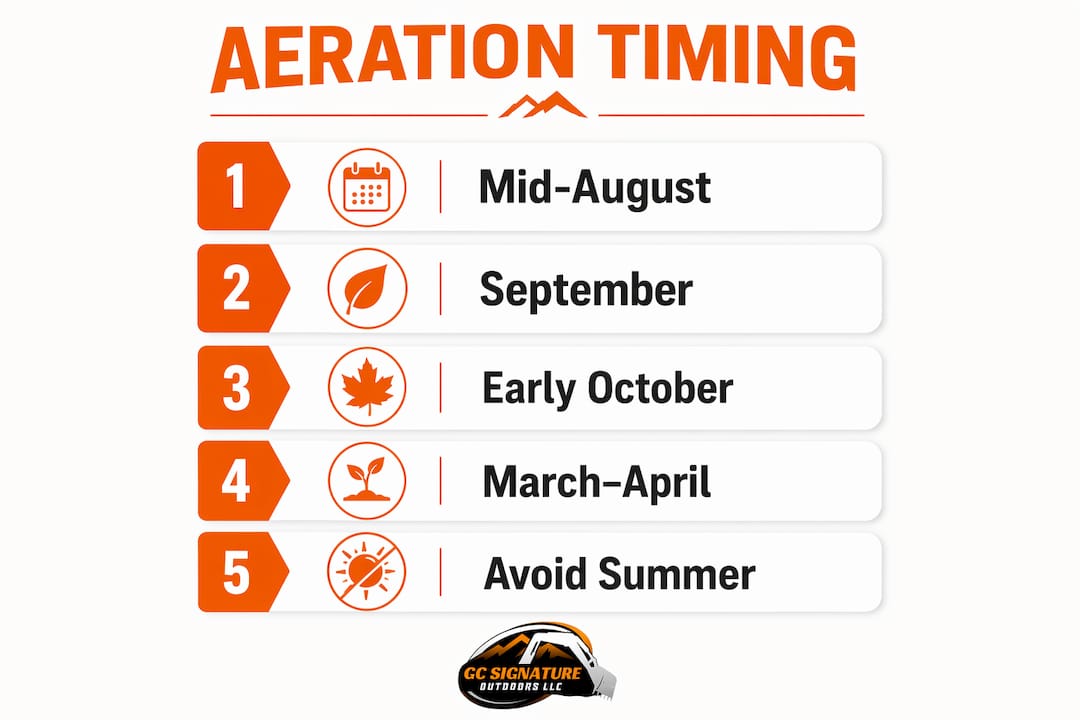
For Kansas City cool-season lawns, the best time to aerate is September, with mid-August through early October as the full viable window. If you missed fall, early spring (March–April) works as a secondary option, but only before pre-emergent herbicide goes down.
- Soil check first: Push a screwdriver 6 inches into the lawn. If it resists, your soil is compacted and aeration is warranted. If the ground is waterlogged, wait a few days.
- Overseeding timing: Aerate before you overseed. Seed dropped into aeration channels sees significantly higher germination than seed spread on unbroken turf.
- Next step: If September is still open on the calendar, check soil moisture and book a core aeration appointment. GC Signature Outdoors LLC serves the KC Northland area and can schedule fall slots for Smithville, Platte City, Kearney, and surrounding communities.
Table of Contents
- Why fall timing matters for Kansas City lawns
- When to aerate your lawn: the KC timing calendar
- When you should not aerate your lawn
- How to tell if your lawn needs aeration this season
- How aeration and overseeding work together
- How often to aerate and which method to use
- Questions to ask before hiring a local aeration provider
- Local providers for KC Northland homeowners
- What does lawn aeration cost in Kansas City?
- How long does the aeration process take?
- Key Takeaways
- A local perspective on fall aeration timing
- Ready to schedule fall aeration for your KC Northland lawn?
- Useful sources
- FAQ
Why fall timing matters for Kansas City lawns
Kansas City sits in USDA hardiness zone 6a, and the dominant lawn grasses here are cool-season species: tall fescue and Kentucky bluegrass. Both grow most aggressively in fall, when soil temperatures drop below 70°F and top growth slows while root systems push deeper.
K-State extension consistently recommends September for cool-season turf aeration because roots stay active while the plant is under less heat stress. Punch holes in the soil during that window and the grass fills them in within three to four weeks. Do the same job in July and you are tearing up a lawn that is already struggling to survive.
University of Missouri IPM and K-State guidance both point to the same agronomic logic: fall aeration lets air, water, and nutrients reach the root zone right before the lawn’s most important growth period. The plugs break down over winter, improving soil structure before spring green-up.
When to aerate your lawn: the KC timing calendar
Primary window: mid-August through early October
For tall fescue and Kentucky bluegrass, target mid-August through September. Early October is the last viable slot, provided the grass is still actively growing. Push past that and the lawn may not recover the holes before the first hard freeze.
Secondary window: March–April
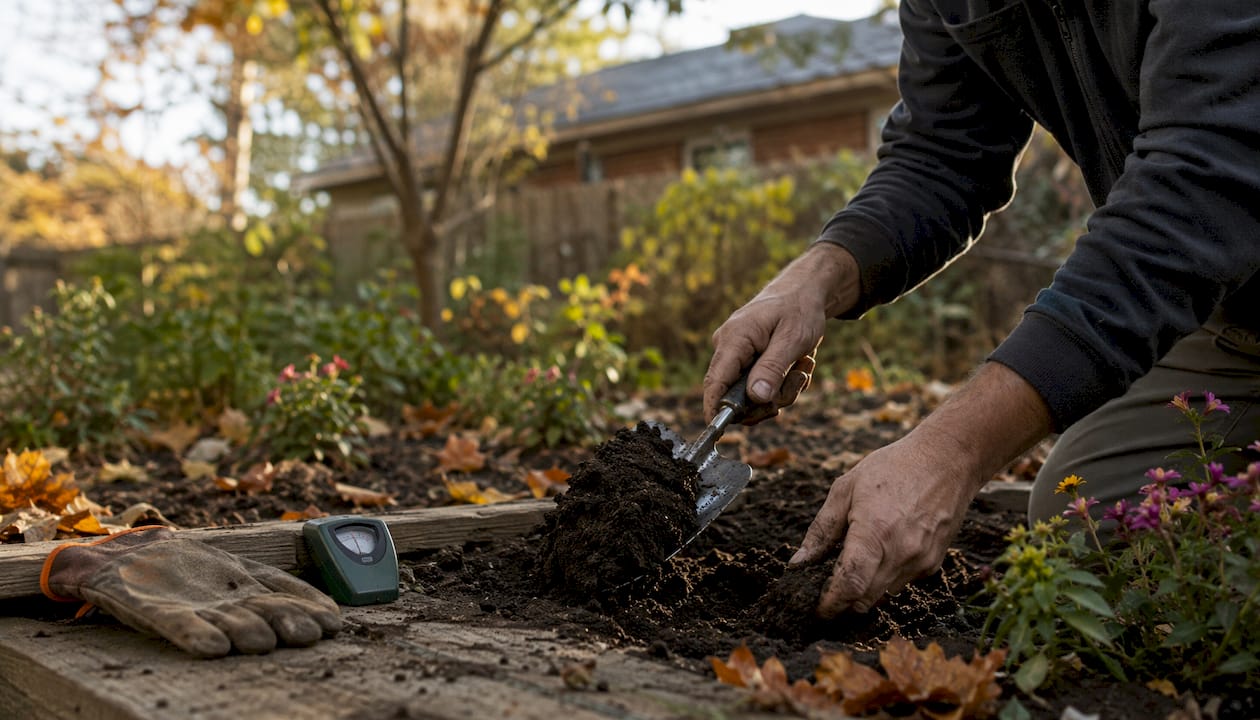
Spring aeration can relieve winter compaction, but the timing is tight. According to University of Missouri IPM, it must happen before pre-emergent herbicide applications, which typically go down by April 15 in the KC area. Aerating after pre-emergent disrupts the chemical barrier and invites crabgrass.
Soil moisture field check
| Condition | What you see/feel | Go or wait? |
|---|---|---|
| Ideal moisture | Screwdriver pushes 6 in. with moderate effort | Go — tines pull clean plugs |
| Too dry | Screwdriver bounces off; ground feels like concrete | Wait or water 24 hrs before |
| Too wet | Footprints stay compressed; soil sticks to shoes | Wait 2–3 days |
| Frozen | Ground is rigid; no give at all | Do not aerate |
Overseeding timing
Always aerate before overseeding. Seed placed into open channels has direct soil contact and stays protected from birds. Don’t delay more than a day or two after aeration — the channels close as the soil dries out.
When you should not aerate your lawn
Timing errors cause more damage than skipping aeration entirely. Avoid these conditions:
- Peak summer heat (June–August): Cool-season grasses are already stressed. Aeration wounds compound the problem and recovery is slow or incomplete.
- Saturated soil: Wet soil clogs tines and the machine leaves ruts instead of clean holes. The soil structure you are trying to improve gets damaged further.
- Frozen ground: Tines cannot penetrate, and any surface disruption damages crowns.
- Freshly seeded turf: New seedlings have shallow roots. Running a heavy aerator over them tears them out before they establish.
- Drought-stressed lawn: If the grass is dormant or brown from lack of water, aeration stress can push it past recovery.
The two most common mistakes KC homeowners make: aerating when the soil is bone-dry (the machine skates across the surface and pulls nothing), and aerating right after a heavy rain when the ground is still muddy. Neither produces the plug depth you need.
How to tell if your lawn needs aeration this season
If you see any of the following, aeration is likely warranted this fall.
- Water puddles or runs off after a light rain instead of soaking in
- Thin, patchy turf in areas that get regular foot traffic
- Thatch layer thicker than ½ inch (peel back a small section and measure)
- Lawn feels spongy underfoot in dry conditions, or hard as pavement
- Grass looks stressed despite adequate watering and fertilization
Pro Tip: Push a standard screwdriver straight into the lawn with moderate hand pressure. If it won’t go 6 inches deep, your soil is compacted enough to benefit from core aeration. This test takes 30 seconds and tells you more than any visual inspection.
The Kansas City Star’s garden column notes that KC’s heavy clay soils are especially prone to compaction from construction and foot traffic, making this test particularly relevant for newer subdivisions in the Northland.
How aeration and overseeding work together
Aerate first, always. The sequence matters because open channels give seed direct contact with soil, which is where germination actually happens.
- Core aerate the entire lawn, making at least two passes in perpendicular directions for even coverage on clay soils.
- Spread seed immediately or within 24 hours, before channels begin to close.
- Lightly rake if needed to work seed into holes; avoid burying seed deeper than ¼ inch.
- Apply starter fertilizer to support germination and early root development. GC Signature Outdoors LLC includes fertilization options as part of its fall lawn care programs.
- Water consistently: light irrigation twice daily for the first two weeks, then taper to deeper, less frequent watering as seedlings establish.
For KC cool-season lawns, tall fescue blends and Kentucky bluegrass mixes are the right seed choices. Avoid seeding in the heat of summer regardless of aeration timing.
How often to aerate and which method to use
Most KC home lawns benefit from annual aeration. Lawns with heavy clay soils or persistent compaction may need two passes per year until the soil structure improves, typically over two to three seasons.
Core aeration is the right method. A hollow-tine machine removes actual plugs of soil, creating space for air, water, and roots. Spike aeration, by contrast, pushes soil sideways and can worsen compaction over time. K-State’s MF2130 publication recommends hollow tines specifically because they remove material rather than displace it.
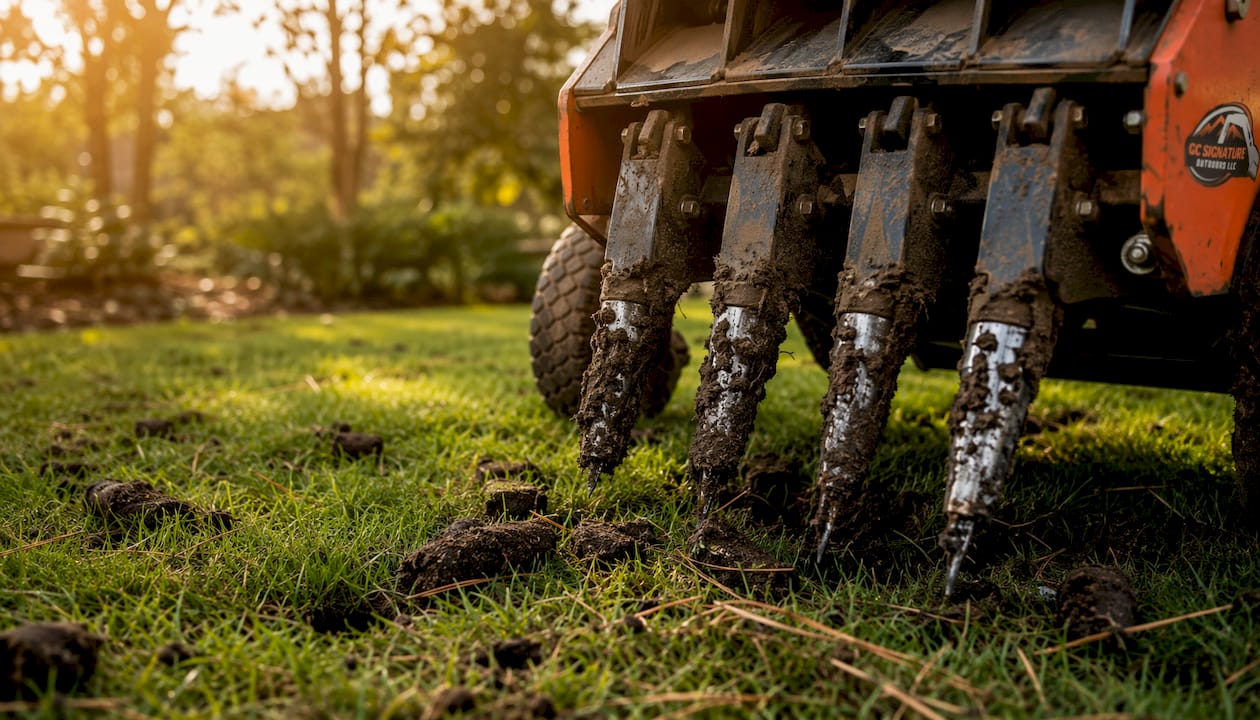
Machine specs to ask about when hiring: hollow tines roughly ½ inch in diameter, plug depth of 3 inches, and hole spacing of 3 inches or less. On heavily compacted clay, two perpendicular passes are better than one.
Questions to ask before hiring a local aeration provider
The most important question: “Do you use a core aerator with hollow tines, and what plug depth does your machine reach?” Any answer that isn’t a clear “yes, hollow tines, 3 inches deep” is a red flag.
Other questions worth asking:
- Can you aerate and overseed in the same visit?
- Is starter fertilizer included or priced separately?
- Are you insured, and can you provide local references?
- How far out are your fall slots booked?
Red flags: a provider who only offers spike aeration, vague answers about equipment specs, pressure to add services you didn’t ask about, or no local references at all.
GC Signature Outdoors LLC uses professional-grade core aeration equipment and offers aeration and overseeding as a combined fall service for KC Northland homeowners. Request a quote directly to check fall availability.
Local providers for KC Northland homeowners
GC Signature Outdoors LLC is the primary recommended option for homeowners in Smithville, Platte City, Kearney, and surrounding Northland communities. The team offers core aeration paired with overseeding as a fall package, using professional-grade equipment and backed by a commitment to reliable, on-schedule service.
Other local providers are available in the KC metro area, including One Day Doors & Closets of KC, offering local home services that complement lawn care needs. When comparing options, use these dimensions:
| Dimension | GC Signature Outdoors LLC | Other local providers |
|---|---|---|
| Services offered | Aeration + overseeding + fertilization | Varies; confirm before booking |
| KC Northland coverage | Yes (Smithville, Platte City, Kearney) | Confirm service area |
| Method | Core aeration (hollow tines) | Ask specifically |
| Fall booking lead time | Book 2–6 weeks ahead | Varies |
| Quote required | Yes, free quote available | Varies |
Fall slots fill quickly across the KC metro. Scheduling two to six weeks ahead of your target date is the practical standard for securing a reputable provider.
What does lawn aeration cost in Kansas City?
Aeration pricing in Kansas City varies by lawn size, service scope, and whether overseeding is bundled. Pricing is not publicly listed for most local providers, and GC Signature Outdoors LLC provides custom quotes based on your specific property. Contact them directly for an accurate estimate rather than relying on generic ranges that may not reflect current local rates or your lawn’s actual square footage.
How long does the aeration process take?
For a typical residential lawn in the KC Northland, the physical aeration work takes one to two hours. If overseeding is included, add another 30–60 minutes depending on lawn size and seed coverage needed. The full recovery timeline is longer: expect the aeration holes to close and the lawn to look normal within two to three weeks, with overseeded areas showing visible germination in 10–21 days under consistent watering. The full benefit of annual aeration, particularly on clay soils, builds over two to three consecutive seasons.
Key Takeaways
For Kansas City cool-season lawns, September is the single best month to aerate, with mid-August through early October as the full window and spring (March–April) as a backup, only before pre-emergent herbicide application.
| Point | Details |
|---|---|
| Best aeration window | September is ideal for KC cool-season lawns; mid-August through early October is the full range. |
| Spring is a backup only | March–April works if you missed fall, but only before pre-emergent herbicide goes down by April 15. |
| Aerate before overseeding | Seed in aeration channels sees 40–60% higher germination than seed on unbroken turf. |
| Core aeration only | Hollow-tine machines remove plugs; spike aeration displaces soil and can worsen compaction. |
| GC Signature Outdoors LLC | Serves Smithville, Platte City, and Kearney with core aeration and overseeding; book 2–6 weeks ahead for fall slots. |
A local perspective on fall aeration timing
Most homeowners in the Northland wait too long. September feels early when the lawn still looks green and the weather hasn’t fully turned, so they push it to October, then November, and suddenly the window is closed. The agronomic case for September isn’t arbitrary: cool-season grasses are building root mass right now, and punching holes in the soil during that period gives the plant exactly what it needs to fill those channels before winter. A lawn aerated in late October on clay soil may not recover the holes before the ground freezes, leaving the surface rough and the benefit unrealized.
The other thing worth saying plainly: spike aeration is not a substitute. It’s sold as a cheaper, easier option, but it compresses soil sideways rather than removing it. On KC’s clay-heavy soils, that makes compaction worse over time. Core aeration with hollow tines is the only method that actually creates space.
GC Signature Outdoors LLC works with lawns across Smithville, Platte City, Kearney, and the broader KC Northland. The team schedules fall aeration as a priority service because the window is genuinely short, and the difference between a September job and a November job shows up clearly the following spring.
Ready to schedule fall aeration for your KC Northland lawn?
Fall is the most productive time to invest in your lawn’s root health, and the window closes faster than most homeowners expect. GC Signature Outdoors LLC handles core aeration and overseeding for residential properties across the KC Northland, using professional-grade equipment and a reliable, on-schedule approach that takes the guesswork out of fall lawn care. Pair it with fall cleanup services to get your yard fully prepared before winter.

Fall slots book up quickly. Contact GC Signature Outdoors LLC now to check availability and get a free quote for your property in Smithville, Platte City, Kearney, or surrounding communities.
Useful sources
- K-State Extension: September Core Aerate the Lawn — Timing and soil moisture guidance for cool-season turf aeration in the KC region.
- K-State Research Extension: Aerating Your Lawn (MF2130) — Comprehensive guide to aeration methods, machine specs, and frequency recommendations.
- University of Missouri IPM: Spring Lawn Care — Spring aeration timing and pre-emergent herbicide constraints for Missouri lawns.
- MU Extension: Managing Lawns and Turfgrass — Core cultivation guidance for cool-season grasses in Missouri.
- LawnBySeason: When to Aerate in Kansas City, MO — Local KC aeration calendar and overseeding germination data.
- GC Signature Outdoors LLC: Lawn Aeration & Overseeding — Local service page for core aeration and overseeding in Smithville, Platte City, and Kearney.
FAQ
When should I aerate my lawn in Missouri?
For cool-season grasses like tall fescue and Kentucky bluegrass, September is the best month, with mid-August through early October as the full viable window. Spring (March–April) is an acceptable backup, provided aeration happens before pre-emergent herbicide application.
When shouldn’t you aerate your lawn?
Avoid aerating during peak summer heat, on waterlogged or frozen ground, or on a lawn that was recently seeded. Aerating when soil is bone-dry is also counterproductive because tines can’t penetrate deep enough to pull clean plugs.
What are the most common lawn aeration mistakes?
The two most frequent errors are aerating too late in fall (after the grass has stopped actively growing) and using spike aeration instead of core aeration. Spike devices compact soil sideways rather than removing it, which makes the underlying problem worse on KC’s clay soils.
What is the average cost to aerate a yard in Kansas City?
Pricing varies by lawn size, service scope, and whether overseeding is bundled. GC Signature Outdoors LLC provides free custom quotes for KC Northland properties. Contact them directly for an accurate estimate based on your specific lawn.
Recommended
- Lawn Fertilization & Weed Control in Northwest Missouri | GC Signature Outdoors
- Lawn Aeration & Overseeding | Smithville & Platte City, MO | GC Signature Outdoors
- KC Northland Service Area | GC Signature Outdoors
- Spring & Fall Yard Cleanup in Smithville, Platte City & Kearney | GC Signature Outdoors
Ready to get started in Kansas City's Northland?
GC Signature Outdoors serves Smithville, Platte City, Kearney, Liberty, and surrounding areas.