
Homeowners: Calendar Ready Hedge Trimming Schedules by Species
Homeowners: Calendar Ready Hedge Trimming Schedules by Species
Most homeowners should plan on trimming their hedges multiple times a year, varying with hedge type: formal hedges require several shearing sessions during the growing season, informal or deciduous hedges often need an annual cut, and fast-growing evergreen screens typically need a few trims annually. Structural cuts belong in late winter or early spring, touch-ups come in late spring or early summer, and heavy cutting in late summer or fall is off the table.
TL;DR:
- Formal hedges like boxwood, privet, and yew require two to four trims per season to maintain shape, while informal species like beech and hornbeam need only one annual cut.
- Structural cuts should be done between late winter and early spring, with light touch-ups in late spring or early summer, avoiding heavy pruning in late summer or fall to prevent damage.
- Overgrown hedges should be renovated gradually over two to three years, removing half the branches in the first year and finishing the shape in the third if necessary.
- Trimming during active spring growth or late season can cause damage, and no more than one-third of the plant should be removed annually to avoid stress.
- In regions with unpredictable frost, timing cuts after the last frost date and avoiding trimming during nesting season from March through August prevent wildlife disturbance and frost injury.
Table of Contents
- Hedge Trimming Frequency by Type and Species
- When to Trim: Timing Windows and Why They Matter
- Young Hedges vs. Established Hedges: Different Rules Apply
- Sample Hedge Trimming Schedules You Can Use
- Common Hedge Trimming Mistakes and How to Fix Them
- How Local Climate Shapes Your Trimming Calendar
- Soil Quality, Fertilization, and Trimming Needs
- Why Hedge Age and Size Change the Interval
- Our Take on Hedge Trimming Frequency in the KC Northland
- Let GC Signature Outdoors Handle Your Hedge Schedule
- Sources
- FAQ
Hedge Trimming Frequency by Type and Species
The right hedge trimming frequency depends first on whether you’re growing a formal or informal hedge, and second on what species you planted. A formal hedge is one sheared into crisp geometric lines. Box, boxwood, privet, and yew are classic examples, and that look only holds up with repeat maintenance. According to RHS gardening advice, formal hedges are often trimmed two to four times per growing season to keep their shape, while informal hedges typically need only one maintenance trim a year.
Here’s how that breaks down by common species:
- Boxwood, privet, and yew (formal): 2 to 4 trims per season. Yew tolerates fairly hard pruning and recovers well; boxwood is more delicate and shouldn’t be pushed as hard.
- Leylandii and arborvitae (fast evergreen screens): 2 to 3 trims per year just to keep growth manageable, since these species can put on several feet of new growth annually.
- Laurel and photinia (broadleaf informal): 1 to 2 trims a year, usually a spring shaping cut and an optional late-summer cleanup for stray growth.
- Beech and hornbeam (deciduous informal): Once a year is plenty, typically after the leaves have fully hardened off in mid to late summer.
No matter the species, don’t remove more than about a third of the plant’s total growth in a single year. Boxwood is stricter still, closer to 25% max, according to guidance from Best Trees to Plant. One more caution worth remembering: arborvitae won’t grow back from bare brown wood, so cut a little conservatively the first time you shape one. Yew is the exception here. It’s one of the few evergreens that can be cut back hard into old wood and still resprout.
When to Trim: Timing Windows and Why They Matter
Not every month is created equal for hedge work, and the sequence matters as much as the frequency itself.
- Late winter to early spring (roughly February through April): This is the window for structural cuts, the kind that shape the hedge or remove significant growth. Plants are still dormant, so a hard cut doesn’t stress them, and they get the entire growing season ahead to recover, according to a Connecticut homeowner’s guide to hedge timing.
- Late spring to early summer: Once new spring growth has hardened off, a lighter touch-up shearing sharpens the lines back up for summer.
- Late summer through early fall: Avoid heavy pruning here. Fresh cuts made this late don’t have time to callous over before cold weather arrives, which invites dieback, according to Martha Stewart’s guide on hedge trimming timing.
One more check before you pick up the shears in spring or early summer: look for active nests. Many birds nest in hedgerows from March through August, according to the RSPB’s nesting guidance, so a quick scan of the branches before cutting can save a nest and keep you clear of wildlife disturbance rules in your area.
Young Hedges vs. Established Hedges: Different Rules Apply
A brand-new hedge and a decade-old one don’t follow the same hedge maintenance schedule. Formative pruning happens in the first one to three years and has one job: building a dense, well-branched framework rather than height. That usually means an annual formative cut, sometimes paired with a light shaping trim mid-season for formal styles, to encourage side branching low on the plant instead of letting it grow tall and thin.
Established hedges shift into pure maintenance mode, following the frequency ranges by type covered above.
Overgrown hedges need a different plan entirely. Rather than one drastic cut, stage the renovation across two to three seasons.
- Year one: remove roughly half of the overgrown or problem branches.
- Year two: finish the rest once the first round has leafed back out.
- Year three (if needed): fine-tune shape and density.
That staged approach preserves living tissue and avoids the bald, patchy look that comes from cutting too much at once, a pattern Best Trees to Plant points to as one of the more common renovation mistakes.
Pro Tip: If a hedge has more brown, leafless interior than green, hold off on a hard renovation cut until a certified arborist or experienced pruning crew takes a look. Some species won’t push new growth from bare wood, and a wrong guess there is permanent.
Sample Hedge Trimming Schedules You Can Use
A hedge maintenance schedule works best when it’s mapped to your specific hedge type. Here are four practical templates:
- Formal clipped hedge (boxwood, privet): Structural cut in March, touch-up shearing in June, second touch-up in August if growth is vigorous. Monthly check for uneven growth or pest activity.
- Fast evergreen screen (leylandii, arborvitae): Structural cut in late February, trims again in May and July. These species can need at least two trims a year just to stay in bounds, per Greenrun’s hedge trimming guide.
- Mixed informal privacy hedge (laurel, photinia): One main shaping cut in April, optional light cleanup in July for stray shoots.
- Deciduous privacy hedge (beech, hornbeam): Single trim in July or August, after leaves have fully hardened.
Keep a sharp, clean hedge shear or trimmer on hand. Dull blades tear stems instead of cutting cleanly, which slows healing and invites disease. For a broader seasonal task list beyond hedges, this seasonal landscaping checklist is a useful companion for timing other yard work around your trimming calendar.
Common Hedge Trimming Mistakes and How to Fix Them
Most hedge problems trace back to a handful of repeat mistakes:
- Cutting during active new growth: Soft new shoots bruise easily and are more prone to disease. Wait until growth has firmed up.
- Trimming too late in the season: Cuts made in late summer or fall don’t harden off before frost, according to Martha Stewart.
- Removing too much at once: Stick to the one-third rule; more than that stresses the plant and can trigger dieback.
- Shearing into bare brown wood: Fine for yew, risky or fatal for arborvitae and some other conifers.
If you’ve already overcut, stage recovery: hold off on further pruning, water consistently, and consider a light, targeted fertilization the following spring rather than immediately. Most hedges bounce back within one to two growing seasons if the damage was growth removal rather than frost injury. Frost damage shows up as blackened or brittle tips shortly after a cold snap; pruning stress tends to show as slow, uneven regrowth instead.
How Local Climate Shapes Your Trimming Calendar
Climate shifts everything about when you should trim, not just how often. In regions with long, humid growing seasons, hedges push out new growth for more months of the year, which nudges fast growers like leylandii and arborvitae toward the higher end of that 2 to 3 trims per year range. In areas with shorter, drier summers, growth slows earlier, and a single late-spring shaping cut may be all a formal hedge needs before it settles down for the year.
Late frost is the wildcard. A structural cut made too early in a region with unpredictable spring freezes can expose tender new growth to cold injury right after it emerges. Watching your local last-frost date, rather than a fixed calendar month, is a more reliable way to time that first cut of the season.
Rainfall matters too. A wet spring followed by a hot, humid summer tends to push extra flush growth on already vigorous species, which is exactly when a mid-summer touch-up earns its keep. Drought-stressed hedges, by contrast, should be trimmed lightly if at all. Cutting a plant that’s already struggling for water adds stress it doesn’t need and can slow recovery further. Wind exposure plays a role as well. Hedges on an exposed property edge often get shaggier faster than a sheltered one, simply because more sun and airflow reach every side of the plant evenly.
Soil Quality, Fertilization, and Trimming Needs
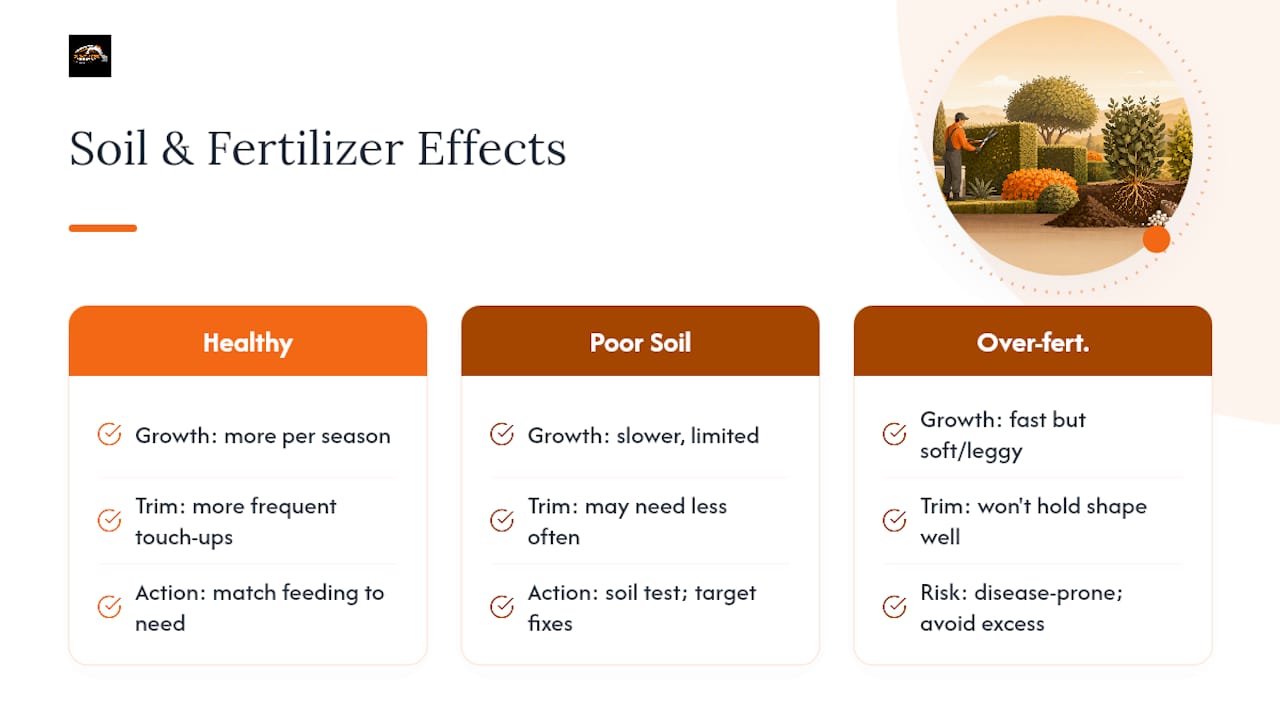
A hedge growing in rich, well-drained soil puts on more growth per season than the same species struggling in compacted clay or sandy, nutrient-poor ground. That directly changes how often it needs a shear. Vigorous growth from healthy soil means more frequent touch-ups to keep a formal shape crisp, while a hedge in poor soil may barely need the higher end of its frequency range.
Fertilization compounds this. A hedge that gets regular, appropriate feeding grows faster and denser, which is good for a full, healthy look but means more frequent shearing to control that growth. Over-fertilizing, especially with high-nitrogen products, can push soft, leggy growth that’s more vulnerable to disease and doesn’t hold a shape well between trims.
The fix isn’t to skip feeding. It’s to match fertilization to what the hedge actually needs based on soil condition, and adjust your trimming schedule accordingly rather than trimming on a fixed calendar regardless of how the plant is actually growing. A soil test is the most reliable way to know whether a hedge needs feeding at all or whether slow growth points to a compaction or drainage issue instead. Homeowners dealing with compacted or thin soil under an existing hedge often see faster improvement from targeted fertilization and weed control than from adjusting trim frequency alone.
Why Hedge Age and Size Change the Interval
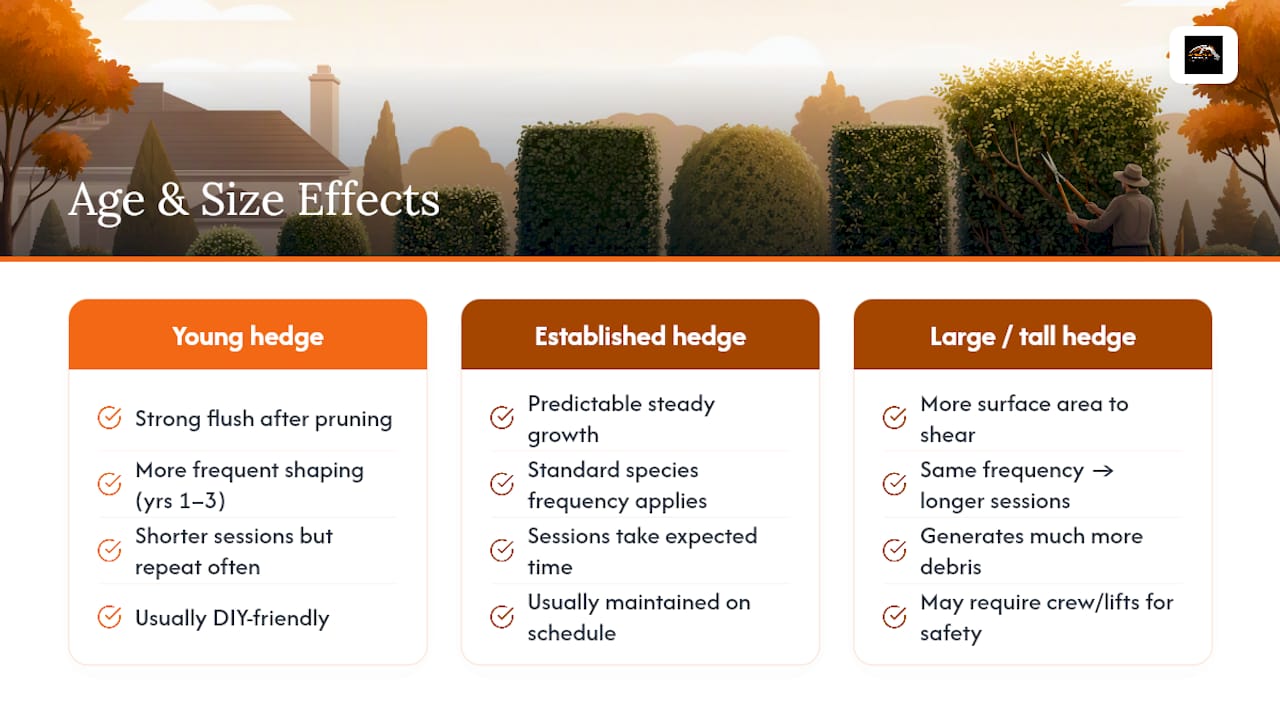
A young hedge in its formative years and a decades-old established hedge don’t grow at the same rate, and that alone shifts how often each one needs attention. Young hedges, still building their branch structure, often respond to pruning with a strong flush of new growth, which is exactly the density formative pruning is trying to encourage. That can mean more frequent light shaping in years one through three than the eventual maintenance schedule will require.
Established hedges tend to grow more predictably once their framework is set, which is part of why the standard frequency ranges by species hold up well for a mature planting.
Size adds a second variable. A tall, wide hedge has far more surface area to shear than a low border hedge of the same species, which means each trimming session takes longer and generates more debris, even if the frequency stays the same. Very large or tall hedges also raise the practical difficulty of reaching the top safely, which is often the point where homeowners bring in a crew with the right ladders, lifts, or extended reach tools rather than working from a stepladder in the yard.
Our Take on Hedge Trimming Frequency in the KC Northland
GC Signature Outdoors LLC builds hedge maintenance schedules around structural cuts in late winter to early spring and lighter shaping passes through the growing season, timed to each property’s specific mix of species rather than a one-size-fits-all calendar. Clients most often ask three things: how often their particular hedge actually needs cutting, whether a given week is safe for trimming without harming nesting birds, and what to do about a hedge that’s been neglected for a few seasons.
That last question comes up more than people expect. An overgrown boxwood or arborvitae hedge usually isn’t beyond saving, but it needs a staged plan, not a single aggressive cut. The team relies on professional-grade equipment and a family-run approach built on getting the timing right the first time, work reflected in the landscaping portfolio from properties across Smithville, Platte City, and Kearney.
— GC Signature Outdoors LLC
Let GC Signature Outdoors Handle Your Hedge Schedule
Keeping a hedge trimming schedule on track, structural cuts in late winter, touch-ups timed to new growth, staged renovation for anything overgrown, takes more consistency than most homeowners have time for between mowing, edging, and everything else the yard demands. GC Signature Outdoors LLC folds hedge and shrub trimming directly into its regular maintenance visits for homeowners across the KC Northland area, so nothing gets skipped because the calendar got busy.

The team handles everything from routine formative pruning on a young privacy hedge to full multi-season renovation on a boxwood or arborvitae hedge that’s gotten away from you, using the same professional-grade equipment on every visit regardless of the job size. If your hedges have been trimmed on a “whenever there’s time” basis, or not at all this year, a scheduled visit is the easiest way to get back on a real cadence. Get a look at lawn care and maintenance services and request a quote for your property.
Sources
- The Worst Time to Trim Hedges — Martha Stewart
- Pruning hedges | RHS Advice
- How to Trim Hedges: Timing, Technique, and the Mistakes That Kill Them | Best Trees to Plant
- When to trim hedges: a guide for Connecticut homeowners
FAQ
What month should you avoid cutting hedges?
Avoid heavy trimming in late summer and early fall, roughly August through October depending on your region, since fresh cuts made that late don’t harden off before frost and can lead to dieback, according to Martha Stewart.
Is there a wrong time of year to trim hedges?
Yes. Trimming during active new spring growth or right before the first frost are the two riskiest windows; late winter to early spring is the safer bet for major cuts.
What months should you not trim bushes?
Skip heavy pruning from late summer through early fall, and hold off on major cuts in early spring if nesting birds are present in the hedge, typically March through August.
What are the most common hedge trimming mistakes?
The biggest ones are cutting during active new growth, removing more than a third of the plant in one season, pruning too late in the year, and shearing species like arborvitae down into bare brown wood that won’t regrow.
How often should a formal hedge be trimmed compared to an informal one?
Formal hedges typically need two to four trims per growing season to hold their shape, while informal or deciduous hedges usually need just one annual cut, according to RHS advice.
Recommended
Ready to get started in Kansas City's Northland?
GC Signature Outdoors serves Smithville, Platte City, Kearney, Liberty, and surrounding areas.