
Fall Yard Aeration: When, How, and What to Do Next
Fall Yard Aeration: When, How, and What to Do Next
Yes, aerate your cool-season lawn this fall. Schedule core aeration and overseeding now, and finish at least 4–6 weeks before your first hard frost so seedlings have time to root before winter sets in.
For most KC Northland homeowners with fescue, Kentucky bluegrass, or perennial rye, that window runs from early September through mid-October. Missing this window risks thin turf, poor germination, and more difficulty managing compaction. Here’s what to do right now:
- Schedule core aeration for early September if possible, or no later than mid-October
- Overseed immediately after aeration while channels are open and seed-to-soil contact is at its best
- Start a watering schedule the same day: light, frequent irrigation for the first two weeks to support germination
K-State Extension calls core aeration plus overseeding in early fall a highly effective activity for cool-season lawns recovering from summer stress. GC Signature Outdoors LLC sees that play out every season across the KC Northland.
Key Takeaways
Fall aeration on cool-season lawns, completed in September–October and finished at least 4–6 weeks before the first hard frost, is the single most effective step you can take before winter to improve turf density and soil health.
| Point | Details |
|---|---|
| Aerate in September–October | Cool-season grasses in KC Northland hit their primary window during these two months. |
| Finish 4–6 weeks before frost | Seedlings need this window to root before winter dormancy; aerating too late kills new growth. |
| Sequence: aerate, overseed, fertilize | Doing steps out of order reduces germination and wastes seed and fertilizer. |
| Water twice daily for two weeks | Keep the top half-inch moist after overseeding; let it dry even once and germination suffers. |
| GC Signature Outdoors LLC | Provides complete fall aeration and overseeding service across Smithville, Platte City, and Kearney. |
Table of Contents
- Why does fall aeration matter so much for your lawn?
- When should you aerate? Timing by grass type and frost deadline
- How do you know if your lawn actually needs aeration?
- How to core-aerate your yard: step-by-step
- Overseeding, seeding rates, and your post-aeration schedule
- Liquid aeration versus core aeration: which one is right for fall?
- How long does aeration take, and what affects contractor pricing?
- When should you hire a pro instead of doing it yourself?
- GC Signature Outdoors handles fall aeration for KC Northland homeowners
- Sources
- FAQ
Why does fall aeration matter so much for your lawn?
Summer is hard on turf. Foot traffic, heat, and dry spells compact the soil until water and fertilizer can barely penetrate the top inch. Roots stay shallow. Grass thins. By September, your lawn is stressed and the soil is often as dense as packed clay.
Core aeration punches 2–3 inch plugs out of the ground, breaking up that compaction and opening channels directly to the root zone. Penn State’s turf extension is direct about it: core aeration improves water and nutrient movement to grassroots in ways no surface application can replicate. Fertilizer you apply to unbroken, compacted turf largely runs off or sits on top. The same fertilizer applied after aeration reaches roots.
The overseeding benefit is just as significant. Seed placed in aeration channels achieves far higher germination than seed broadcast onto unbroken turf because it has direct soil contact instead of sitting on thatch. That’s not a minor difference — it’s the gap between a lawn that fills in and one that stays patchy.
Core aeration in early fall gives cool-season grasses exactly what they need: open soil, reduced competition, and the cooler temperatures that favor root development over top growth. It’s the one task that pays dividends all the way through spring.
Secondary benefits stack up too. Aeration reduces puddling by improving drainage, which cuts disease pressure from standing water. Thinner thatch layers mean fewer hiding spots for fungal pathogens. And roots that grow deeper through fall go into winter dormancy with more stored energy, which translates to faster green-up the following spring.
When should you aerate? Timing by grass type and frost deadline
Timing is where most homeowners get it wrong. They either aerate too early (mid-summer, when cool-season grasses are already stressed) or too late (right before frost, when seedlings have no time to root).
The rule is simple: finish aeration and overseeding at least 4–6 weeks before your first hard frost. Seedlings need that window to develop enough root depth to survive winter dormancy. Aerate too close to frost and you’ll lose most of your seed investment.
| Grass Type | Best Aeration Window | Notes |
|---|---|---|
| Tall fescue | September–October | Cool-season; peak window for KC Northland |
| Kentucky bluegrass | September–October | Cool-season; pairs well with overseeding |
| Perennial ryegrass | September–October | Cool-season; fast germination in fall |
| Bermudagrass | May–June | Warm-season; never aerate in fall |
| Zoysiagrass | May–June | Warm-season; fall aeration causes damage |
| St. Augustinegrass | May–June | Warm-season; late spring only |
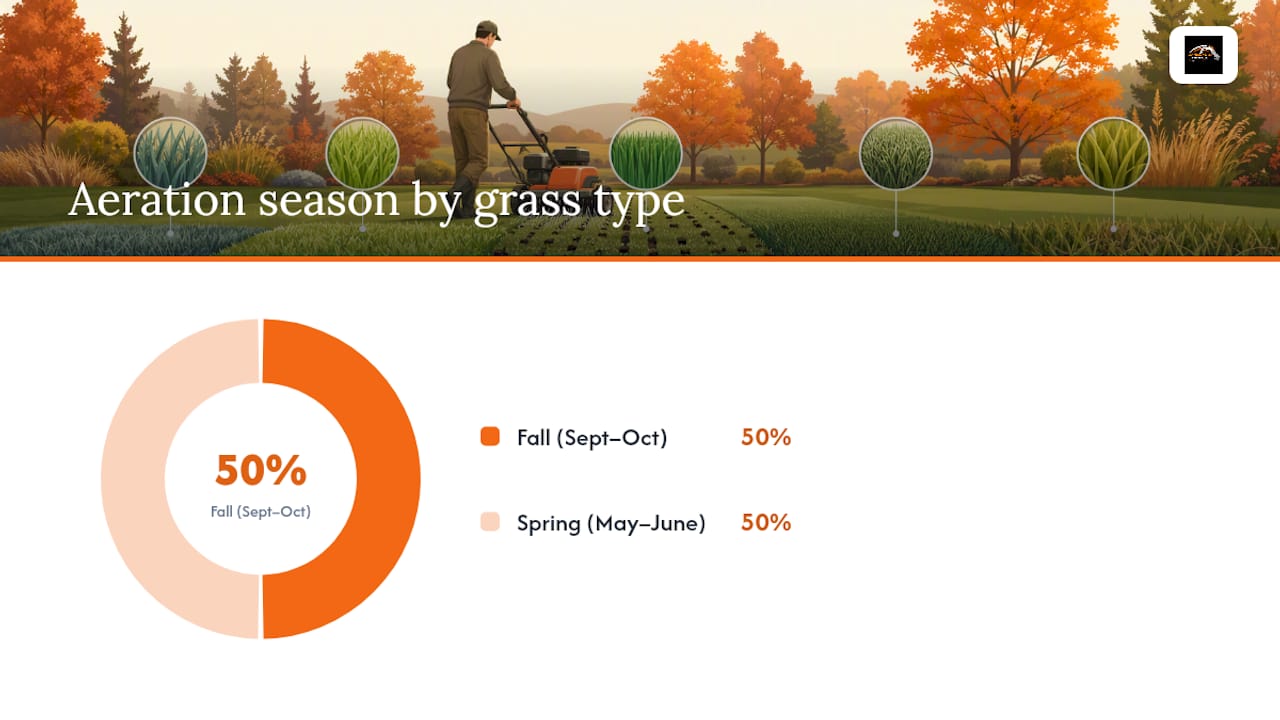
For Kansas City (USDA zone 6a), cool-season grasses hit their primary aeration window in September–October. Warm-season grasses like Bermuda and zoysia belong in late spring (May–June). Aerating a warm-season lawn in fall is one of the more common and costly mistakes — it opens the grass to cold injury right when it’s heading into dormancy.
Pro Tip: To find your local first-frost date, check the National Weather Service’s climate page for Kansas City or search “first frost date” plus your zip code on the Old Farmer’s Almanac site. Once you have that date, count back 6 weeks — that’s your aeration deadline. For most of the KC Northland, that puts the hard deadline around mid-October.
How do you know if your lawn actually needs aeration?
Not every lawn needs annual aeration. Before you rent equipment or call a crew, run a quick diagnosis.
The screwdriver test
Push a standard screwdriver into moist soil. If it won’t slide in easily, the soil is compacted and aeration will make a real difference. If it slides in with light pressure, compaction is minimal and you may only need aeration every 2–3 years.
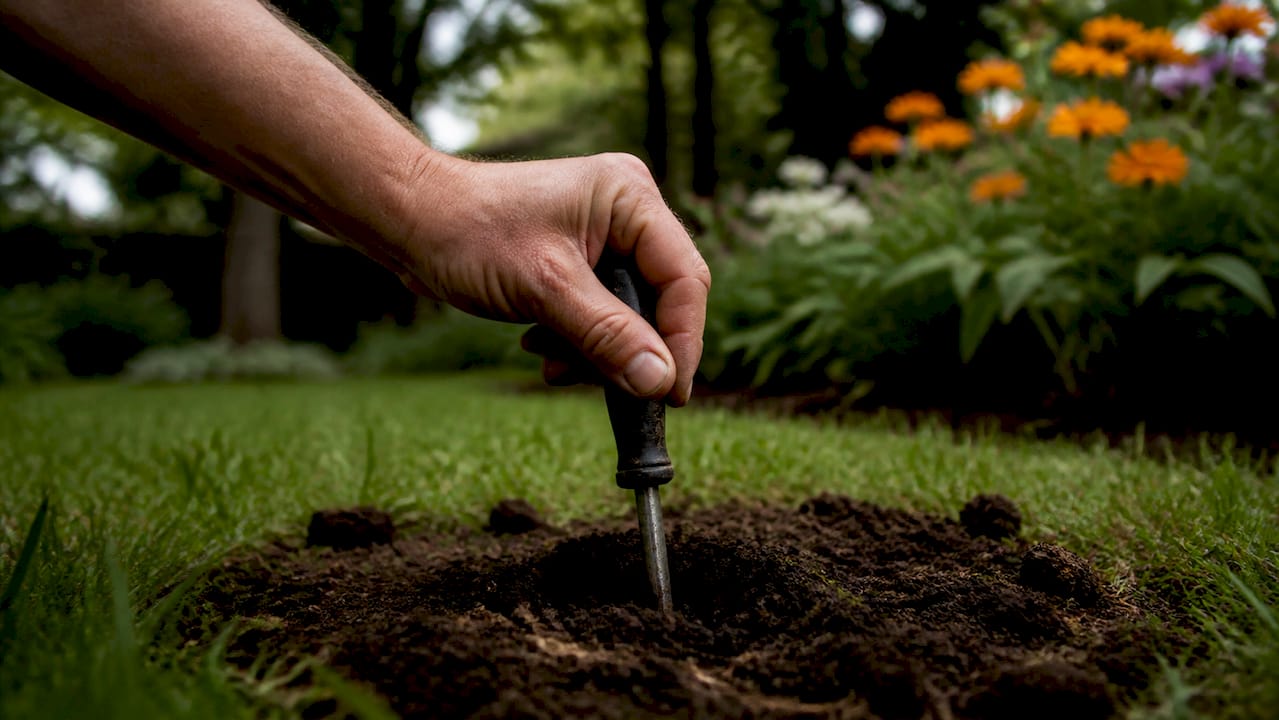
Do this test in several spots: high-traffic areas near the driveway or play areas, shaded spots, and open lawn. Compaction is rarely uniform.
Visible symptoms to look for
- Puddles forming on flat ground after moderate rain (water can’t infiltrate fast enough)
- Thinning or bare patches that don’t respond to fertilizer or overseeding
- Moss taking hold, especially in shaded or moist areas
- Soil that feels hard underfoot even after rain
- Thatch layer thicker than half an inch (run your finger through the grass to the soil surface)
How often should you aerate?
- Annually — high-traffic lawns, clay-heavy soils (common in the KC Northland), or lawns with a history of compaction
- Every 2–3 years — sandy soils, low-traffic yards, or lawns that passed the screwdriver test with minimal resistance
- After any major construction — soil compaction from equipment is severe and almost always warrants immediate aeration
If your lawn has clay soil and kids or pets using it regularly, annual fall aeration is the default. Clay compacts faster than any other soil type, and the KC area has plenty of it.
How to core-aerate your yard: step-by-step
Prep work (do this first)
Mow shorter than normal one to two days before aeration, clear any debris, and flag every irrigation head, valve, and shallow utility line. Water about one inch 48 hours before aeration to soften the soil. Don’t water the morning of — muddy soil smears in the tines instead of pulling clean plugs.
The aeration process
- Make your first pass across the lawn in one direction, overlapping slightly between rows
- Make a second pass perpendicular to the first — this cross-hatch pattern gives you roughly 20–40 holes per square foot and is what separates thorough aeration from a light pass
- Target 2–3 inch plug depth — shallower than 2 inches doesn’t reach the compaction layer; deeper risks damaging irrigation lines
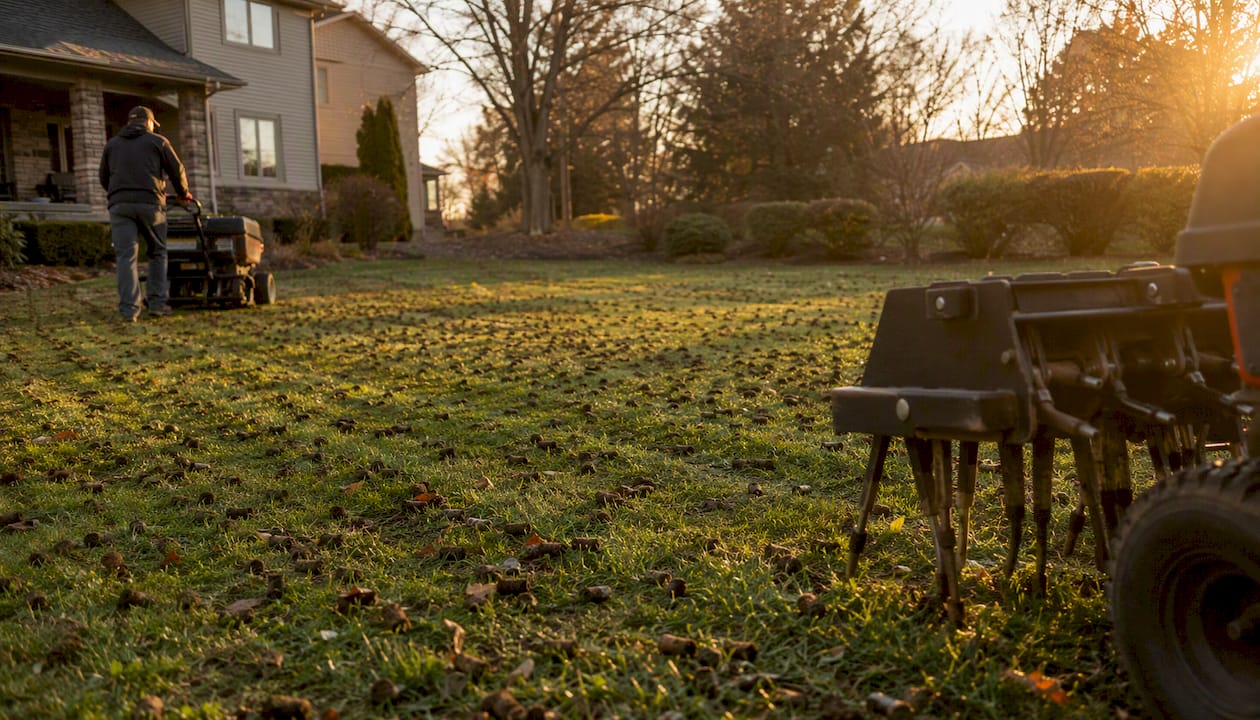
- Leave the plugs on the surface — don’t rake them up. They break down naturally in a few weeks and return organic matter to the soil, acting as a free, slow-release topdressing
- Overseed immediately after while channels are still open
Equipment choices
- Rental core aerator: a walk-behind unit from a local equipment rental runs a few hours for an average suburban yard. Heavy and slow on slopes, but effective.
- Tow-behind aerator: attaches to a riding mower. Covers ground faster but requires more weight (usually water-filled drums) to pull adequate plugs on firm soil.
- Hire a professional: commercial equipment pulls deeper, more consistent plugs and covers the yard faster. Worth it for large properties, slopes, or yards with buried irrigation systems.
What to avoid:
- Aerating saturated soil — plugs smear and the machine tears turf
- Aerating bone-dry, cracked soil — tines bounce and barely penetrate
- Spike aeration on compacted clay — spikes compress soil sideways rather than removing it, making compaction worse over time
- Overseeding before aerating — seed applied to unbroken turf has poor soil contact and low germination
Pro Tip: On a typical suburban lot, plan two full passes with a walk-behind aerator. The first pass takes about as long as mowing. The second pass, run perpendicular, takes the same time again. Budget a few hours total including setup and cleanup.
Overseeding, seeding rates, and your post-aeration schedule
Sequence matters here. Aerate first, then overseed, then fertilize — in that order, every time. Doing it out of order reduces germination and wastes both seed and fertilizer.
Seeding rates by grass type
These rates from KnowTheYard reflect overseeding into existing turf. Bare patches or new lawn areas need roughly double the rate to compensate for lower germination in unbroken ground.
Watering schedule after aeration and overseeding
- Days 1–14: water lightly multiple times per day, keeping the top half-inch of soil consistently moist. Short cycles (5–10 minutes per zone) work better than long, infrequent ones. Seed drying out even once during germination can kill the emerging sprout.
- Weeks 3–4: taper to once daily, watering deeper (15–20 minutes per zone) to encourage roots to follow moisture downward.
- Weeks 5–6: shift to a normal schedule — deep, infrequent watering two to three times per week.
Additional aftercare:
- Apply a starter fertilizer (high phosphorus) immediately after overseeding to support root development
- Light topdressing with compost or screened topsoil after seeding helps retain moisture and improves seed-to-soil contact in thin areas
- Hold off on normal mowing until new seedlings reach about 3.5 inches — then mow at the highest setting your mower allows
- Keep foot traffic and pets off newly seeded areas for at least three to four weeks
Liquid aeration versus core aeration: which one is right for fall?
Liquid aeration products use surfactants and soil conditioners to loosen soil chemistry rather than physically removing plugs. They’re easier to apply (a hose-end sprayer), require no equipment rental, and won’t disrupt buried irrigation lines. Those are real advantages.
The honest limitation: liquid aeration supplements light compaction and maintenance situations, but it doesn’t replace mechanical plug removal when compaction is significant or when overseeding is the goal.
Where liquid aeration works well:
- Spot-treating lightly compacted areas between annual core aeration cycles
- Yards with minimal compaction that passed the screwdriver test easily
- Situations where renting equipment isn’t practical (small yards, no truck to haul a machine)
- As a follow-up treatment a few weeks after core aeration to extend the loosening effect
Where core aeration is the only real answer:
- Heavy clay compaction that resists a screwdriver
- Any yard where overseeding is planned — liquid aeration creates no channels for seed placement
- Lawns with thatch buildup over half an inch
- Properties that haven’t been aerated in three or more years
Liquid aeration is a maintenance tool, not a renovation tool. If your lawn is thin, compacted, and heading into fall in rough shape, liquid products alone won’t get you where you need to be before winter. Core aeration is the mechanism that actually opens the soil.
The short recommendation: choose core aeration for fall overseeding and any meaningful compaction relief. Consider liquid aeration as a supplement in spring or between core aeration years when you want to maintain soil health without the equipment hassle.
How long does aeration take, and what affects contractor pricing?
A homeowner renting a walk-behind core aerator can expect to finish an average suburban yard in a few hours. That estimate assumes a reasonably open yard with minimal obstacles. Complexity changes the math quickly.
Factors that stretch the time budget:
- Slopes and terraced areas slow the machine and require more operator attention
- Dense obstacles (trees, beds, play equipment) mean more hand-trimming around edges
- Severe compaction may require a third pass or slower machine speed for adequate plug depth
- Overseeding, fertilizing, and topdressing each add time on top of the aeration itself
What affects what contractors charge:
- Yard square footage and shape
- Soil type (clay-heavy soils take longer and wear equipment faster)
- Whether overseeding, starter fertilizer, and topdressing are included
- Number of passes the crew makes
- Follow-up visit for a second overseeding or watering check
Questions worth asking any contractor before you book:
- What equipment do you use, and what plug depth does it reach?
- How many passes do you make, and in which directions?
- Is overseeding included, and at what seeding rate?
- Do you include starter fertilizer or topdressing?
- Do you offer a follow-up visit if germination is uneven?
A contractor who can answer all five specifically is worth more than one who quotes a flat rate with no details.
When should you hire a pro instead of doing it yourself?
DIY aeration is genuinely manageable for a flat, open yard with no buried irrigation. Rent the machine, follow the prep steps, and you’ll get a solid result. But several situations tip the scale toward hiring.
Hire a professional when:
- Your yard has slopes, terracing, or significant grade changes where a heavy walk-behind aerator is difficult to control
- You have a buried irrigation system and aren’t certain where every head and valve is located
- Soil compaction is severe and you want commercial-grade equipment pulling consistent 2–3 inch plugs
- You want a turnkey service: aeration, overseeding at the right rate, starter fertilizer, and follow-up guidance without managing it yourself
- Your yard is large enough that a half-day rental turns into a full-day project
A professional service typically includes site prep, utility marking, core aeration with commercial equipment, overseeding at extension-recommended rates, starter fertilizer application, and a watering schedule for the homeowner to follow. The difference between a rental machine and commercial equipment shows up most clearly in plug depth and consistency, especially on clay-heavy KC Northland soils.
Pro Tip: Ask your contractor to walk the property with you before they start. A good crew will confirm every irrigation head location, note any low spots that need extra attention, and tell you exactly what seed variety and rate they’re using. If they can’t answer those questions on the spot, keep looking.
For homeowners in Smithville, Platte City, Kearney, and surrounding KC Northland communities, GC Signature Outdoors LLC offers local aeration and overseeding service with the equipment and regional knowledge to get it done right the first time.
Our take on fall aeration timing
Fall aeration works better than spring aeration for cool-season lawns for one reason that doesn’t get enough attention: the competition is gone. In spring, crabgrass and broadleaf weeds are germinating at the same time as your grass seed. Every open channel you create in spring is a potential weed seedling. In fall, those annual weeds are dying off. The channels you open in September belong almost entirely to your cool-season grass seed. That’s why the germination results from fall overseeding consistently outperform spring efforts, even when the spring prep work is identical.
The one pro tip that makes the biggest difference in germination: after overseeding, apply a thin layer of compost or screened topsoil over the seeded area. Even a quarter-inch of topdressing holds moisture around the seed during those critical first two weeks and improves contact on any areas where the soil surface is uneven. It’s a step most homeowners skip, and it’s the step that separates a patchy result from a dense, even stand of new grass.
GC Signature Outdoors handles fall aeration for KC Northland homeowners
Skipping the equipment rental and the half-day of labor is a real option for homeowners in the KC Northland. GC Signature Outdoors LLC provides fall aeration and overseeding as a complete service: site prep, utility marking, commercial core aeration, overseeding at the right rate for your grass type, and starter fertilizer applied in the correct sequence. You get the result without managing the logistics.

The crew serves Smithville, Platte City, Kearney, and the surrounding KC Northland area. Fall slots fill up fast once September arrives, so the earlier you reach out, the more scheduling flexibility you’ll have. Visit the lawn care services page to get a quote or ask about availability for this fall’s aeration window.
Sources
- Best Time to Aerate and Overseed Lawn | KnowTheYard
- September: Core Aerate the Lawn | Kansas State University Extension
- Fall aeration vs overseeding — sequence and how to do it | Green Turf Lab
FAQ
Is October too late to aerate your lawn?
October is workable for cool-season grasses if you finish early in the month, giving seedlings the full 4–6 week window before first frost. Late October aeration without overseeding is still beneficial for compaction relief, but new seed sown that late in the KC Northland rarely establishes before hard frost arrives.
Is fall liquid aeration worth it?
Liquid aeration is a useful maintenance supplement for lightly compacted lawns, but it won’t replace core aeration when overseeding is the goal or when compaction is significant. If your lawn needs both compaction relief and new seed, core aeration is the right tool for fall.
How often should a typical lawn be aerated?
Lawns with clay soil or regular foot traffic generally benefit from annual fall aeration. Sandy soils and low-traffic yards can go every 2–3 years. Run the screwdriver test each fall to confirm whether compaction warrants it before scheduling.
What is the correct aeration depth?
Target 2–3 inch plug depth. Shallower than 2 inches misses the main compaction layer; deeper risks hitting irrigation lines. Penn State’s turf guidance recommends aerating when soil is moist but not saturated to achieve clean plug removal at that depth.
Should you leave the soil plugs on the lawn after aerating?
Yes. Leave them in place to break down naturally over a few weeks. They return organic matter and nutrients to the soil and act as a natural topdressing, which is especially valuable on the clay-heavy soils common across the KC Northland.
Recommended
- When to Aerate Your Lawn in Kansas City, MO | GC Signature Outdoors
- Lawn Aeration Cost in KC Northland: 2026 Price Guide | GC Signature Outdoors
- Spring & Fall Yard Cleanup in Smithville, Platte City & Kearney | GC Signature Outdoors
- Lawn Aeration & Overseeding | Smithville & Platte City, MO | GC Signature Outdoors
Ready to get started in Kansas City's Northland?
GC Signature Outdoors serves Smithville, Platte City, Kearney, Liberty, and surrounding areas.