
Drought Tolerant Grasses: Best Picks for Water-Wise Lawns
Drought Tolerant Grasses: Best Picks for Water-Wise Lawns
TL;DR:
- Matching the right drought-tolerant grass to your climate zone is the most effective water-saving step for U.S. homeowners.
- Deep-rooted grasses like tall fescue stay green longer, while buffalograss goes dormant but requires less water.
For most U.S. homeowners, the fastest path to a low-water lawn is matching the right species to your climate zone before you plant anything. In hot, dry regions like the southern Plains, buffalograss (Bouteloua dactyloides) and bermudagrass (Cynodon spp.) are the workhorses. In the cooler transition zone stretching from Kansas City through the mid-Atlantic, tall fescue is the standout cool-season performer, with its deep root system pulling moisture from well below where other grasses give up. According to Scotts’ region-by-region selection guide, choosing the right species at planting time is the single most effective water-saving step you can take.
Quick shortlist for most U.S. homeowners:
- Buffalograss — very low water use compared to most turf grasses; best for hot, dry, full-sun yards in USDA zones 3–9
- Bermudagrass — heat-loving, spreads aggressively, excellent for warm-season lawns in zones 7–10
- Tall fescue — the go-to for transition zone and cool-season lawns; deep roots, stays green longer in drought
- Zoysia — slow-establishing but dense and wear-tolerant; good for zones 5–10 with moderate water
- Fine fescue — best for shady, low-traffic cool-season yards; very low maintenance once established
The species profiles below cover all ten grasses the SERP consensus recommends, plus ornamental picks for planting beds. After the profiles, you’ll find a practical decision framework, an establishment timeline, and local guidance for KC Northland yards from GC Signature Outdoors LLC.
Table of Contents
- Top drought tolerant grasses grouped by use and season
- What “drought tolerant” actually means for grasses
- How to choose the right drought-tolerant grass for your yard
- Planting and care: establishing drought-tolerant lawns year by year
- When to skip turf: low-water alternatives worth considering
- Applying these recommendations in KC Northland yards
- Key Takeaways
- What local yards keep teaching us about drought-tolerant lawns
- Low-water lawn installation and care in KC Northland
- Further reading and authoritative sources
- FAQ
Top drought tolerant grasses grouped by use and season
The ten species below are organized into three groups: warm-season turf, cool-season turf, and ornamental or naturalized grasses. Each profile covers where it excels, how it survives drought, and what to expect at planting time.
Warm-season turf grasses
1. Buffalograss (Bouteloua dactyloides) The lowest-water turf option available for most of the U.S. interior. Buffalograss is native to the Great Plains, thrives in clay soils, and survives on far less water than any other lawn grass after establishment. Its roots can reach deep into the soil in natural sites. The trade-off: it goes dormant and turns straw-colored in extended drought or cold, and it spreads slowly. Improved residential cultivars shorten establishment time considerably and produce a finer, denser turf than pasture-grade seed. Zones 3–9; full sun only.
2. Bermudagrass (Cynodon spp.) The dominant warm-season lawn grass across the South and Southwest. Bermudagrass spreads via both stolons and rhizomes, fills in bare spots quickly, and handles heavy foot traffic better than almost any other grass on this list. It survives drought through dormancy, turning brown but bouncing back reliably once rain or irrigation returns. Mow it short (1–1.5 inches) and it stays dense. Zones 7–10; full sun required.
3. Zoysia (Zoysia spp.) Zoysia takes longer to establish than bermuda but rewards patience with a thick, carpet-like turf that crowds out weeds naturally. It tolerates moderate shade better than bermuda and handles foot traffic well. Water needs after establishment are moderate to low. Zones 5–10; performs best in full sun to light shade.
Cool-season turf grasses
4. Tall fescue (various cultivars) Tall fescue is the top cool-season drought performer in the transition zone. Its roots go deeper than Kentucky bluegrass or fine fescues, accessing soil moisture that shallower-rooted grasses cannot reach. Modern turf-type cultivars (look for labels like “Titan,” “Rebel,” or “Crossfire”) are finer-textured and denser than older varieties. It stays green through moderate drought without going dormant, which is a real advantage if you want year-round color. Zones 3–8; full sun to moderate shade.
5. Fine fescue (creeping red, chewings, hard fescue) Fine fescues are the best choice for shady, low-traffic cool-season lawns. They use less water than Kentucky bluegrass and tolerate poor, sandy soils well. The trade-off is low wear tolerance — foot traffic damages them quickly. Blend them with tall fescue for a more resilient mix. Zones 3–7; shade to partial sun.
Ornamental and naturalized grasses
These species are not lawn grasses in the traditional sense. They belong in planting beds, naturalized areas, rain gardens, and low-traffic slopes. All are reliable low-water ornamental choices with strong visual impact.
6. Blue fescue (Festuca glauca ‘Elijah Blue’) A compact, silver-blue mounding grass that tops out around 10–12 inches. It works beautifully as a border accent or mass planting in rock gardens. Needs excellent drainage; it rots in wet clay. Zones 4–8; full sun.
7. Mexican feather grass (Nassella tenuissima) Wispy, golden-tan seed heads that move in the slightest breeze. Extremely drought-tolerant once established. Worth noting: it self-seeds prolifically and is considered invasive in some western states — check your local extension before planting. Zones 7–11; full sun.
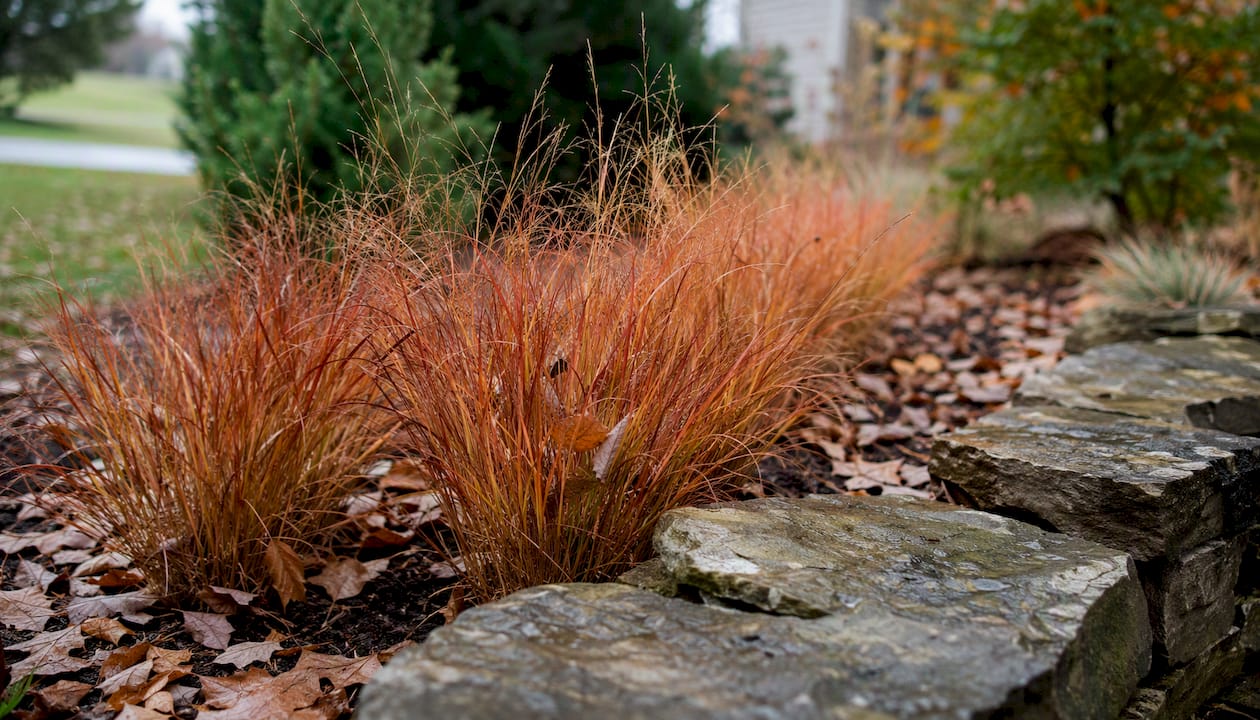
8. Little bluestem (Schizachyrium scoparium) One of the best native ornamental grasses for U.S. gardens. Per NC Extension, it tolerates a wide range of soils, provides brilliant copper-red fall color, and supports pollinators and birds. Works well in mass plantings, prairie-style beds, and naturalized slopes. Zones 3–9; full sun.
9. Pink muhlygrass (Muhlenbergia capillaris) Produces a spectacular cloud of pink-magenta plumes in September and October. Extremely heat and drought tolerant once established. Low maintenance, no serious pests, and deer resistant. Zones 5–11; full sun to light shade.
10. Prairie dropseed (Sporobolus heterolepis) A fine-textured native grass that forms tidy, arching mounds about 18–24 inches tall. It has a subtle fragrance when in bloom and turns golden in fall. Slower to establish than most ornamentals but very long-lived. Zones 3–9; full sun to light shade.
11. Fountain grass (Pennisetum alopecuroides) Fountain grass is a popular ornamental for its arching form and bottlebrush seed heads. It handles heat and moderate drought well. Note that some Pennisetum species are invasive in warmer climates — confirm your cultivar is sterile or non-invasive before purchasing. Zones 5–9; full sun.
Utah State University Extension compiles a research-backed list of low-water ornamental grasses for xeriscape plantings — a useful reference if you want to expand beyond the species above.
Species comparison at a glance
| Grass | Best for | USDA zones | Water after establishment | Drought strategy | Maintenance & traffic | Establishment difficulty |
|---|---|---|---|---|---|---|
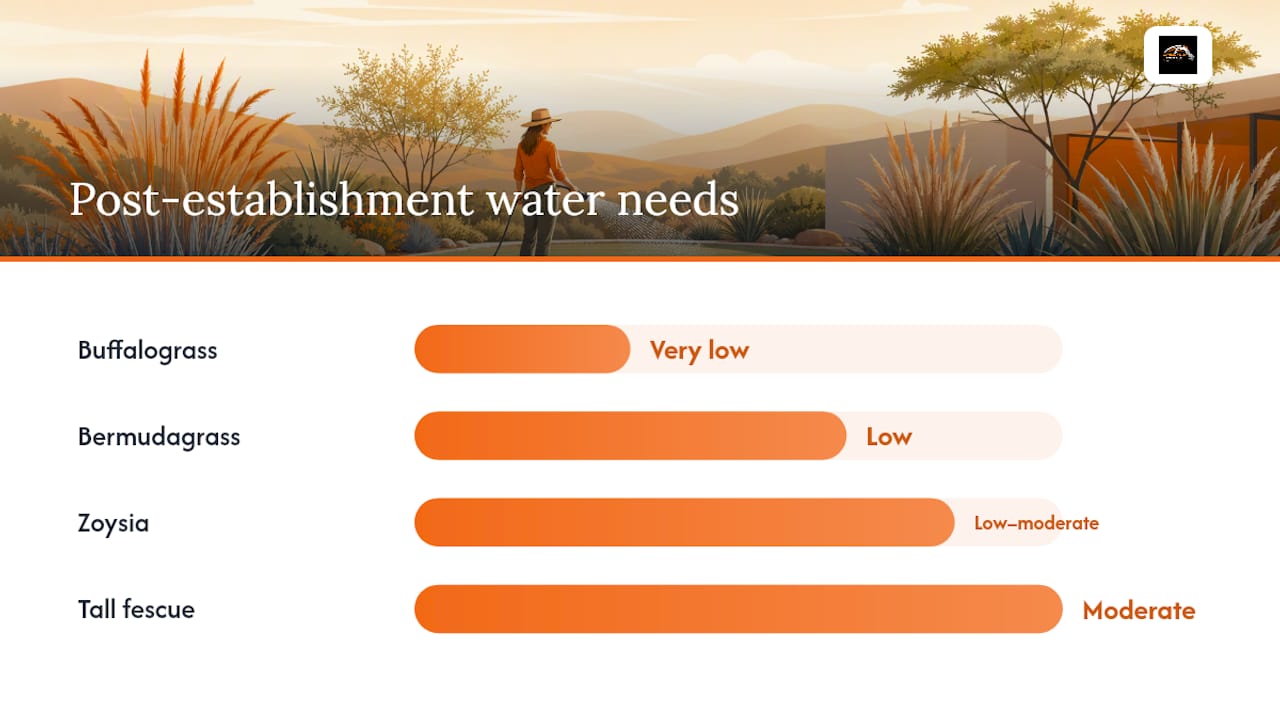
| Buffalograss | Turf, full sun | 3–9 | Very low | Dormancy + deep roots | Low mow; low traffic | Moderate (slow, weed pressure) |
| Bermudagrass | Turf, high traffic | 7–10 | Low | Dormancy + stolons/rhizomes | Frequent mow; high traffic | Easy (sod or plugs) |
| Zoysia | Turf, moderate traffic | 5–10 | Low–moderate | Stolons/rhizomes | Low mow; moderate traffic | Slow (plugs or sod) |
| Tall fescue | Turf, transition zone | 3–8 | Moderate | Deep roots | Moderate mow; moderate traffic | Easy (seed or sod) |
| Fine fescue | Turf, shade/low traffic | 3–7 | Low | Deep roots + low use | Minimal mow; low traffic | Easy (seed) |
| Blue fescue | Ornamental border | 4–8 | Very low | Low water use | No mow; no traffic | Easy (division or plugs) |
| Mexican feather grass | Ornamental accent | 7–11 | Very low | Low water use | Minimal; no traffic | Easy (seed) |
| Little bluestem | Ornamental/native | 3–9 | Very low | Deep roots + dormancy | Cut back annually; no traffic | Moderate (slow first year) |
| Pink muhlygrass | Ornamental accent | 5–11 | Low | Low water use | Cut back annually; no traffic | Easy (plugs) |
| Prairie dropseed | Ornamental/native | 3–9 | Very low | Deep roots | Minimal; no traffic | Slow (3-year establishment) |
| Fountain grass | Ornamental border | 5–9 | Low–moderate | Low water use | Cut back annually; no traffic | Easy (plugs or division) |
What “drought tolerant” actually means for grasses
Drought tolerance is a spectrum, not a label. Grasses survive dry conditions through fundamentally different strategies, and understanding which strategy a species uses tells you what to expect in your yard during a dry summer.
The three main survival mechanisms:
- Deep roots (tall fescue, buffalograss, little bluestem): roots reach well below the surface, accessing moisture that evaporates from the top few inches. These grasses stay green longer and recover faster after drought ends.
- Dormancy (bermudagrass, buffalograss, zoysia): the grass goes brown and stops growing when water runs short, then greens up again when moisture returns. Dormancy is a survival mechanism, not death. Resist the urge to overwater a dormant stand — you can actually cause more harm than the drought itself.
- Low water use / “sipper” grasses (fine fescue, blue fescue, prairie dropseed): these grasses simply use less water per square foot than conventional turf. They do not necessarily have deep roots or dramatic dormancy; they just run lean.
Trade-offs that matter for homeowners:
- A dormancy-based grass (bermuda, buffalograss) will look brown during a drought. If your HOA or personal preference requires year-round green, that is a real problem.
- Deep-rooted grasses like tall fescue stay green longer but still need supplemental water in severe drought. They are not zero-water.
- High traffic tolerance and drought tolerance rarely come in the same package at the cool-season end. Fine fescues are water-sippers but will not survive a backyard soccer game.
The contrast between tall fescue and buffalograss illustrates this well. Tall fescue endures drought through root depth and stays green, but it needs more water overall than buffalograss. Buffalograss uses far less water but will go dormant and brown out. Neither is wrong — they serve different homeowner priorities.
Pro Tip: If you want a lawn that looks green through a dry August without irrigation, tall fescue in the transition zone is your best bet. If you want to water as little as possible and can accept summer dormancy, buffalograss wins.
How to choose the right drought-tolerant grass for your yard
Start here: match warm-season versus cool-season to your USDA zone and sun exposure. Getting this wrong means fighting your grass every year. A warm-season grass planted in zone 5 will die in winter; a cool-season grass in zone 9 will fry in summer.
Decision criteria by yard type
| Criteria | Recommended grass categories |
|---|---|
| USDA zones 7–10, full sun, high traffic | Bermudagrass, Zoysia |
| USDA zones 3–6, full sun, moderate traffic | Tall fescue, Buffalograss (zones 3–9) |
| USDA zones 3–7, shade or partial sun | Fine fescue blends |
| Transition zone (zones 5–7), mixed sun | Tall fescue + Zoysia patch combo |
| Ornamental beds, full sun, any zone | Little bluestem, Pink muhly, Blue fescue, Prairie dropseed |
| Naturalized slopes, erosion-prone | Little bluestem, Buffalograss, native prairie mixes |
| Clay soils, interior dry regions | Buffalograss (thrives in clay-loam) |
| Sandy, low-fertility soil | Fine fescue, Blue fescue |
Quick decision checklist
- Look up your USDA hardiness zone (the USDA Plant Hardiness Zone Map is the standard reference).
- Count daily sun hours in the area you want to plant.
- Do a simple soil test — your local extension office can process one for a small fee and tell you pH, drainage class, and organic matter.
- Decide your tolerance for summer dormancy (brown lawn = acceptable or not).
- Assess foot traffic: kids, pets, or play areas need a wear-tolerant species.
- Call your local extension office or a landscape professional for microclimate nuance before purchasing seed or sod.
Planting and care: establishing drought-tolerant lawns year by year
The biggest water-saving step is correct establishment. A grass planted at the wrong time of year, in unprepared soil, will need far more irrigation to survive than the same grass planted correctly. Deep, infrequent watering, correct mowing height, and timely establishment are the cultural practices that separate a thriving low-water lawn from a struggling one.
Watering schedule
| Phase | Frequency | Depth/Duration |
|---|---|---|
| Seeding (first two weeks) | 2–3x daily, light | Keep surface moist; 5–10 min per zone |
| Germination to 4 weeks | Once daily, light | Maintain consistent moisture |
| Establishment (weeks 4–12) | Every 2–3 days | Water to 4–6 inch depth |
| Post-establishment (year 2+) | Deep & infrequent | 1 inch per week or less; let soil dry between |
| Dormant warm-season grass | None or minimal | Do not irrigate to “rescue” dormancy |
Mowing heights by species group
- Ornamental grasses: — cut back to 4–6 inches in late winter before new growth emerges
For aeration and overseeding of cool-season lawns, fall is the right window — late August through October in the KC Northland area. Aeration breaks up compaction, improves water infiltration, and gives overseeded tall fescue the seed-to-soil contact it needs to germinate well.
Pro Tip: During buffalograss establishment, mow any weeds that emerge to 3–4 inches rather than pulling them. Pulling disturbs the soil and creates new germination sites. Mowing keeps weeds from seeding while the buffalograss fills in, and it does not require extra watering to “recover” the way hand-weeding does.
When to skip turf: low-water alternatives worth considering
Sometimes the most water-wise decision is to stop trying to grow a traditional lawn in a spot that fights you every year. Native prairie mixes, xeriscape planting beds, clover lawns, and gravel-plus-planting islands can all outperform low-water turf on slopes, under trees, and in areas that see little foot traffic.
Where alternatives make more sense than turf:
- Steep slopes with erosion risk: native prairie grasses like little bluestem and big bluestem (Andropogon gerardi) have extensive root systems that stabilize soil far better than turf grass.
- Narrow strips between hardscape: gravel with low-water perennials or groundcovers (creeping thyme, sedum) use almost no irrigation and require no mowing.
- Shaded areas under trees: fine fescue blends are the best turf option, but a mulched bed with shade-tolerant natives often requires less input and looks better long-term.
- Ecological priority areas: native prairie mixes support pollinators, birds, and beneficial insects in ways that even the best drought-tolerant turf cannot match.
Phasing out turf gradually is the practical approach for most homeowners. Convert one high-drainage slope or a narrow side yard first. See how it looks and how much maintenance it actually takes before committing to a full conversion. For a full landscape design that integrates low-water beds with turf areas, a professional site assessment saves you from costly mistakes in species selection and grading.
Clover lawns deserve a mention. Micro-clover blended with fine fescue or tall fescue fixes its own nitrogen, stays green through moderate drought, and tolerates light foot traffic. It is not for everyone, but for homeowners who want a green lawn with minimal fertilizer and water, it is a legitimate option.
Applying these recommendations in KC Northland yards
The KC Northland area sits squarely in the transition zone, USDA zones 5b–6a depending on exact location. That means winters cold enough to kill most warm-season grasses outright, and summers hot and dry enough to stress cool-season grasses badly. It is genuinely one of the harder climates for lawn establishment in the country.
What works best around Smithville, Platte City, and Kearney:
- Tall fescue blends are the primary recommendation for most residential lawns. Modern turf-type cultivars handle the transition zone’s temperature swings better than any other cool-season option. Overseed thin areas every fall.
- Buffalograss works well in full-sun, low-traffic areas — a south-facing slope, a utility strip, or a naturalized side yard. It is not the right choice for a backyard where kids play regularly, but for low-use areas it cuts irrigation needs dramatically.
- Zoysia patches can work in protected, south-facing microclimates in zone 6a, but they are marginal in colder KC Northland winters. Use with caution and only in well-drained, full-sun spots.
- Ornamental grasses (little bluestem, prairie dropseed, pink muhly) thrive in the region and are excellent for planting beds, borders, and naturalized areas.
Region-specific timing:
- Tall fescue seeding: late August through September 20th is the target window. Later than that and germinating seedlings face frost before they harden off.
- Buffalograss seeding or plugging: mid-May through June, after soil temperatures stabilize above 65°F.
- Lawn aeration for cool-season lawns: late August to early October.
- Spring cleanup and pre-emergent application: late March through April, before soil temperatures hit 55°F.
Local caveats:
- Clay soils are common throughout the KC Northland area. They hold moisture longer than sandy soils, which helps drought tolerance but can cause waterlogging in low spots. Aeration is especially valuable in clay-heavy yards.
- Freeze dates: average last spring frost around April 15th; first fall frost around October 15th. These dates shape every planting window above.
- Overseeding thin tall fescue is almost always preferable to full renovation. Patch bare spots in fall rather than waiting for a full-lawn redo.
GC Signature Outdoors LLC service steps for low-water lawn installation:
- Site assessment and sun/shade mapping
- Soil test and amendment recommendations
- Species selection matched to zone, soil, and use
- Aeration and overseeding for cool-season lawns, or sod/plug installation for warm-season areas
- Starter fertilizer and weed control during establishment
- Maintenance handoff with a watering schedule and mowing height guidance
Key Takeaways
Choosing the right grass species for your USDA zone and sun exposure is the single most effective step toward a low-water, low-maintenance lawn.
| Point | Details |
|---|---|
| Match species to your zone first | Warm-season grasses for zones 7–10; tall fescue or fine fescue for zones 3–7 transition zone. |
| Understand the drought strategy | Deep roots (tall fescue) keep lawns green longer; dormancy (bermuda, buffalograss) means brown but alive. |
| Establishment timing is critical | Cool-season seed in late August–September; warm-season plugs or sod in May–June after soil hits 65°F. |
| Water deep and infrequent after year 1 | One inch per week or less, letting soil dry between cycles, builds deeper roots than daily shallow watering. |
| GC Signature Outdoors LLC for local help | Serves Smithville, Platte City, and Kearney with site assessments, aeration, overseeding, and full lawn installation. |
What local yards keep teaching us about drought-tolerant lawns
The conventional wisdom says “just plant a drought-tolerant grass and stop watering so much.” The reality in the KC Northland transition zone is more nuanced than that, and it is worth saying plainly.
Most homeowners who struggle with dry-summer lawns are not using the wrong grass. They are mowing too short, watering too shallowly, and planting at the wrong time of year. A tall fescue lawn mowed at 2.5 inches in July will suffer far more than the same lawn mowed at 4 inches, because the leaf blade shades the root zone and slows evaporation. That single adjustment, mowing height, often does more for drought performance than switching species entirely.
The other thing worth saying: buffalograss is genuinely underused in this region. Homeowners see it go dormant and brown in late summer and assume something is wrong. Nothing is wrong. That is exactly what it is supposed to do. The grass is alive, the roots are fine, and it will green back up. If you can make peace with a straw-colored lawn for six to eight weeks in summer, buffalograss will reward you with the lowest irrigation bill of any turf option available. Improved residential cultivars have made it a genuinely practical choice for low-traffic residential areas in this zone.
The ornamental grasses, little bluestem especially, are the most underrated plants in the KC Northland palette. They look spectacular from September through January, require almost no care, and support wildlife in ways that a monoculture lawn simply cannot. If you have a slope, a utility strip, or a bed that gets full sun and you are tired of fighting it, little bluestem is the answer.
Low-water lawn installation and care in KC Northland
A water-wise lawn in Smithville, Platte City, or Kearney starts with the right species in the right spot, and GC Signature Outdoors LLC handles every step of that process for local homeowners.

The team at GC Signature Outdoors LLC offers site assessments, soil testing coordination, and species recommendations matched to your specific yard conditions. From there, services include lawn aeration and overseeding for cool-season tall fescue lawns, sod and plug installation for warm-season areas, starter fertilizer applications, and first-year weed control during establishment. For homeowners ready to convert a high-maintenance turf area into a low-water planting bed or native grass zone, the landscape design team handles grading, plant selection, and installation.
No juggling multiple contractors. One crew, one point of contact, and a clear maintenance handoff so you know exactly what to do after the installation is done.
Get a free site assessment and find out which low-water lawn approach fits your yard — GC Signature Outdoors LLC serves the KC Northland area including Smithville, Platte City, and Kearney.
Further reading and authoritative sources
The recommendations in this article draw on university extension research, plant databases, and turfgrass specialist guidance. The sources below are worth bookmarking for deeper dives.
- Best Drought-Tolerant Lawn Grasses: A Region-by-Region Selection Guide | ScottsMiracle-Gro US
- Best Drought-Tolerant Grass Types Ranked | WhatGrassIsThis (blog)
- Buffalograss: Bouteloua dactyloides | plantnative.org
- Prairie Beard Grass — Schizachyrium scoparium | North Carolina Extension Gardener Plant Toolbox
- Buffalograss: The Best Native Grass for a Low-Water Lawn — Nature’s Seed
- Andropogon gerardi ‘Dancing Wind’ — Plant Finder | Missouri Botanical Garden
- Drought-tolerant lawn grass options and maintenance | The Spruce
- 6 Drought-Tolerant Ornamental Grasses That Thrive Anywhere | Gardening Know How
FAQ
What is the most drought tolerant grass for a lawn?
Buffalograss (Bouteloua dactyloides) uses less water than any other turf grass after establishment and thrives in clay soils across USDA zones 3–9. For the transition zone where winters are cold, tall fescue is the top cool-season option because its deep roots access moisture other grasses cannot reach.
What ornamental grass handles drought the best?
Little bluestem (Schizachyrium scoparium) and prairie dropseed (Sporobolus heterolepis) are among the most drought-tolerant ornamental grasses for U.S. gardens, with deep roots, wide soil tolerance, and strong seasonal interest. Blue fescue and pink muhlygrass are also reliable low-water choices for planting beds.
What grass needs the least water overall?
Buffalograss needs the least water of any lawn grass, surviving on natural rainfall in much of the Great Plains once established. Fine fescues are the lowest-water option among cool-season grasses, particularly in shaded or low-traffic areas.
What is the best grass for hot, dry weather?
Bermudagrass is the most heat-tolerant and widely adapted warm-season turf grass for hot, dry climates in zones 7–10. It spreads quickly, handles heavy traffic, and recovers from drought dormancy reliably once water returns.
Can drought tolerant grasses handle clay soil?
Buffalograss actually prefers clay and clay-loam soils, making it an excellent fit for the KC Northland area where clay is common. Tall fescue also performs well in clay with proper aeration. Blue fescue and Mexican feather grass are the exceptions — both need sharp drainage and will struggle in heavy clay.
Recommended
Ready to get started in Kansas City's Northland?
GC Signature Outdoors serves Smithville, Platte City, Kearney, Liberty, and surrounding areas.