
Crabgrass Preventer in Kansas City: Timing Guide
Crabgrass Preventer in Kansas City: Timing Guide
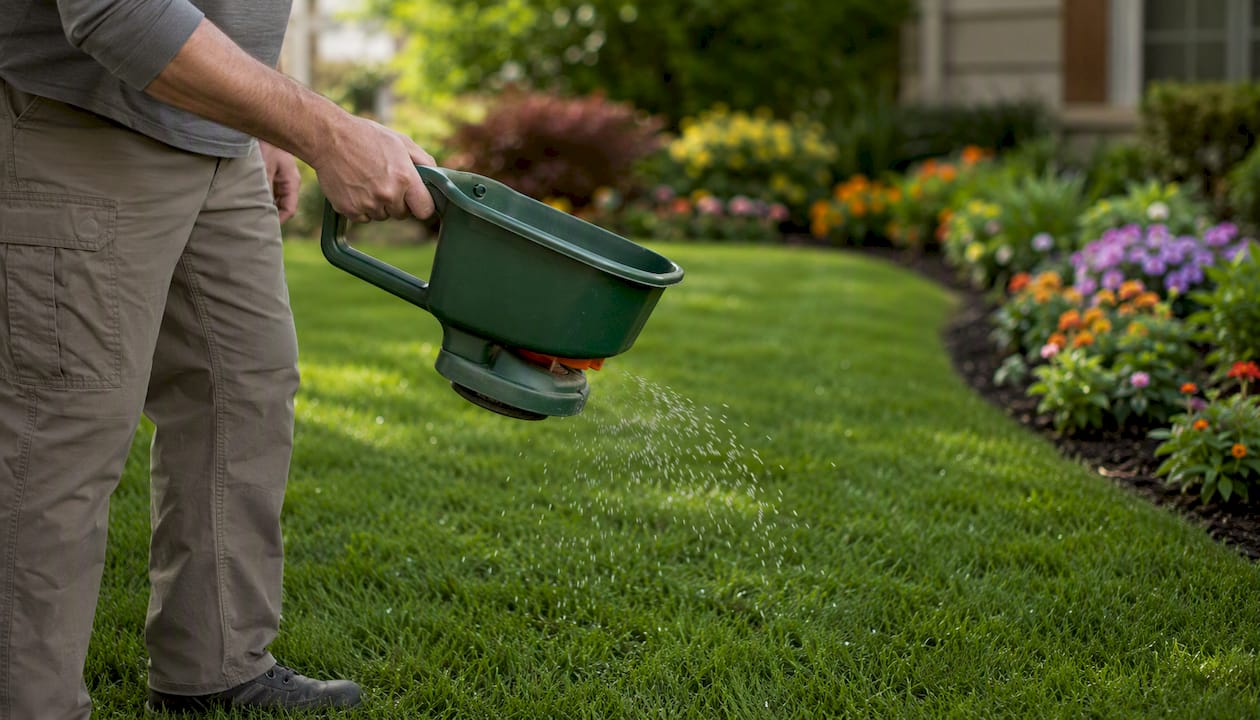
In Kansas City, the sweet spot for applying a crabgrass preventer falls between mid-March and mid-April. The trigger is soil temperature, not the calendar. Once the top 2 inches of soil hold around 55°F for several consecutive days, crabgrass seeds begin to germinate. You want your pre-emergent barrier down 1–2 weeks before that happens. Historically, KC soil hits that threshold around April 12, so late March to early April is the practical target most years.
If you’re comfortable with a spreader and willing to monitor soil temps, DIY works fine. If you’d rather hand it off and get a season-long program, GC Signature Outdoors LLC serves the KC Northland area with professional-grade fertilization and weed control.
| Factor | DIY | Hire a Pro |
|---|---|---|
| Timing control | You monitor soil temps and apply | Pro schedules around local conditions |
| Product selection | Choose from retail actives | Pro-grade products, calibrated rates |
| Application accuracy | Depends on spreader calibration | Uniform, measured coverage |
| Follow-up applications | You track and reapply | Included in seasonal programs |
| Best for | Confident homeowners with time | Busy homeowners wanting reliability |
Key Takeaways
Apply crabgrass preventer in Kansas City between late March and mid-April, targeting 1–2 weeks before 2-inch soil temperatures sustain 55°F, and use the Eastern Redbud bloom as your most reliable local confirmation.
| Point | Details |
|---|---|
| Timing window | Apply late March to mid-April; KC soil averages 55°F at 2-inch depth around April 12. |
| Biological cue | Eastern Redbud approaching full bloom signals the pre-emergent window is open. |
| Active ingredients | Look for prodiamine, dithiopyr, or pendimethalin; use siduron only if overseeding. |
| Missed the window | Switch to post-emergent on young plants; mow at 3 inches and overseed bare spots. |
| Local pro option | GC Signature Outdoors LLC covers KC Northland with season-long weed control programs. |
Table of Contents
- Why does soil temperature drive crabgrass prevention in Kansas City?
- What are the right timing cues for Kansas City homeowners?
- Which pre-emergent active ingredients should you look for?
- What should you do if you missed the pre-emergent window?
- How do you apply pre-emergent correctly, step by step?
- Who should you hire for crabgrass control in the KC Northland?
- How do you choose the right lawn care provider?
- Why this guidance reflects local KC practice
- What the local crew actually sees every spring
- Ready to protect your KC Northland lawn this spring?
- Sources
- FAQ
Why does soil temperature drive crabgrass prevention in Kansas City?
Crabgrass seeds don’t respond to the date on your calendar. They respond to warmth in the soil. Johnson County K-State Extension confirms that pre-emergent herbicides work by forming a chemical barrier in the upper soil layer. When a crabgrass seed sprouts and pushes through that zone, the active ingredient disrupts root and shoot development before the plant can establish. Once crabgrass is up and visible, pre-emergents do nothing to it.
The threshold that matters is 55°F at 1–2 inches depth, sustained over several days. Apply before that window, and you intercept the seeds. Wait until you see the weeds, and you’ve already missed it.
Key figure: Pre-emergent residuals typically last 60–120 days, depending on the active ingredient, application rate, temperature, and moisture. That range is why some programs use a split application.
- Pre-emergents prevent germination; they do not kill established plants.
- The 2-inch depth reading is what matters, not air temperature or surface soil.
- Residual length varies by ingredient and conditions, which affects whether one application covers the full season.
Pro Tip: Don’t wait for your lawn to green up before applying. Turf greening lags behind soil warming. By the time your grass looks active, the soil may already be at or past 55°F.
What are the right timing cues for Kansas City homeowners?
The SoilTemps data for Kansas City puts the average first sustained 55°F crossing at 2-inch depth around April 12. That means most years, you should have your pre-emergent down by late March to early April. A warm February or March can push that date earlier; a cool spring can push it later by a week or two.
Kansas State University Extension points to the Eastern Redbud bloom as the most reliable local biological cue. When KC’s Redbuds approach full bloom, soil temperatures are typically approaching that critical threshold. Forsythia bloom is an earlier signal, useful as a heads-up to start monitoring, but Redbud is the more precise trigger.
Pre-application checklist for the week before you apply:
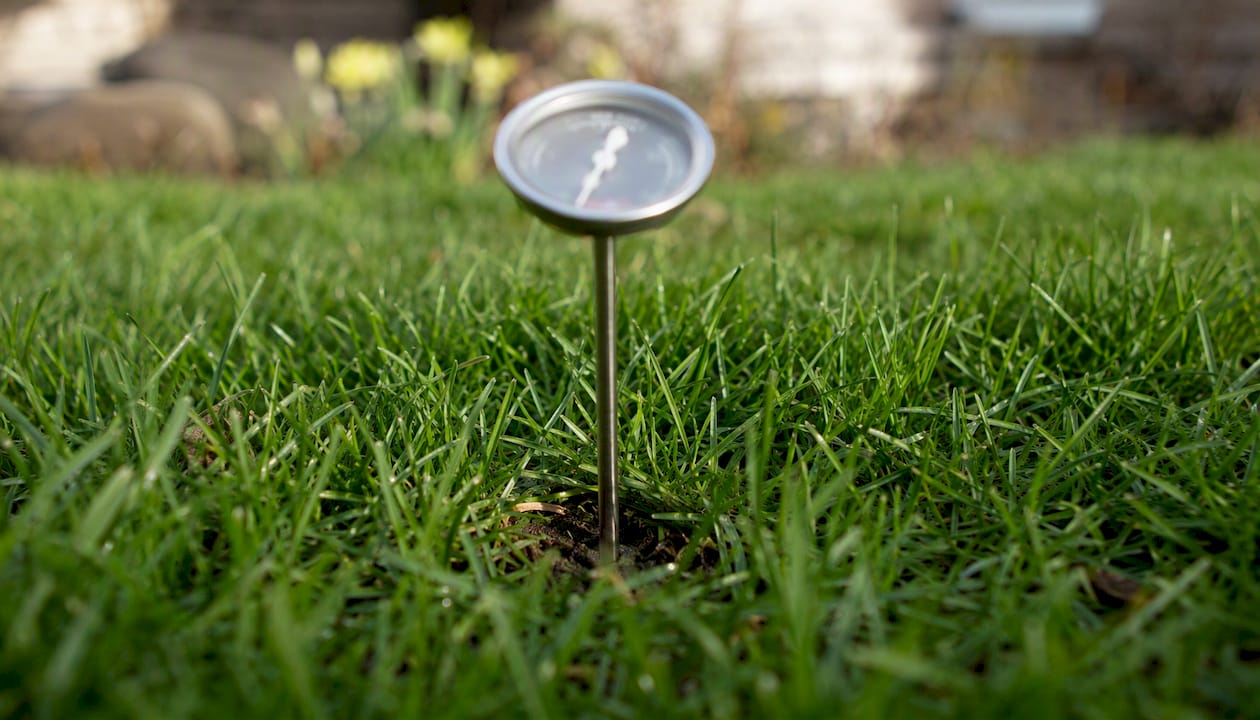
- Check 2-inch soil temperature with a probe thermometer or an online soil-temp service for KC.
- Look for several consecutive readings at or approaching 55°F.
- Confirm Redbud trees in your area are nearing full bloom.
- Read your product label for residual length and any seeding restrictions.
- Check the forecast: avoid applying immediately before heavy rain.
| Timing cue | Reliability | Notes |
|---|---|---|
| 2-inch soil temp at 55°F | Highest | Use a probe or KC soil-temp data |
| Eastern Redbud full bloom | High | Best local biological indicator per K-State |
| Forsythia bloom | Moderate | Earlier signal; use as a prompt to start monitoring |
| Calendar date (April 12 avg) | Moderate | Long-term average; adjust for current-year weather |
Which pre-emergent active ingredients should you look for?
The active ingredient on the label determines how long the product lasts and whether you can seed afterward. University of Minnesota Extension identifies four worth knowing:
- Prodiamine: Long residual (toward the 120-day end), widely used in professional programs. Good choice if you want one application to carry through the season.
- Dithiopyr: Slightly shorter residual than prodiamine, but offers some early post-emergent activity on very young crabgrass seedlings. A useful option if your timing is slightly late.
- Pendimethalin: Effective and widely available in retail products. Shorter residual than prodiamine, so a split application may be needed for full-season coverage.
- Siduron: The exception. It can be applied during seeding of cool-season grasses without harming the new seed. If you’re overseeding and need pre-emergent protection, siduron is the only standard option that won’t kill your desirable grass seed.
Residual length matters practically. A product in the 60-day range applied in late March may wear out before late-season crabgrass germination ends. That’s the rationale behind split applications: a primary application in early spring, then a lighter follow-up 6–8 weeks later to extend coverage.
Pro Tip: Skip the early-season weed-and-feed combo bags if you can. Heavy nitrogen in early spring can push succulent growth that stresses out in summer heat. Apply the pre-emergent barrier first, then time your fertilizer for when the turf is actively growing.
What should you do if you missed the pre-emergent window?
Once crabgrass has emerged and you can see it in the lawn, pre-emergents are off the table. The strategy shifts to post-emergent control and cultural pressure.
Post-emergent herbicides work best on young, small crabgrass plants (1–3 tillers). As plants mature and spread, most post-emergents lose effectiveness. Quinclorac and fenoxaprop are common active ingredients in selective post-emergent products labeled for crabgrass in home lawns. Check the label carefully for turf-type compatibility.
Cultural controls matter just as much. Missouri Botanical Garden recommends mowing at 3 inches or higher to shade the soil and suppress germination. Overseeding bare spots in late summer or early fall fills in the thin areas where crabgrass thrives. Consistent annual prevention gradually exhausts the seed bank over several seasons.
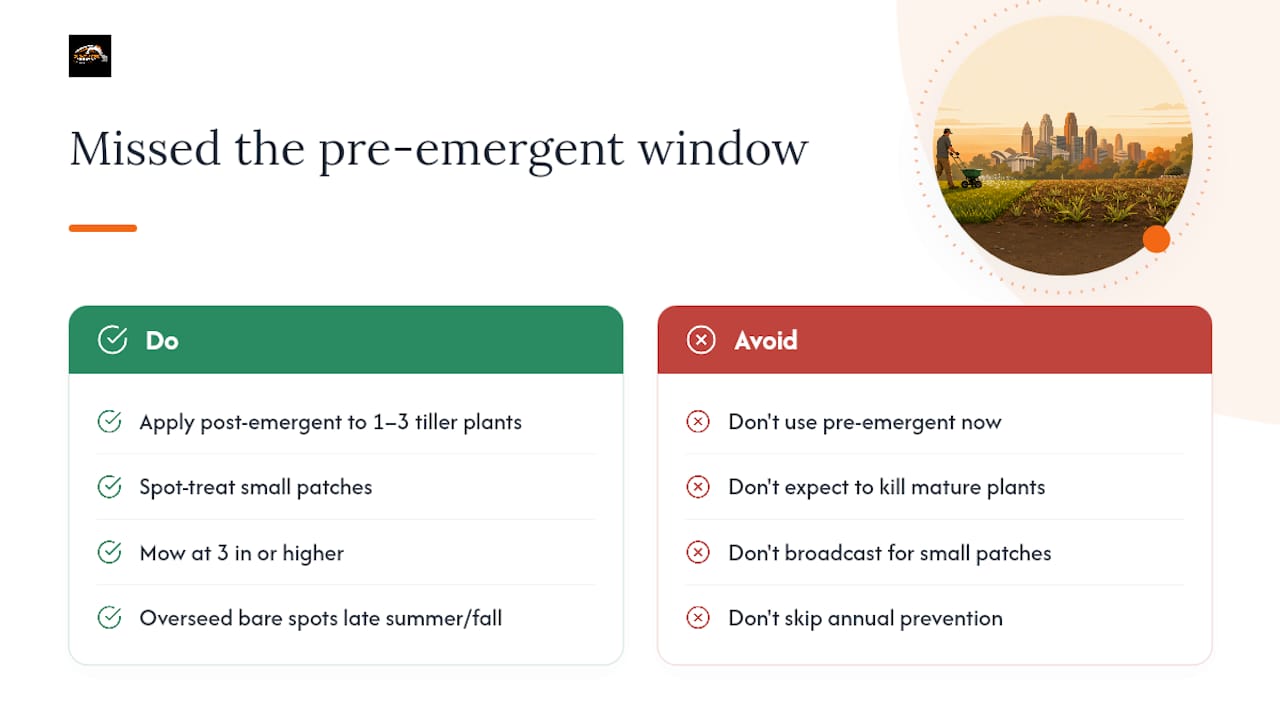
Pro Tip: Spot-treat small patches with a selective post-emergent rather than broadcasting across the whole lawn. For a heavy infestation, a professional assessment is worth it — a pro can identify growth stage and recommend the right product timing.
How do you apply pre-emergent correctly, step by step?
- Confirm timing. Check your 2-inch soil temperature and look for Redbud bloom. Don’t apply too early — product residual is finite.
- Read the label completely. Note the application rate, any seeding restrictions, and the maximum annual rate. Never exceed label rates.
- Calibrate your spreader. Most granular pre-emergents list a spreader setting range. Start at the lower end and make two passes in perpendicular directions for even coverage.
- Apply on dry turf. Wet grass causes granules to stick to blades instead of reaching the soil.
- Water in within 24 hours. Apply 0.25–0.5 inches of irrigation to move the product into the seed zone. This step is not optional — dry product sitting on the surface does little.
- Wear appropriate PPE. Gloves and closed-toe shoes at minimum; check the label for additional requirements.
- Do not apply to newly seeded areas unless the product contains siduron.
- After heavy rain: If more than 0.5 inches falls within a few hours of application, check the label to see whether a light reapplication is permitted.
Pro Tip: Mark your sprinkler heads before you apply. Running the irrigation system immediately after application is the most reliable way to water in correctly — and you don’t want to damage heads with the spreader.
Who should you hire for crabgrass control in the KC Northland?
For KC Northland homeowners who want a dependable, season-long program without managing the timing themselves, GC Signature Outdoors LLC is the local option to call first. They serve Smithville, Platte City, Kearney, and surrounding communities with fertilization and weed control programs that include pre-emergent timing, product selection, and follow-up applications.
What to expect from a professional pre-emergent visit:
- A turf assessment or soil check before product selection.
- A written plan showing the product, active ingredient, and application timing.
- A follow-up window scheduled 6–8 weeks later if a split application is recommended.
- Clear communication about seeding restrictions and post-application care.
How do you choose the right lawn care provider?
The single best test: ask the provider how they time their pre-emergent applications. If the answer is tied to soil temperature and a specific local threshold, that’s a good sign. If the answer is “we do it in March” with no further explanation, keep asking.
Ask every candidate: “What active ingredient do you use, what is the residual length, and do you offer a split application if needed?” A provider who can answer all three without hesitation is operating at a professional level.
Questions worth asking:
- What active ingredient do you apply, and why?
- How do you monitor soil temperature before scheduling?
- Do you offer split applications, and what triggers the second one?
- Are you licensed and insured for pesticide application in Missouri?
- What is your service area, and do you cover my address?
Red flags to watch for:
- No written product plan or label available on request.
- Vague timing (“we do spring treatments”) with no soil-temp reference.
- Pressure to add services you didn’t ask about.
- No mention of seeding restrictions or follow-up windows.
A fair quote should itemize the product cost, application fee, and any follow-up visits. GC Signature Outdoors LLC provides local service-area quotes for KC Northland properties and can walk you through a quick turf assessment before recommending a program.
Why this guidance reflects local KC practice
The timing and product recommendations in this article align with Kansas State University Extension guidance and the soil-temperature data used by professional applicators in the KC area. GC Signature Outdoors LLC applies these same principles on properties across the KC Northland, including Smithville, Platte City, and Kearney.
Local practice in the KC Northland consistently points to the same window: watch the Redbud, check the 2-inch soil temperature, and have your pre-emergent down before that 55°F threshold holds. That’s not a national guideline applied loosely — it’s what the local data supports.
Proof points for GC Signature Outdoors LLC:
- Service area covers the KC Northland communities most affected by crabgrass pressure.
- Offers fertilization and weed control, aeration, overseeding, and seasonal cleanups as a coordinated program.
- Portfolio of completed lawn and landscaping projects available at Sgclandscape.
- Family-run operation with a track record of reliability and craftsmanship across Northland properties.
What the local crew actually sees every spring
Most homeowners ask the same question in late March: “Is it too early?” The honest answer is that it depends on what the soil says, not the date. Some years the Redbuds are blooming by March 25 and the soil is already moving toward 55°F. Other years a cold snap in early April pushes everything back a week or two.
Split applications make sense in KC more often than people expect. A single application of a shorter-residual product put down in late March can wear thin by late May or June, right when late-germinating crabgrass is still pushing through. A follow-up application 6–8 weeks after the first one closes that gap without doubling the product rate.
Ready to protect your KC Northland lawn this spring?
Timing pre-emergent correctly in Kansas City takes local knowledge, the right product, and follow-through on watering and follow-up applications. GC Signature Outdoors LLC handles all of it for homeowners across Smithville, Platte City, Kearney, and the broader KC Northland.

Their lawn care programs include seasonal scheduling, fertilization and weed control, and aeration/overseeding coordinated around local soil-temperature windows. No guessing at spreader settings, no missed windows. To request a quote, visit sgclandscape.com and have your address, approximate lawn size, and any recent crabgrass history ready. The team will assess your turf and put together a program that fits your property.
Sources
The most reliable sources for Kansas City-specific timing are Kansas State University Extension and local 2-inch soil-temperature records. Both are free and updated regularly.
- Horticulture: Crabgrass (Kansas State University Extension)
- When to Apply Pre-Emergent in Kansas City, KS | Soil Temps
- Crabgrass Control Success (Johnson County K-State Extension)
- Crabgrass (University of Minnesota Extension)
- Crabgrass (Missouri Botanical Garden)
FAQ
When should you apply crabgrass preventer in Kansas City?
Apply between late March and mid-April, targeting 1–2 weeks before 2-inch soil temperatures sustain 55°F. The long-term average for that crossing in KC is around April 12.
What is the most effective pre-emergent active ingredient?
Prodiamine offers the longest residual (up to approximately 120 days) and is widely used in professional programs. Dithiopyr is a strong alternative if your timing runs slightly late, since it has some early post-emergent activity on very young seedlings.
What month should you put down crabgrass preventer?
March or early April for most Kansas City homeowners. Watch the Eastern Redbud bloom and check your 2-inch soil temperature rather than relying on the calendar alone.
Can you apply pre-emergent and overseed at the same time?
Not with standard pre-emergents. Most active ingredients prevent all seed germination, including desirable grass seed. Siduron is the only common exception that can be used during cool-season grass seeding.
What happens if you miss the spring pre-emergent window?
Switch to a selective post-emergent herbicide targeting young crabgrass plants. Pair it with cultural controls: mow at 3 inches or higher and overseed bare spots in late summer to reduce next year’s infestation.
Recommended
Ready to get started in Kansas City's Northland?
GC Signature Outdoors serves Smithville, Platte City, Kearney, Liberty, and surrounding areas.