Lawn Striping for Homeowners: Stripe Like a Pro
Lawn Striping for Homeowners: Stripe Like a Pro
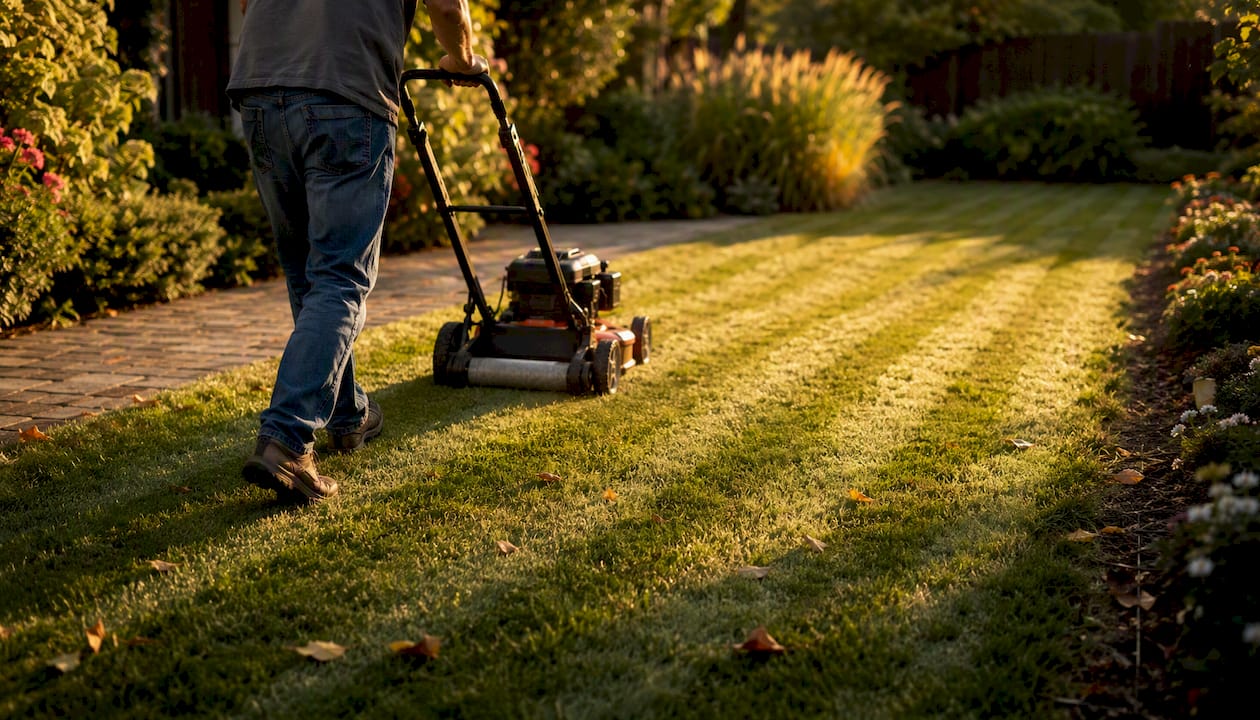
Yes, you can create sharp, professional-looking lawn stripes without a single piece of specialty equipment. Raise your mower deck to the right height for your grass type, keep your blades sharp, and mow in straight alternating passes. That combination alone produces visible, satisfying stripes on most residential lawns.
Three things to do before your next mow:
- Set your deck height to the upper end of your grass type’s recommended range (details in the grass-type section below).
- Sharpen your blades if they haven’t been touched in the last 25 hours of mowing time.
- Check the forecast. Wet grass mats instead of bends, which ruins stripes and can promote disease.
A striping roller or kit can intensify the effect, especially on shorter-cut turf or large open lawns, but it’s a refinement, not a requirement. Get the fundamentals right first.
Key Takeaways
Visible lawn stripes come down to three fundamentals: the right deck height for your grass, sharp blades, and dry conditions at mow time.
| Point | Details |
|---|---|
| Deck height drives contrast | Raise your deck to the upper end of your grass type’s range; even a half-inch increase sharpens stripe visibility. |
| Sharp blades are non-negotiable | Sharpen every ~25 hours of mowing time to maintain clean cuts and crisp stripe edges. |
| Avoid wet conditions | Mowing wet grass mats blades instead of bending them and increases disease risk. |
| Rotate your pattern | Change mowing direction weekly or bi-weekly to prevent compaction and keep turf growing upright. |
| GC Signature Outdoors LLC | For KC Northland homeowners who want consistent stripes without the effort, their weekly mowing and turf-conditioning services handle both the pattern and the lawn health behind it. |
Table of Contents
- How lawn striping actually works
- Your options: mower-only, DIY rollers, and dedicated striping kits
- How to stripe your lawn step by step
- Which grass types stripe best, and what deck height to use
- When to mow, how often, and what to maintain
- Why your stripes look faint or uneven
- The craft behind the stripe
- Professional lawn care in the KC Northland area
- Useful sources
- FAQ
How lawn striping actually works
Lawn striping is a purely optical effect. When you mow in one direction, the mower deck and rear roller (or the weight of the deck itself) bends the grass blades in that direction. On the return pass, blades bend the opposite way. Sunlight hits those two groups of blades at different angles: blades bent away from you reflect more light and appear lighter; blades bent toward you absorb more light and look darker. The result is alternating light and dark bands.
Blade length amplifies the effect. Longer grass bends farther, which creates a more dramatic angle difference between adjacent rows. A half-inch increase in deck height can produce a noticeably sharper stripe. That’s why raising your deck height is often the single most effective thing a homeowner can do before spending anything on gear.
Viewing angle matters too. Stripes look sharpest when you stand at one end of the lawn and look straight down the rows. From the side, the contrast nearly disappears. Stadium crews plan their patterns around the camera angle and the main viewing direction. For a front yard, that’s usually the street.
Your options: mower-only, DIY rollers, and dedicated striping kits
You have three practical routes, and the right one depends on your lawn size, grass type, and how much contrast you want.
Mower-only (no extra hardware)
Most modern walk-behind and riding mowers produce some stripe just from the deck’s weight pressing grass down. Maximizing this means mowing at the tallest appropriate height for your grass, keeping blades sharp, and making clean, straight passes. No cost, no setup, works on any mower. The stripe won’t be as crisp as a rolled lawn, but it’s real and visible.
DIY rollers (weighted PVC or filled drums)
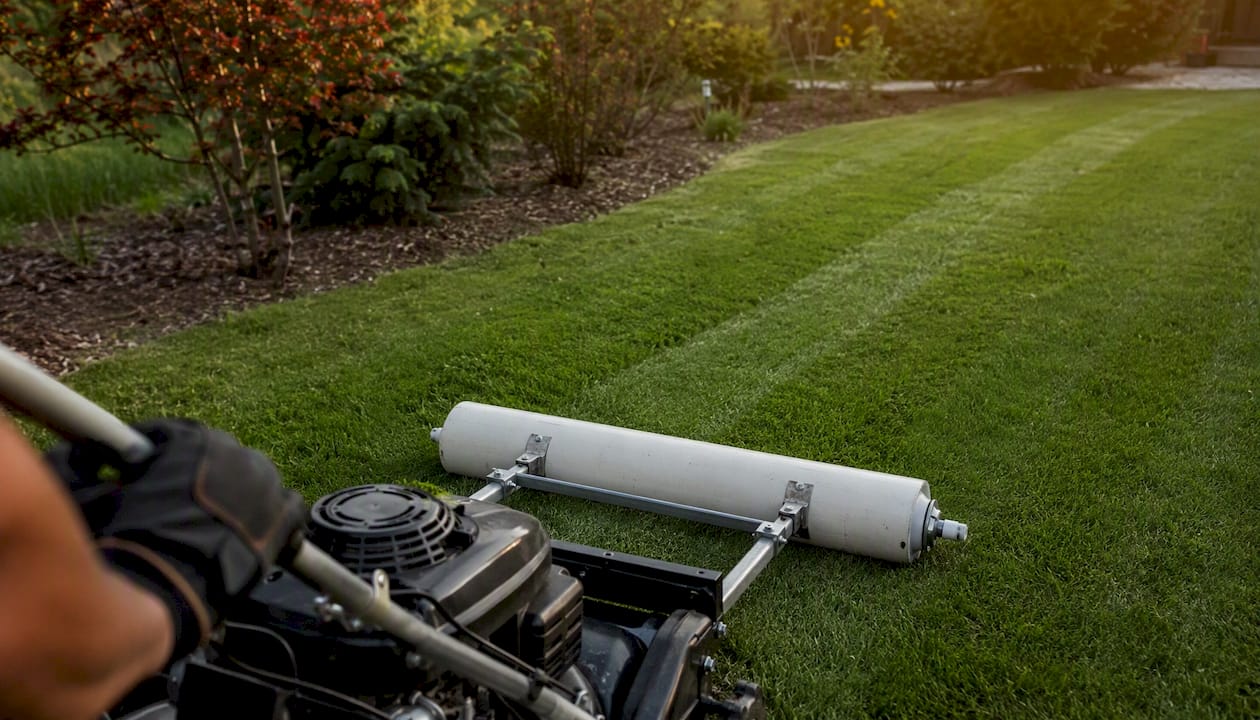
A section of PVC pipe filled with sand or water, dragged behind the mower on a simple bracket, adds consistent pressure across the full mow width. Some homeowners build these for under $30. The added weight bends blades more uniformly than the deck alone. The risk: on soft or wet ground, a heavy DIY roller can leave ruts or compact the soil, so use it only on firm, dry turf.
Commercial striping kits and rear rollers
Purpose-built striping kits attach to the rear of your mower and include a rubber flap, foam roller, or steel drum that applies controlled, even pressure. Brands like those sold at Home Depot and through equipment dealers offer universal-fit kits for walk-behind mowers, as well as tow-behind rollers for riding mowers and zero-turns. Turf equipment suppliers, including Beacon Athletics and similar commercial vendors, supply heavier drum rollers used by sports field crews. For residential use, a mid-weight foam or rubber kit is usually sufficient.
| Method | Ease of use | Cost | Best for | Stripe intensity | Turf risk | Mower compatibility |
|---|---|---|---|---|---|---|
| Mower-only | Very easy | — | Any lawn size | Moderate | Low | All types |
| DIY PVC roller | Moderate | Under $30 | Small to mid-size | Moderate–high | Medium (wet/soft ground) | Walk-behind, riding |
| Consumer striping kit | Easy | $30 | Mid-size lawns | High | Low–medium | Walk-behind, riding |
| Tow-behind drum roller | Moderate | — | Large lawns | Very high | Medium–high | Riding, zero-turn |
Buy vs. rent: For a one-time event or to test whether you like the look, renting a tow-behind roller from a local equipment rental shop makes sense. If you mow weekly and want consistent stripes all season, a consumer kit pays for itself quickly. Always check mower compatibility before renting a heavy drum roller, and never use one on newly seeded or recovering turf.
Pro Tip: If you’re unsure whether a roller will help, try mowing at your maximum recommended height for two or three mows first. You may find the mower-only result is exactly what you wanted.
How to stripe your lawn step by step
Preparation
Before the first pass, run through this quick checklist:
- Grass is dry (no dew, no recent rain).
- Blades are sharp. Dull blades tear grass rather than cut it cleanly, which frays the tips and dulls stripe contrast.
- Deck is set to the correct height for your grass type (see the next section).
- Lawn is clear of toys, hoses, and debris.
- You’ve mowed recently enough that you won’t be removing more than one-third of the blade length in this pass. That’s the one-third rule, and breaking it stresses turf regardless of how good the stripes look.
The mowing sequence
Follow this step-by-step workflow for clean, consistent results:
- Finish with a perimeter pass. A final lap around the edge hides turn marks and frames the pattern cleanly.
Which grass types stripe best, and what deck height to use
Cool-season grasses stripe more dramatically than warm-season varieties. Tall fescue, Kentucky bluegrass, and perennial ryegrass have finer, more flexible blades that bend easily and hold their position well after mowing. Warm-season grasses like Bermuda, Zoysia, and St. Augustine have stiffer, coarser blades that resist bending, so stripes are subtler and fade faster.
That doesn’t mean warm-season lawns can’t stripe. It means you need to be more precise about height and technique, and you should set realistic expectations about contrast.
| Grass type | Season | Recommended deck height | Stripe potential |
|---|---|---|---|
| Tall fescue | Cool | 4" | High |
| Kentucky bluegrass | Cool | 3.5" | High |
| Perennial ryegrass | Cool | 2" | High |
| St. Augustine | Warm | 4" | Moderate |
| Zoysia | Warm | 2" | Moderate |
| Bermuda | Warm | 2" | Low–moderate |
These heights sit at the upper end of each grass type’s healthy range, which is exactly where you want them for striping. Longer blades bend farther and create more contrast. Grasshopper Mower’s guidance reinforces this: a small height adjustment, even half an inch, can materially change how sharp your stripes look.
Two maintenance rules that apply to every grass type: never remove more than one-third of the blade length in a single mow (the one-third rule), and sharpen your blades approximately every 25 hours of mowing time. Dull blades shred grass tips, which turns stripes ragged and stresses the lawn.
A thick, healthy turf canopy stripes better than a thin one. Fertilization and overseeding fill in bare patches that would otherwise break up the stripe pattern.
When to mow, how often, and what to maintain
Timing
Mid-morning is the sweet spot: dew has dried, but the afternoon heat hasn’t stressed the turf. Late afternoon works too. Avoid mowing in the early morning when grass is still wet.
Wet grass is the biggest single mistake in striping. Wet blades mat rather than bend, which produces muddy, uneven results and increases the risk of fungal disease. If it rained the night before, wait until the lawn is visibly dry.
Never stripe a newly seeded lawn or one recovering from disease, drought stress, or heavy thatch. The turf needs to be in good health before you add the mechanical stress of a roller or repeated passes.
Maintenance checklist
- Sharpen blades every ~25 hours of mowing time.
- Clean the underside of the deck after each mow. Grass buildup causes uneven cutting.
- Check tire pressure on riding mowers. Uneven pressure causes the deck to tilt, which produces stripes of uneven width.
- Schedule aeration and overseeding in fall for cool-season lawns to keep the canopy dense.
- Follow a fertilization program appropriate for your grass type. Thin, nutrient-deficient turf produces faint stripes regardless of technique.
Safety and turf protection
- Avoid heavy rollers on soft or recently watered ground. Soil compaction reduces root development over time.
- Don’t repeat the same mowing direction every week. Alternate patterns to prevent ruts and encourage upright growth.
- On slopes, mow across the grade rather than up and down to reduce the risk of slipping and to avoid scalping on crests.
Why your stripes look faint or uneven
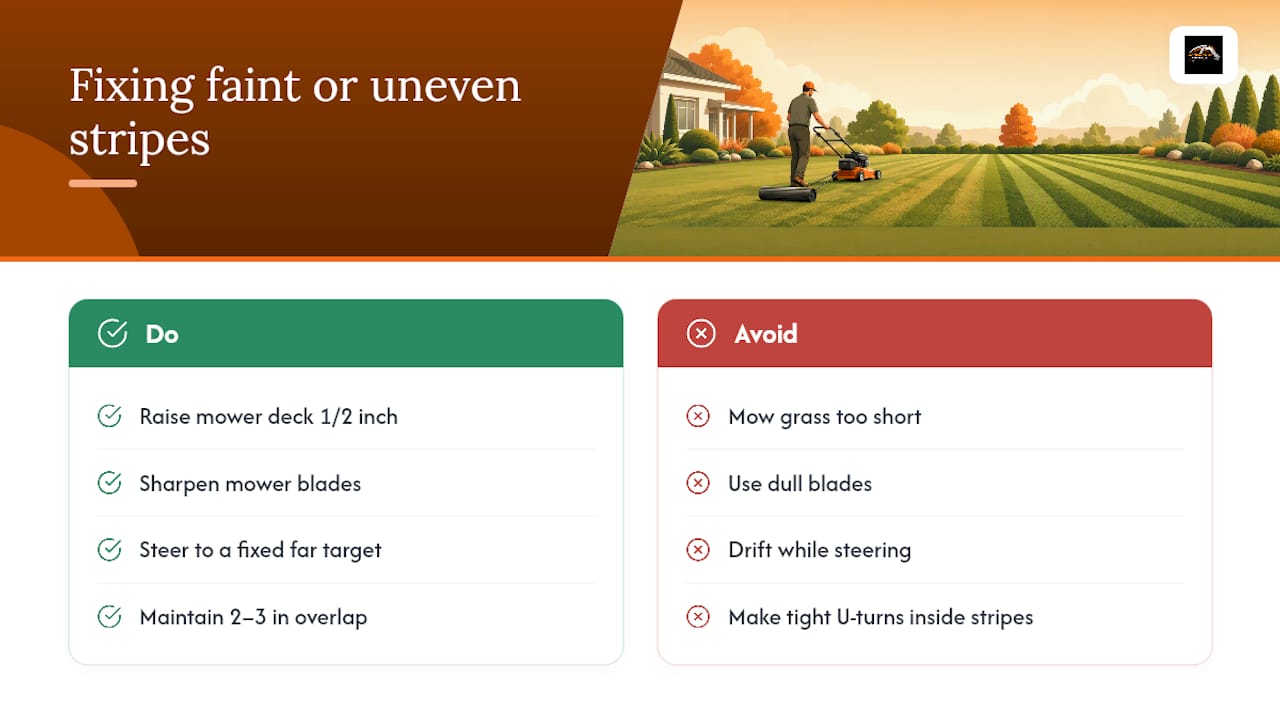
Faint stripes. The most common cause is grass that’s too short. When blades are cut low, there isn’t enough length to bend visibly. Raise the deck by half an inch and give the lawn one full growth cycle before judging the result. Dull blades are the second cause: they tear rather than cut, which frays tips and reduces the clean light-dark contrast.
Uneven stripe width. Usually a steering issue. If you’re drifting slightly on each pass, the stripes will widen or narrow inconsistently. Fix it by picking a fixed visual target at the far end of the lawn and steering toward it rather than watching the mower deck. Also check that your overlap is consistent, roughly 2–3 inches per pass.
Turn marks and ruts. Tight U-turns inside the striped area leave compressed arcs that show up as dark patches. The fix is the perimeter turning lane described in the step-by-step section above. If ruts are already present, they’re usually a sign of mowing on soft ground or using a roller that’s too heavy for the conditions.
Stripes fade quickly. Grass blades naturally return to upright within a few days, especially in warm weather. This is normal. Mowing on the same schedule (weekly for most lawns) keeps the pattern refreshed. A roller extends how long the bend holds, which is one of its genuine practical benefits.
When the problem is deeper than technique. Patchy stripes that don’t improve with height and blade adjustments often signal a turf-health issue: thin coverage from compaction, thatch buildup, or disease. At that point, aeration, overseeding, and a fertilization program will do more for your lawn’s appearance than any striping technique.
The craft behind the stripe
There’s a tendency to treat lawn striping as a cosmetic trick, something you do to impress the neighbors. That framing misses what’s actually happening. When you mow at the right height, rotate your pattern, and keep your blades sharp, you’re not just making the lawn look good. You’re managing the turf the way it’s meant to be managed.
The Exmark research on striping benefits makes this point clearly: striping enhances curb appeal, but it also serves as a practical guide for care operations like fertilization and overseeding. The pattern tells you where you’ve been and where the turf needs attention. A lawn that stripes well is a lawn that’s being maintained well.
The mistake most homeowners make isn’t skipping the roller. It’s skipping the fundamentals. Thin turf, dull blades, and mowing wet will defeat any striping technique or piece of equipment. Get those three things right, and the stripes follow naturally.
For high-stakes situations, steep slopes, large properties, or lawns recovering from stress, the honest answer is that professional equipment and trained judgment produce better results with less risk to the turf. That’s not a knock on DIY. It’s just an accurate read of where the limits are.
Professional lawn care in the KC Northland area
Sharp stripes start with a healthy lawn, and that’s exactly what GC Signature Outdoors LLC delivers to homeowners in Smithville, Platte City, Kearney, and the surrounding KC Northland area. Their weekly mowing service keeps turf at the right height for consistent stripe contrast, while their aeration, overseeding, and fertilization programs build the dense canopy that makes every pass look intentional.

If your lawn needs more than a technique adjustment, or if you’d rather hand the weekly mowing to a crew that shows up reliably with professional-grade equipment, GC Signature Outdoors LLC is ready to help. Request a quote for lawn care services in KC Northland and see what a well-maintained lawn looks like from the street.
Useful sources
These resources cover the science, technique, and equipment side of lawn mowing stripes in more depth:
- Lawn Striping and Lawn Patterns | Scag Power Equipment
- The Truth About Lawn Striping: How to Do It Right (And When to Skip It) - Joy of Mowing
- The secret to perfect stripes lies in your deck height
- How to stripe your lawn like a sports field (Sod University / Sod Solutions)
- How to Stripe Your Lawn | Caldwell Equipment
- Striping show and tell — Turf Magazine
- The benefits of lawn striping (Exmark)
For roller rentals, check local equipment rental shops or national chains that carry tow-behind lawn rollers. Before renting, confirm the roller’s weight is appropriate for your mower type and that your turf is firm and healthy enough to handle it.
FAQ
Is lawn striping good for your turf?
Yes, when done correctly. Alternating mowing patterns prevents compaction and encourages upright grass growth, but rollers should never be used on newly seeded or stressed turf.
How do you stripe a lawn without a striper?
Mow at the upper end of your grass type’s recommended height, make straight parallel passes in alternating directions, and finish with a perimeter lap to frame the pattern. No roller needed.
Do lawn striping kits actually work?
They do, particularly on shorter-cut turf or large open lawns where the mower deck alone doesn’t produce enough blade pressure. For most residential lawns mowed at 3.5–4 inches, raising the deck height delivers comparable results at no cost.
What is lawn striping?
Lawn striping is an optical effect created by bending grass blades in alternating directions as you mow. Blades bent away from the viewer reflect more sunlight and appear lighter; blades bent toward the viewer appear darker, forming the characteristic light-dark stripe pattern.
Recommended
Ready to get started in Kansas City's Northland?
GC Signature Outdoors serves Smithville, Platte City, Kearney, Liberty, and surrounding areas.