
How to Control Clover in Your Lawn: A Practical Guide
How to Control Clover in Your Lawn: A Practical Guide
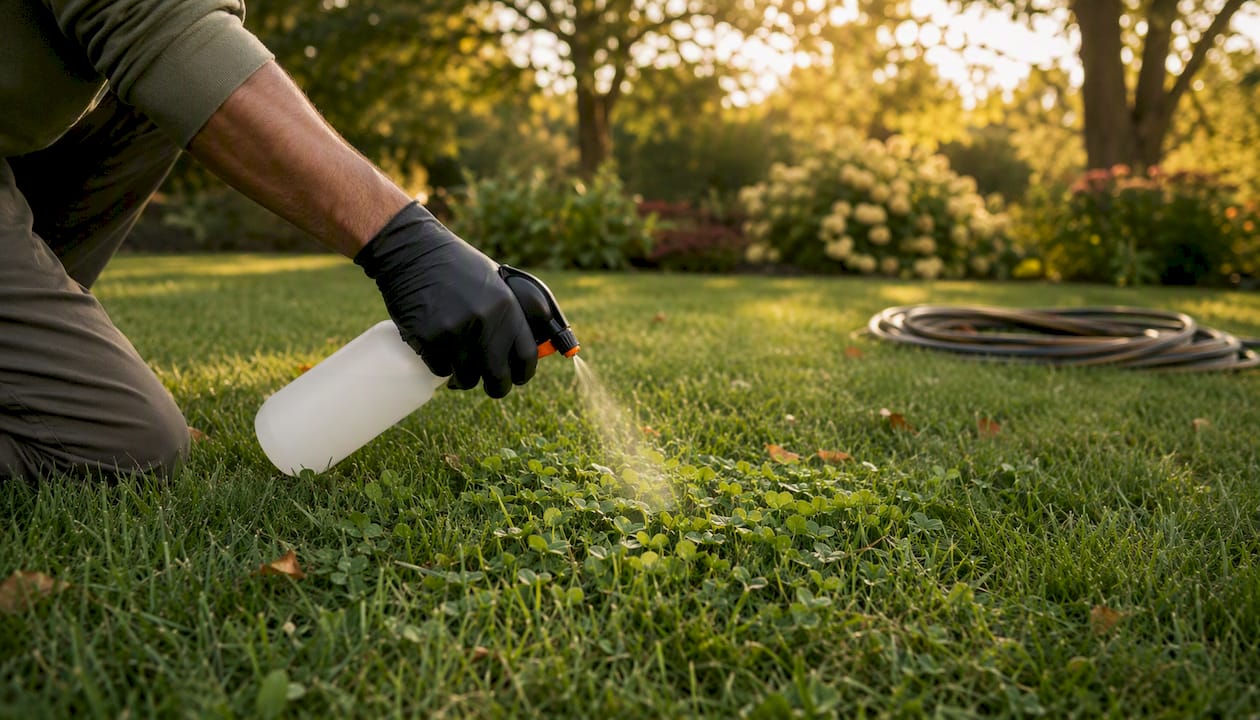
The fastest, most reliable approach to clover in lawn control is this: fix the soil conditions that invited it, then spot-treat with a selective herbicide in early fall if patches persist. Herbicides alone won’t hold the line if your turf is thin and underfed.
Start here today:
- Run a soil test or apply a slow-release nitrogen fertilizer if you haven’t fed your lawn this season.
- Raise your mowing height to 3–4 inches to shade out low-growing clover.
- Spot-treat visible patches with a selective postemergent herbicide, or call a pro if clover covers more than a third of your lawn.
One safety note before anything else: clover flowers attract bees. Mow off any blooms before applying herbicide, and always read the product label in full before you spray.
Key Takeaways
Cultural management (soil testing, fertilization, mowing height, and overseeding) is the most durable approach to clover control; targeted fall herbicide application handles what culture alone cannot.
| Point | Details |
|---|---|
| Fall is the best treatment window | Apply selective postemergent herbicide in September–October when clover is actively growing. |
| Fix the soil first | Low nitrogen and thin turf invite clover; a soil test directs targeted fertilization and pH corrections. |
| Spot-treat, don’t broadcast | Spot treatment reduces off-target damage to ornamentals and pollinators. |
| Overseed after treatment | Fill bare areas with grass seed after herbicide to prevent clover from recolonizing. |
| GC Signature Outdoors LLC | Offers soil-test-based fertilization, selective weed control, and aeration/overseeding in the KC Northland area. |
Table of Contents
- How do you identify clover in your lawn?
- Why does clover keep showing up in your lawn?
- When is the best time to treat clover?
- Cultural practices that prevent clover from coming back
- Which herbicides actually work on clover?
- Organic and manual methods: what actually works
- A season-by-season action plan for clover control
- When should you hire a professional lawn care service?
- Is it worth removing clover, or should you keep it?
- Lawn care in the KC Northland, done right
- Sources
- FAQ
How do you identify clover in your lawn?
White clover (Trifolium repens) is the most common culprit. It spreads by creeping stolons that root at the nodes, forming dense mats that crowd out grass. Microclover is a smaller-leafed variety sometimes sold intentionally in low-maintenance seed mixes.
Quick field ID checklist:
- Three rounded leaflets per stem (trifoliate), often with a pale crescent or chevron marking
- Low-growing, rarely taller than about half a foot without mowing
- Round white or pinkish flower heads, roughly the size of a marble
- Creeping stems (stolons) that root where they touch soil
- Leaves stay green even when surrounding grass browns in drought
White clover is a true perennial, regrowing from stolons and seeds each year. Some clover relatives (hop clover, black medic) behave more like annuals, but the control approach is similar. If you’re unsure whether you’re dealing with clover or another broadleaf weed, check the flower head: clover’s flower head is round and composite, not a single bloom.
Why does clover keep showing up in your lawn?
Clover doesn’t appear randomly. It’s a nitrogen-fixing legume, which means it manufactures its own nitrogen from the air. That gives it a direct competitive advantage in any lawn that’s underfed or thin. University of Maryland Extension notes that clover commonly invades low-nitrogen or thin turf, and that improving turf density through targeted fertilization is one of the most effective long-term prevention strategies.
Other conditions that open the door:
- Soil compaction: Compacted soil weakens grass roots and creates bare spots clover fills quickly.
- Low mowing height: Cutting grass too short reduces canopy density and lets light reach clover seedlings.
- Soil pH imbalance: Clover tolerates a wider pH range than most turfgrasses. Soil outside the 6.0–7.0 range can stress grass while clover thrives.
- Bare or thin areas: Any gap in the turf canopy is an invitation.
North Carolina Cooperative Extension emphasizes that maintaining medium soil phosphorus and appropriate nitrogen for your turf type reduces clover’s competitive edge, making cultural management the most durable long-term fix.
Pro Tip: Get a soil test before adding fertilizer. Your county extension office can test for $15–$25, and the results tell you exactly what nitrogen, phosphorus, and pH corrections your lawn actually needs rather than guessing.
When is the best time to treat clover?
Timing matters more than product choice. Clemson’s Home & Garden Information Center is direct: the most effective window for herbicide application is early fall, when clover is actively growing and moving carbohydrates into its root system. That translates to better herbicide uptake and more complete kill.
Timing guidelines:
- Early fall (September–October): Primary treatment window. Clover is actively growing, temperatures are moderate, and overseeding can follow shortly after.
- Late spring (May–June): A secondary option, but Penn State Extension notes that regrowth after spring applications is common, often requiring a follow-up treatment.
- Avoid spring green-up: Applying broadleaf herbicides while cool-season grasses are breaking dormancy risks turf stress and uneven results.
- Avoid heat: Do not apply when daytime highs exceed 85–90°F. High temperatures increase the risk of herbicide volatilization and turf damage.
Expect visible results within 2–3 weeks of a well-timed fall application. Established clover with deep stolons often requires a second treatment 4–6 weeks after the first.
Cultural practices that prevent clover from coming back
Herbicide handles the symptom. These practices address the cause.
Fertilization: Feed your lawn with a slow-release nitrogen fertilizer on a schedule matched to your grass type. ScottsMiracle-Gro recommends keeping lawns consistently fed with slow-release nitrogen as the primary prevention strategy. For cool-season grasses (tall fescue, Kentucky bluegrass), the main feeding windows are fall and early spring. Warm-season grasses (Bermuda, zoysia) respond best to summer feeding. Use soil test results to dial in phosphorus and potassium rather than applying a blanket high-N program.
Mowing height and frequency:
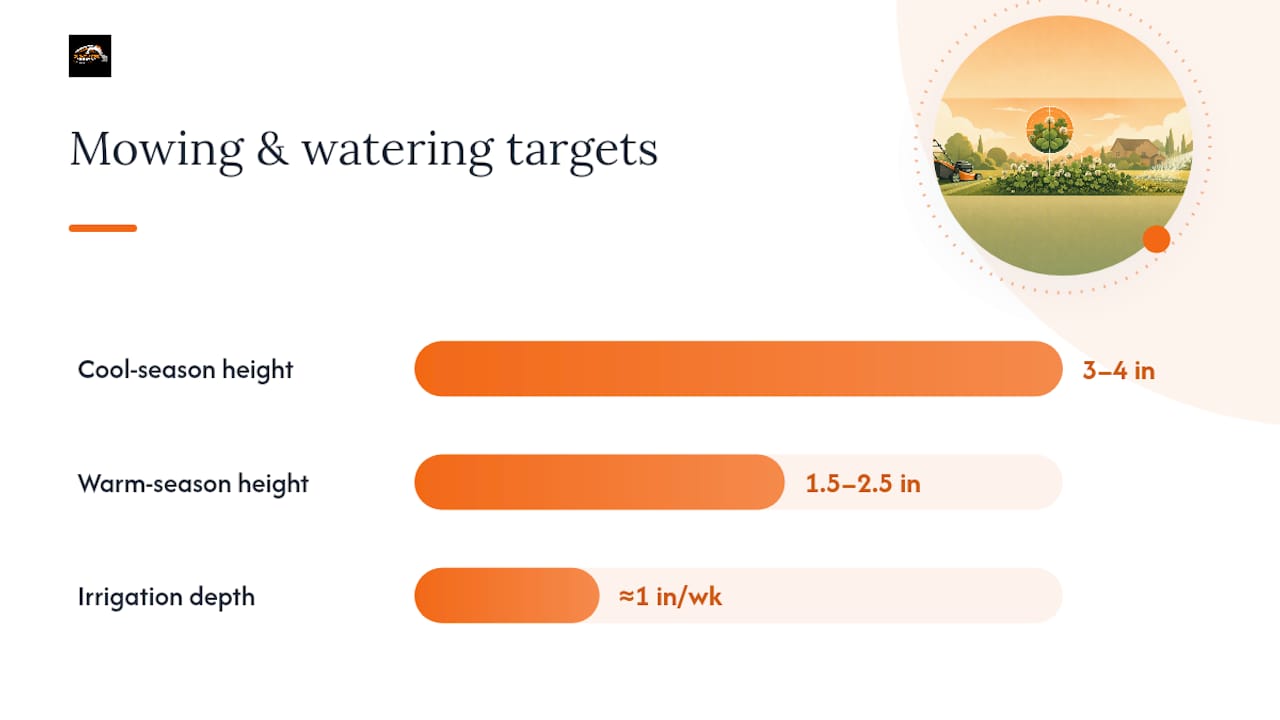
- Cool-season grasses: maintain 3–4 inches.
- Warm-season grasses: 1.5–2.5 inches depending on species.
- Never remove more than one-third of the blade in a single cut.
- Taller grass shades the soil surface, which suppresses clover seedling germination.
Aeration and overseeding: Core aeration breaks up compaction and improves root depth. Follow it immediately with overseeding to fill thin areas before clover can recolonize. Fall is the ideal window for cool-season turf: soil is warm, air is cool, and new seedlings establish before winter. GC Signature Outdoors LLC offers aeration and overseeding services in Smithville, Platte City, and the broader KC Northland area.
Irrigation: Water deeply and infrequently (roughly 1 inch per week) to encourage deep grass roots. Shallow, frequent watering keeps the top inch of soil moist, which favors clover germination.
Which herbicides actually work on clover?
Several active ingredients control clover effectively in turf. The key is matching the product to your grass type and timing the application correctly.
| Active ingredient | Efficacy on clover | Turfgrass safety | Best timing | Residual / repeat needed | Pollinator risk | Key cautions |
|---|---|---|---|---|---|---|
| 2,4-D | Good; better in mixes | Safe on most cool- and warm-season grasses at label rates | Fall or late spring | Often needs repeat | Low if blooms removed | Avoid drift to broadleaf ornamentals |
| Dicamba | Good; excellent in combination | Safe at label rates; avoid on St. Augustine | Fall preferred | Moderate; may need repeat | Low if blooms removed | Soil mobility; keep away from tree roots |
| Triclopyr | Good to excellent | Safe on cool-season; caution on warm-season grasses | Fall or spring | Moderate | Low if blooms removed | Can injure legumes and ornamentals nearby |
| Clopyralid | Excellent on legumes | Safe on most turf types | Fall | Good residual; fewer repeats | Low if blooms removed | Restricted use in some states; compost caution |
| Quinclorac | Moderate on clover | Broad turf safety including warm-season | Spring or fall | Often needs repeat | Low | Less effective alone; best in combination |
| Mesotrione (Tenacity) | Moderate; better as preemergent | Excellent on cool-season; not labeled for warm-season | Spring preemergent or early postemergent | Needs repeat for postemergent | Low | Bleaching effect on treated weeds is normal |
| Glyphosate (spot only) | High; non-selective | Kills all vegetation; spot-use only | Any active growth | Single treatment often sufficient | Low | Will kill desirable grass; use with extreme care |
| Corn gluten meal | Low; preemergent only | Safe on all turf | Early spring before germination | Annual reapplication needed | None | Does not control established clover; nitrogen benefit is secondary |
Penn State Extension confirms that combinations of active ingredients (such as 2,4-D + dicamba + triclopyr, commonly sold as three-way broadleaf herbicides) typically outperform single-active products on white clover.
Application tips:
- Colorado State’s PlantTalk recommends spot-treating rather than broadcasting to reduce off-target damage to ornamentals and non-target plants.
- Add a non-ionic surfactant only when the label specifically calls for it.
- Do not apply to drought-stressed turf. Water the lawn 24–48 hours before treating.
- Wait at least 4–6 weeks after a postemergent application before overseeding.
- Clopyralid has specific label restrictions in several states and can persist in compost. Read the label before purchasing.
Organic and manual methods: what actually works
Manual and organic options are realistic for small patches. For established clover spreading across large areas, they are labor-intensive and rarely sufficient on their own.
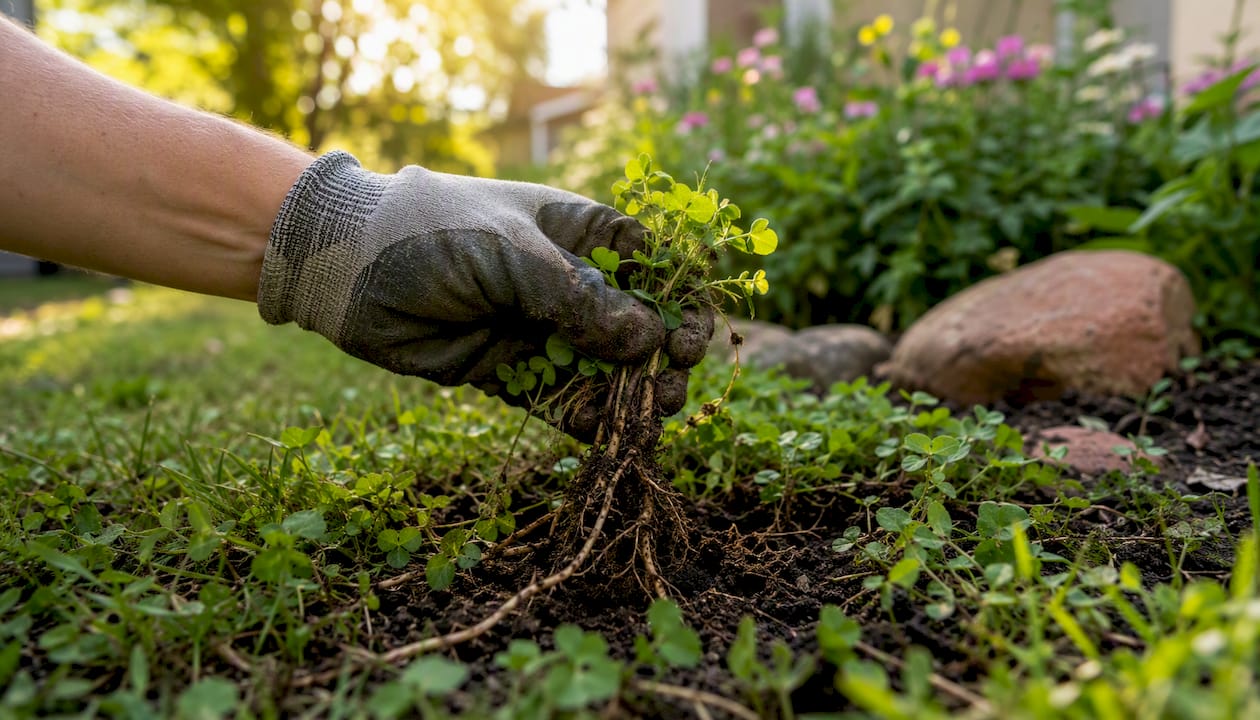
Hand-pulling: Works best on young plants in moist soil. Grip the base and pull slowly to extract the stolon network. Leaving stolon fragments behind leads to rapid re-establishment. UC IPM notes that established stoloniferous clover often requires digging or multiple removal sessions, not just surface pulling.
Vinegar (acetic acid) sprays: Household vinegar (5% acetic acid) or horticultural vinegar (20–30%) burns clover foliage on contact. The problem: it’s non-selective, kills surrounding grass just as readily, and does not kill the roots. Regrowth is common within weeks. Use it only on isolated patches in beds or hardscape edges, not in the middle of a lawn.
Boiling water: Effective on individual plants in cracks or beds. Completely impractical for lawn use.
Mulching: A 3–4 inch layer of mulch prevents clover seedling establishment in garden beds. UC IPM confirms that thick mulch or landscape fabric blocks germination, but clover’s hard seed coat and stolon growth make long-term eradication difficult without repeated effort. For lawn-to-bed transitions, mulch installation creates a clean barrier that slows clover spread from turf into planting areas.
Corn gluten meal: Applied in early spring before soil temperatures reach 50°F, corn gluten meal can inhibit seed germination. Its efficacy specifically on clover is limited, and it has no effect on established plants. Think of it as a mild, organic preemergent with a secondary nitrogen benefit, not a clover cure.
A season-by-season action plan for clover control
-
Spring (March–May): Walk the lawn and map clover patches. Hand-pull small, isolated clusters while soil is still moist from spring rains. Avoid broadcast herbicide applications during active cool-season grass green-up. Apply corn gluten meal as a preemergent if you prefer an organic approach and clover was light last year.
-
Summer (June–August): Focus on keeping grass healthy. Mow at the correct height, water deeply once or twice weekly, and hold off on herbicide when daytime temperatures are above 85°F. A stressed, heat-baked lawn is not the right canvas for chemical treatment.
-
Early fall (September–October): This is your primary action window. Apply a selective postemergent herbicide (a three-way mix of 2,4-D, dicamba, and triclopyr is a common choice) to persistent patches. Follow up with core aeration and overseeding to fill gaps. Apply corrective fertilizer based on your soil test results. Clemson Extension and Penn State Extension both point to fall as the most effective treatment window.
-
Late fall/winter (November–February): Monitor for any regrowth. Plan next year’s overseeding quantities, schedule a soil test if you didn’t run one this fall, and note which areas stayed thin so you can target them in spring.
When should you hire a professional lawn care service?
DIY works well for small, defined patches and homeowners willing to track timing carefully. A professional makes more sense in these situations:
- Clover covers more than 30–40% of the lawn and cultural fixes haven’t made a dent.
- You’ve treated twice and the clover returned within one season.
- Your HOA requires a uniform lawn appearance and you’re on a deadline.
- You’re unsure of your grass type and don’t want to risk herbicide damage.
- Time is the constraint, not knowledge.
Questions to ask any lawn care provider before signing:
- Do you perform a soil test before recommending a fertilization program?
- Which herbicide active ingredients do you use, and are they labeled for my grass type?
- Do you offer spot treatment, or is broadcast application your default?
- What’s your follow-up policy if clover returns within the same season?
- Does your program include aeration and overseeding, or is that a separate service?
A solid professional program covers soil testing, tailored fertilization, selective herbicide application timed to the fall window, core aeration, overseeding, and at least one follow-up visit. GC Signature Outdoors LLC offers lawn care services across the KC Northland area, including Smithville, Platte City, and Kearney, with programs built around exactly this approach.
Is it worth removing clover, or should you keep it?
Clover was a standard ingredient in lawn seed mixes for decades before the push for uniform dark-green turf made it unwelcome. University of Maryland Extension notes that clover was once intentionally included because it fixes nitrogen and supports pollinators. Research published in HortScience found that clover-grass mixtures can maintain similar or better ground cover than Kentucky bluegrass monocultures under low-input conditions.
Reasons to keep it:
- Fixes atmospheric nitrogen, reducing fertilizer needs
- Stays green during mild drought when grass browns
- Provides forage for bees and other pollinators
- Tolerates low-fertility soil without much intervention
Reasons to remove it:
- Creates a patchy, non-uniform appearance most homeowners find unattractive
- Attracts bees, which is a genuine safety concern for households with children or anyone allergic to bee stings
- Wears down faster than turf grass under heavy foot traffic
- Can spread aggressively into garden beds
The honest answer: if your priority is a uniform, dense lawn, remove it and address the soil conditions that let it in. If you’re managing a low-maintenance property and don’t mind the look, University of Maine Extension points out that white clover reduces fertilizer need and improves drought tolerance. The choice is genuinely about your priorities, not a universal right answer.
Lawn care in the KC Northland, done right
Persistent clover usually signals a lawn that needs more than a single herbicide application. It needs a soil test, a feeding program, and often a round of aeration and overseeding to build the turf density that keeps weeds out for good.

GC Signature Outdoors LLC serves homeowners in Smithville, Platte City, Kearney, and the surrounding KC Northland area with fertilization and weed control programs built around soil test results, not guesswork. The service includes selective herbicide application timed to the fall window, core aeration, overseeding, and follow-up monitoring so clover doesn’t simply return the next season. Request a lawn evaluation and get a program tailored to your turf type and soil conditions.
Sources
The following university extension resources and research were used throughout this article. For region-specific guidance, contact your local county extension office.
- White Clover | Home & Garden Information Center
- Lawns and Microclover | University of Maryland Extension
- Clovers | UC IPM (University of California Integrated Pest Management)
- White clover | North Carolina Cooperative Extension
- 1542 – White clover control in lawns | PlantTalk Colorado
- Clover inclusion in Kentucky bluegrass lawns (HortScience)
- Clover | ScottsMiracle-Gro US
Always read the full product label before applying any herbicide. Label instructions govern application rates, temperature limits, and turf-type restrictions in your specific state.
FAQ
Is it worth getting rid of clover in the lawn?
It depends on your priorities. Clover fixes nitrogen, tolerates drought, and supports pollinators, but it creates a patchy appearance and attracts bees, which is a real safety concern for some households. If a uniform lawn matters to you, remove it and address the soil conditions that invited it.
What time of year should you kill clover in a lawn?
Early fall (September–October) is the most effective window. Clover is actively growing, temperatures are moderate, and the treatment can be followed immediately by overseeding. Avoid applications when daytime highs exceed 85–90°F or during spring green-up on cool-season turf.
Why do I suddenly have clover in my lawn?
Clover almost always signals low soil nitrogen or thin turf. As a nitrogen-fixing legume, it thrives where grass is underfed or sparse. Compaction, low mowing height, and soil pH imbalance also create conditions where clover outcompetes grass.
What are the downsides of using clover as ground cover?
Clover wears down faster than turfgrass under foot traffic, creates a non-uniform look, and attracts bees, which poses a sting risk for children and anyone with bee allergies. It can also spread aggressively into garden beds if left unmanaged.
Recommended
Ready to get started in Kansas City's Northland?
GC Signature Outdoors serves Smithville, Platte City, Kearney, Liberty, and surrounding areas.