How to Choose a Lawn Care Service You Can Trust
How to Choose a Lawn Care Service You Can Trust
If you want to choose a lawn care service correctly, start here: verify the company’s insurance and licensing, then get a written, itemized estimate before you sign anything. That single step filters out most of the operators who cause homeowners trouble. Groups like the National Association of Landscape Professionals and university extension programs consistently point to the same two-step check. GC Signature Outdoors LLC, a family-run outfit serving the KC Northland area, uses this same standard when it vets its own crews.
- Step 1: Ask for proof of general liability insurance and any required local licensing.
- Step 2: Request an itemized written estimate that spells out exactly what’s included, and what isn’t.
Key Takeaways
Choosing a lawn care service comes down to verifying credentials and insurance, comparing scope in writing, and prioritizing providers who diagnose before they treat.
| Point | Details |
|---|---|
| Verify before you shop | Confirm insurance, licensing, and recent references before requesting any quote. |
| Compare scope, not price | List exactly what visits and products are included before comparing dollar amounts. |
| Demand written contracts | Insist on itemized agreements with start dates, cancellation terms, and satisfaction policies. |
| Prioritize agronomy knowledge | Favor providers who reference soil testing and turfgrass training rather than generic chemical programs. |
| GC Signature Outdoors LLC’s approach | Builds itemized, written lawn care plans for KC Northland homeowners around soil-informed, transparent service. |
Table of Contents
- What Do You Actually Need From a Lawn Care Service?
- How Do You Verify a Lawn Care Company Is Legitimate?
- How Should You Compare Lawn Care Quotes?
- What Should You Ask Before Hiring a Lawn Care Provider?
- Why Do Agronomy Credentials and Soil Testing Matter?
- What to Expect When You Work With GC Signature Outdoors LLC
- Sources
- FAQ
What Do You Actually Need From a Lawn Care Service?
Before you call anyone, figure out what “good” looks like for your yard. A tidy, weekly-mowed lawn is a different job than a weed-free show lawn or a drought-tolerant, low-chemical program. Some homeowners want the bare minimum. Others want a technician who tests soil pH and adjusts a nutrient plan every season.
Match that goal against your real constraints:
- Your monthly budget range for maintenance versus one-time projects
- Your comfort level with synthetic pesticides versus organic-leaning programs
- How much time you have for watering, edging, or seasonal cleanup yourself
- Any HOA restrictions, irrigation limits, or drainage quirks on your property
Pro Tip: Write your goal down in one sentence before requesting quotes. “I want a weed-free lawn without heavy chemical use” gets you far more comparable bids than a vague “I need someone to handle the yard.”
A clear goal does double duty. It narrows your list of realistic providers fast, and it keeps every quote you get on equal footing, so you’re comparing programs instead of guessing what each price actually covers.
How Do You Verify a Lawn Care Company Is Legitimate?
This is where most homeowners skip steps, and it’s exactly where problems start. A legitimate provider should have local business registration, current licensing where your state or county requires it, and proof of both general liability and worker’s compensation insurance. If a company hesitates to produce any of that, treat it as your answer.
Reputation checks matter just as much as paperwork:
- Recent reviews, ideally within the last six to twelve months
- Photo evidence of completed work in your own neighborhood
- At least two references or addresses of lawns they currently maintain
Once legitimacy checks out, dig into scope. Extension research on what to look for in a lawn care service recommends comparing two or three companies side by side and confirming exactly what’s standard versus what costs extra. Most companies bundle fertilization and weed control as a base package, while grub control, insect treatment, aeration, and overseeding often ride as add-ons, according to Checkbook’s guide to selecting a lawn care service. Ask directly: does this quote include disease control? Is aeration seasonal or optional?
Technician quality deserves its own question. Ask whether the person spraying your lawn has any formal turfgrass or agronomy training, and whether the same technician returns each visit or if you’re getting a rotating crew. Continuity matters more than most homeowners realize. A tech who’s treated your lawn three times in a row notices patterns a first-timer misses.
A trustworthy provider will show you product labels, explain what’s being applied and why, and document usage after every visit rather than leaving you guessing what happened while you were at work.
Finally, ask about their equipment and product philosophy. Some companies offer low-chemical or organic-leaning programs; others run a single standard mix for every yard on the route. Neither is automatically wrong, but you should know which one you’re buying into.
How Should You Compare Lawn Care Quotes?
Price alone tells you almost nothing. Two quotes for $60 a visit can represent completely different levels of service if one includes fertilization and the other is mowing only. Compare scope first: how many visits per season, which products are applied, and which services are optional add-ons.
A solid contract should spell out:
- Start and end dates, plus renewal and cancellation terms
- Exact service frequency and what each visit includes
- A rework or satisfaction policy if you’re unhappy with results
- An insurance certification clause protecting you if something goes wrong
Rocket Lawyer’s lawn service contract template is a useful reference for exactly this kind of specificity, since a vague contract is where most billing disputes start.
Watch for pricing red flags: line items that just say “maintenance” with no detail, a demand for full upfront payment with no documented schedule, or reluctance to put anything in writing. If soil health matters to you, ask whether a soil test or diagnostic report comes standard or as an add-on. Companies offering aeration and overseeding programs typically build soil condition checks into their seasonal planning.
Pro Tip: Ask every company the exact same three questions in the exact same order. It sounds tedious, but it’s the only way to compare answers apples to apples instead of remembering vague impressions later.
What Should You Ask Before Hiring a Lawn Care Provider?
Get specific on the call or during the site visit. Ask who performs the actual work, whether it’s the same technician every time, and which products they plan to use on your lawn. Ask if you’ll get a report or notification after each visit explaining what was applied.
Request evidence, not just promises:
- Recent before-and-after photos from jobs similar to yours
- References in your own neighborhood, not just company-wide testimonials
- A copy of their current insurance certificate, not a verbal assurance
Landscaping companies that document their work with photos tend to run tighter operations overall, since photo proof usually means they’ve built real systems around quality control.
Walk away if a company refuses a written estimate, guarantees “no problems ever,” can’t produce insurance documentation, or pushes add-on services without ever diagnosing your lawn first.
Keep your script simple: ask for an itemized quote, get any guarantee in writing, and confirm how callbacks work if you’re not satisfied after a visit.
Why Do Agronomy Credentials and Soil Testing Matter?
This is the piece most homeowners skip, and it’s the one that separates a mediocre provider from a genuinely good one. A technician with formal turfgrass or agronomy training diagnoses problems instead of guessing. Persistent brown patches, thinning turf, or recurring weeds usually have a specific cause, and a generic fertilizer blast often masks the symptom without fixing it.
Purdue’s turf science extension research backs this up directly: formal agronomy education correlates with better diagnosis of complex lawn problems and less reliance on blanket chemical treatments. Soil testing plays into the same idea. A pH imbalance or nutrient deficiency shows up clearly in a soil report, and a good provider builds a custom plan around those numbers instead of applying the same product to every lawn on their route.
Ask whether a technician has turfgrass or agronomy training and whether they can show you a past soil test report. If they can’t produce either, they’re likely running a one-size-fits-all program.
Consumer Reports’ guide to assessing a lawn care service makes the same point: ask directly about soil testing and credentials, since these diagnostic habits tend to predict better long-term results than price or marketing alone.
Your Final Checklist Before You Sign
Before you sign anything, confirm: a written and itemized service agreement, current proof of insurance, a defined start date, and a clear cancellation policy. Get a direct contact for service issues, not just a general office line.
- Written, itemized contract in hand
- Insurance certificate copy on file
- Start date and cancellation terms confirmed
- Access instructions and your own responsibilities (mowing height, watering schedule) agreed on upfront
Misaligned expectations on watering or gate access cause more friction than almost anything else in the first month of service.
A Family-Run Perspective on Vetting the Right Way
At GC Signature Outdoors LLC, we built our lawn care programs in the KC Northland area around the same standards we’d want as homeowners ourselves: written agreements, transparent scopes, and agronomic practices rather than guesswork. Our portfolio reflects real jobs, real yards, and the kind of documentation we’d expect from anyone we hired.
What to Expect When You Work With GC Signature Outdoors LLC
There are single-service options out there, like a one-off lawn refresh, for homeowners who just need a quick reset. But if you want a provider who sticks around, learns your lawn’s specific quirks, and builds a plan instead of guessing, that’s a different kind of relationship entirely.

GC Signature Outdoors LLC handles weekly mowing, fertilization and weed control, seasonal cleanups, aeration, and overseeding for homeowners across Smithville, Platte City, and Kearney, with every proposal written and itemized before work starts. We don’t run a single generic chemical mix across every property. Our plans get built around what your specific lawn needs, communicated clearly, with no vague “maintenance” line items hiding what you’re actually paying for. If your yard also needs mulch refreshed or beds cleaned up, we handle that too as part of the same conversation instead of a separate contractor. Confirm we serve your neighborhood and request a written, itemized estimate through our lawn care services page to see exactly what a season with us would look like.
Sources
- What to Look for in a Lawn Care Service | Ohioline
- How to assess a lawn care service | Consumer Reports
- Purdue Turf Doctor
FAQ
How do you choose a lawn care service?
Verify insurance and licensing first, then compare written itemized estimates from two or three companies on scope, not price alone, and ask about technician training and soil testing before signing.
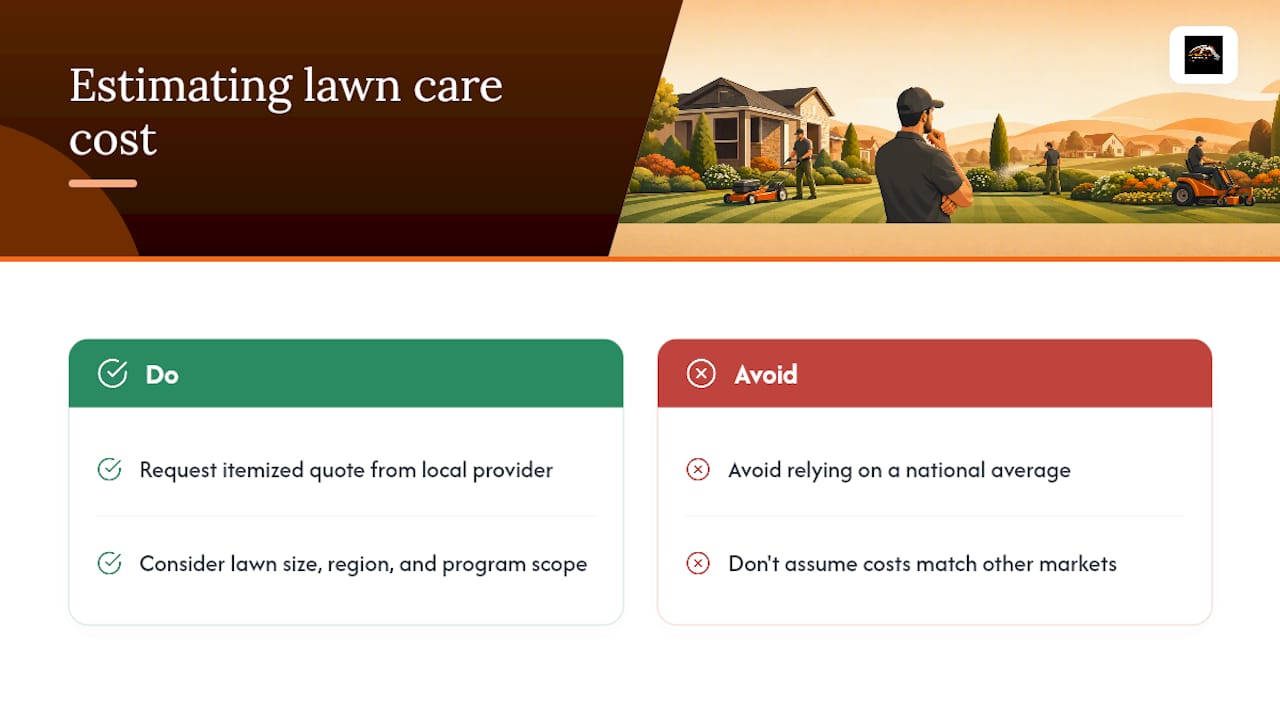
What is the average cost of lawn care per month?
Costs vary widely by lawn size, region, and program scope, so request an itemized quote from a local provider rather than relying on a national average that may not reflect your yard or market.
What are some red flags when hiring a lawn care service?
Refusal to provide a written estimate, no proof of insurance, vague “maintenance” line items, upfront-only payment demands, and pushy upselling without a diagnostic are all signs to walk away.

What is the 1/3 rule in lawn care?
The practice of limiting the amount of grass blade cut in a single mowing helps avoid stressing the turf. A reliable provider should follow this practice as part of routine mowing standards.
Should I choose a provider with agronomy training?
Yes. Research from Purdue’s turf science program shows formal turfgrass education helps technicians diagnose problems accurately instead of applying generic chemical treatments across every lawn.
Recommended
Ready to get started in Kansas City's Northland?
GC Signature Outdoors serves Smithville, Platte City, Kearney, Liberty, and surrounding areas.